

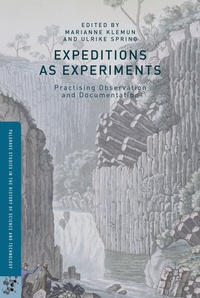
Expeditions as Experiments
Description

This collection focuses on different expeditions and their role in the process of knowledge acquisition from the eighteenth century onwards. It investigates various forms of scientific practice conducted during, after and before expeditions, and it places this discussion into the scientific context of experiments. In treating expeditions as experiments in a heuristic sense, we also propose that the expedition is a variation on the laboratory in which different practices can be conducted and where the transformation of uncertain into certain knowledge is tested. The experimental positioning of the expedition brings together an ensemble of techniques, strategies, material agents and social actors, and illuminates the steps leading from observation to facts and documentation. The chapters show the variety of scientific interests that motivated expeditions with their focus on natural history, geology, ichthyology, botany, zoology, helminthology, speleology, physical anthropology, oceanography, meteorology and magnetism.
More details
Other editions
Additional editions
Persons
Marianne Klemun is Professor of Modern History and, from 2006 to 2012, Vice Dean of the Faculty of Historical and Cultural Studies at the University of Vienna, Austria. Her publications include (as Guest Editor) 'Moved Natural Objects: Spaces in Between' in HOST - Journal of History of Science and Technology , Vol. 5 (2012).
Ulrike Spring is Associate Professor of History at the Department of Social Sciences at Sogn og Fjordane University College, Norway, and Researcher in the project 'Making Sense of the Aurora' at the Department of History and Religious Studies at UiT - The Arctic University of Norway.
