

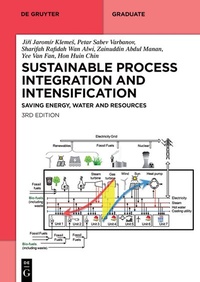
Sustainable Process Integration and Intensification
Description

This Third Edition of Sustainable Process Integration and Intensification extends the presentation of fundamentals of Energy Integration, Water Integration and CO2 management into Process Integration for waste valorisation and advanced Water Integration involving water mains and considering multiple contaminants. This edition is thoroughly updated and extended to include the latest developments and illustrated working sessions to assist readers in gaining a deeper understanding of the materials. The book is a suitable reference for graduate students as well as professionals seeking to apply Process Integration solutions in plant design and operation.
More details
Other editions
Additional editions
Previous edition
Persons
Prof Jiri Klemes has comprehensive experience in Process Integration, Computer Aided Design methods, PSE tools for environmental protection, sustainability, and greenhouse gases footprints reduction. Head of "Sustainable Process Integration Laboratory - SPIL", NETME Centre, Faculty of Mechanical Engineering, Brno University of Technology - VUT Brno, Czech Republic and Emeritus Professor at "Centre for Process Systems Engineering and Sustainability", Pázmány Péter Catholic University, Budapest, Hungary.
Dr. Petar Sabev VARBANOV, is the Deputy Head of Centre for Process Integration and Intensification CPI2 at the Research Institute of Chemical and Process Engineering, University of Pannonia, Veszprém, Hungary.
He graduated from the University of Chemical Technology and Metallurgy - Sofia, Bulgaria, worked for Bulgarian Academy of Sciences and a Bulgarian IT Company. In September 2000 he was awarded PhD scholarship in Process Integration at DPI UMIST supervised by Robin Smith. He won a Research Fellowship at Tyndall Centre for Research in Climate Change in Manchester. After graduation he was rewarded Marie Curie Intra-European Fellowship at Technische Universität Berlin, Germany running two years research with Gunter Wozny. In 2007 he won another EC Marie Curie European Reintegration Grant and joined Jirí Klemes and Ferenc Friedler in Veszprém. He is a Scientic Secretary of PRES conferences.
Assoc Prof. Dr. Sharifah Rafidah Wan Alwi, CEng, MIChemE, is the Director of Process Systems Engineering Centre (PROSPECT) of Universiti Teknologi Malaysia (UTM), Johor Bahru, Malaysia.
She graduated from UMIST, Manchester in 2003 and later completed her PhD study on Water Integration studies in 2006. Her PhD work has won the 2008 Prince Sultan Abdul Aziz International Water Award. She also won the Green Talents 2009 award from the Federal Ministry of Research Germany for her excellence in environmental research and was also among the five shortlisted candidates for IChemE Young Engineer Award 2009. She was awarded Highly Commended Sir Frederick Warner Prize 2011 from IChemE UK. Sharifah main research area is in process integration, specifically towards Pinch Analysis, where she has embarked on various resource conservation minimisation for heat, water, mass, gas, carbon and very recently power. She is also a certified Energy Manager trainer and an Energy Professional under Green Technology Malaysia (GTM). She has been extensively involved as a consultant in eleven consultancy projects for various companies and government agencies and has trained engineers from more than 50 companies in the field of energy and water minimisation.
Professor Dr. Zainuddin Abdul Manan is the Dean of the Faculty of Chemical Engineering, Universiti Teknologi Malaysia (UTM). He is the Founding Director of UTM-Process Systems Engineering Centre (PROSPECT). He holds a BSc in Chemical Engineering from the University of Houston, USA, MSc in Process Integration from the Department of Process Integration, UMIST, UK, and PhD in Chemical Engineering from the University of Edinburgh, Scotland. He was an engineer in PETRONAS and Hume Industries and has been extensively involved as a researcher, consultant and trainer for 20 years. He is a chartered professional engineer, a certified energy manager and currently the certified lead trainer for Malaysia's energy managers' accreditation under the ASEAN Energy Management Accreditation Scheme (AEMAS). Zain was the co-winner of 2008 Prince Sultan Abdul Aziz International Award for Water, and a vice-chairman of the Board of Judges for ASEAN Energy Awards program until 2011. He spearheaded the implementation of Sustainable Energy Management Program in UTM, and led UTM to win the 2012 ASEAN Energy Awards.
Content
- Intro
- Preface to the third edition
- Preface to the second edition
- Preface
- Contents
- 1 Process Integration and Intensification: an introduction
- 2 Setting energy targets and Heat Integration
- 3 Synthesis of Heat Exchanger Networks
- 4 Total Site Integration
- 5 An integrated Pinch Analysis framework for low CO⊂&2&/sub& industrial site planning
- 6 Introduction to Water Pinch Analysis
- 7 Setting the Maximum Water Recovery targets
- 8 Water network design/retrofit
- 9 Design of Cost-Effective Minimum Water Network (CEMWN)
- 10 Extension of Water Integration to Water Mains, Total Site targeting and multiple quality problems
- 11 Resources or Solid Waste Pinch Analysis
- 12 Conclusions and sources of further information
- Index
