

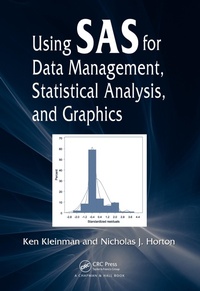
Using SAS for Data Management, Statistical Analysis, and Graphics
1st Edition
Published on 28. July 2010
305 pages
978-1-040-07968-3 (ISBN)
Description

Quick and Easy Access to Key Elements of Documentation
Includes worked examples across a wide variety of applications, tasks, and graphics
A unique companion for statistical coders, Using SAS for Data Management, Statistical Analysis, and Graphics presents an easy way to learn how to perform an analytical task in SAS, without having to navigate through the extensive, idiosyncratic, and sometimes unwieldy software documentation. Organized by short, clear descriptive entries, the book covers many common tasks, such as data management, descriptive summaries, inferential procedures, regression analysis, multivariate methods, and the creation of graphics.
Through the extensive indexing, cross-referencing, and worked examples in this text, users can directly find and implement the material they need. The text includes convenient indices organized by topic and SAS syntax. Demonstrating the SAS code in action and facilitating exploration, the authors present example analyses that employ a single data set from the HELP study. They also provide several case studies of more complex applications. Data sets and code are available for download on the book's website.
Helping to improve your analytical skills, this book lucidly summarizes the features of SAS most often used by statistical analysts. New users of SAS will find the simple approach easy to understand while more expert SAS programmers will appreciate the invaluable source of task-oriented information.
Includes worked examples across a wide variety of applications, tasks, and graphics
A unique companion for statistical coders, Using SAS for Data Management, Statistical Analysis, and Graphics presents an easy way to learn how to perform an analytical task in SAS, without having to navigate through the extensive, idiosyncratic, and sometimes unwieldy software documentation. Organized by short, clear descriptive entries, the book covers many common tasks, such as data management, descriptive summaries, inferential procedures, regression analysis, multivariate methods, and the creation of graphics.
Through the extensive indexing, cross-referencing, and worked examples in this text, users can directly find and implement the material they need. The text includes convenient indices organized by topic and SAS syntax. Demonstrating the SAS code in action and facilitating exploration, the authors present example analyses that employ a single data set from the HELP study. They also provide several case studies of more complex applications. Data sets and code are available for download on the book's website.
Helping to improve your analytical skills, this book lucidly summarizes the features of SAS most often used by statistical analysts. New users of SAS will find the simple approach easy to understand while more expert SAS programmers will appreciate the invaluable source of task-oriented information.
Reviews / Votes
This book is a well-organized reference text that summarizes and illustrates SAS code and common SAS features most often used by statistical analysts and others engaged in research and data analysis. ... a handy reference tool for common tasks performed in SAS due to the book's task-oriented nature and the broad range of topics covered. This book would also nicely serve as a supplemental reference text for an introductory SAS programming class.-Journal of Biopharmaceutical Statistics, Issue 3, 2011
More details
Edition
1. Auflage
Language
English
Place of publication
London
United Kingdom
Publishing group
Taylor & Francis Ltd
Target group
Professional and scholarly
ISBN-13
978-1-040-07968-3 (9781040079683)
Copyright in bibliographic data and cover images is held by Nielsen Book Services Limited or by the publishers or by their respective licensors: all rights reserved.
Schweitzer Classification
Other editions
Additional editions
Ken Kleinman | Nicholas J. Horton
Using SAS for Data Management, Statistical Analysis, and Graphics
Book
11/2017
1st Edition
CRC Press
€282.26
Shipment within 10-20 days
Ken Kleinman | Nicholas J. Horton
Using SAS for Data Management, Statistical Analysis, and Graphics
Book
07/2010
1st Edition
CRC Press
€108.30
Shipment within 15-20 days
Persons
Ken Kleinman is an associate professor in the Department of Population Medicine at Harvard Medical School in Boston, Massachusetts. His research deals with clustered data analysis, surveillance, and epidemiological applications in projects ranging from vaccine and bioterrorism surveillance to observational epidemiology to individual-, practice-, and community-randomized interventions.
Nicholas J. Horton is an associate professor in the Department of Mathematics and Statistics at Smith College in Northampton, Massachusetts. His research interests include longitudinal regression models and missing data methods, with applications in psychiatric epidemiology and substance abuse research.
Nicholas J. Horton is an associate professor in the Department of Mathematics and Statistics at Smith College in Northampton, Massachusetts. His research interests include longitudinal regression models and missing data methods, with applications in psychiatric epidemiology and substance abuse research.
Content
Introduction to SAS. Data Management. Common Statistical Procedures. Linear Regression and ANOVA. Regression Generalizations. Graphics. Advanced Applications. Appendix. Bibliography. Indices.
