

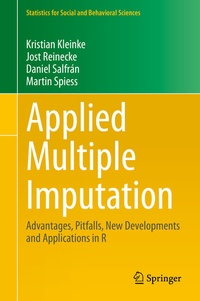
Applied Multiple Imputation
Description

Reviews / Votes
"This is an interesting book encouraging the application of the content presented." (Maria de Ridder, ISCB News, iscb.info, Issue 70, December, 2020)
More details
Other editions
Additional editions
Persons
Kristian Kleinke received his PhD from the University of Bielefeld and is currently an interim Professor of Psychological Methods and General Psychology at the University of Siegen, Germany. His primary research interests include missing data and multiple imputation. His methodological research focuses on multiple imputation solutions for complex data structures like panel data and "non-normal" missing data problems, i.e. when convenient distributional assumptions of the standard MI procedures are violated.
Jost Reinecke
is a Professor of Quantitative Methods of Empirical Social Research at the University of Bielefeld, Germany. His current methodological research focuses on growth curve and growth mixture models and the development of techniques related to multiple imputation in complex survey designs. His substantive research focuses on the development of adolescents' delinquent behavior and relationships between group-focused enmity and individual and contextual variables.
Daniel Salfrán
was a member of the Applied Mathematics Department and the Cryptography Group at the University of Havana, Cuba, where he worked on a spatial stochastic model for Dengue epidemics. He received his PhD from the University of Hamburg, Germany and is currently lecturer at the Institute for Psychology, University of Hamburg. His research focuses on robust methods to generate multiple imputations.
Martin Spiess
is a Professor of Psychological Methods and Statistics at the University of Hamburg, Germany. He studied Psychology, received his PhD in Statistics on the estimation of categorical panel models and was a Research Assistant at the German Institute for Economic Research (DIW). His current research focuses on the estimation of regression and panel data models and techniques to compensate for missing units and missing items.
Content
1 Introduction and Basic Concepts.- 2 Missing Data Mechanism and Ignorability.- 3 Missing Data Methods.- 4 Multiple Imputation: Theory.- 5 Multiple Imputation: Application.- 6 Multiple Imputation: New Developments.- A Appendices.- Index.
