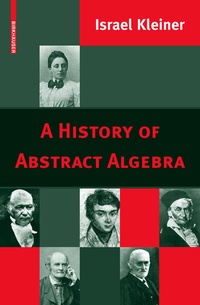
A History of Abstract Algebra
Description

Prior to the nineteenth century, algebra meant the study of the solution of polynomial equations. By the twentieth century it came to encompass the study of abstract, axiomatic systems such as groups, rings, and fields. This presentation provides an account of the history of the basic concepts, results, and theories of abstract algebra.
The development of abstract algebra was propelled by the need for new tools to address certain classical problems that appeared unsolvable by classical means. A major theme of the approach in this book is to show how abstract algebra has arisen in attempts to solve some of these classical problems, providing a context from which the reader may gain a deeper appreciation of the mathematics involved.
Mathematics instructors, algebraists, and historians of science will find the work a valuable reference. The book may also serve as a supplemental text for courses in abstract algebra or the history of mathematics.
Reviews / Votes
From the reviews:
"This concise history conveniently brings together topics in modern algebra that one might otherwise only find in scattered sources. . it reflects a deep attention to the mathematics and to how its history can be used to help understand the subject today. . The author provides an outline of his course in abstract algebra, a course that is intended for teachers of mathematics . ." (Albert C. Lewis, Mathematical Reviews, Issue 2008 g)
"This book gives an overview of the origin and development of the basic ideas of modern abstract algebra. . In each chapter, the author makes extensive references to relevant literature. The book can be recommended to mathematicians, teachers of mathematics (especially of algebra), historians of the sciences and students, who can find many useful references and ideas for their research, teaching or studies." (EMS Newsletter, September, 2008)
"This remarkable book presents both the history of algebra as well as selected detailed biographies of algebraists. . the origin of important ideas and concepts is presented very skillfully, even in a way such that the development of ideas can be used as a very good textbook for algebra. . This book combines in relatively few pages non-trivial algebra with detailed historical facts and ideas and should bring the reader a wealth of new insights." (G. Pilz, Internationle Mathematische Nachrichten, Issue 210, 2009)
More details
Other editions
Additional editions