

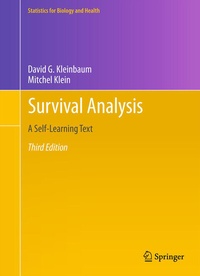
Survival Analysis
Description

This greatly expanded third edition of Survival Analysis- A Self-learning Text provides a highly readable description of state-of-the-art methods of analysis of survival/event-history data. This text is suitable for researchers and statisticians working in the medical and other life sciences as well as statisticians in academia who teach introductory and second-level courses on survival analysis.
The third edition continues to use the unique "lecture-book" format of the first two editions with one new chapter, additional sections and clarifications to several chapters, and a revised computer appendix. The Computer Appendix, with step-by-step instructions for using the computer packages STATA, SAS, and SPSS, is expanded this third edition to include the software package R.
Reviews / Votes
From the book reviews:"The authors present fundamental and basic ideas and methods of analysis of survival/event-history data from both applications and methodological points of view. . This book is clearly written and well structured for a graduate course as well as for practitioners and consulting statisticians. . There are many good examples in this edition, and more importantly, this new edition offers additional exercises, making it a good candidate for adoption as a textbook." (Technometrics, August, 2012)"This text is . an elementary introduction to survival analysis. It is primarily intended for self-study, but it has also proven useful as a basic text in a standard classroom course . . Each chapter starts with an Introduction, an Abbreviated outline, and Objectives, and ends with self tests, exercises and a detailed outline. Solutions to tests and exercises are also provided." (Göran Broström, Zentralblatt MATH, Vol. 1093 (19), 2006)"The most meaningful accolade that I can give to this text is that it admirably lives up to its title." Journal of the American Statistical Association, September 2006"Imagine---a statistics textbook that actually explains things in English instead of explaining a topic by bombarding the reader with page-width equations requiring an advanced degree in Math just to read the book. If it weren't for this book, I would be really stuck." (David Britz)More details
Other editions
Additional editions
Previous edition
Persons
David Kleinbaum is Professor of Epidemiology at the Rollins School of Public Health at Emory University, Atlanta, Georgia. Dr. Kleinbaum is internationally known for innovative textbooks and teaching on epidemiological methods, multiple linear regression, logistic regression, and survival analysis. He has provided extensive worldwide short-course training in over 150 short courses on statistical and epidemiological methods. He is also the author of ActivEpi (2002), an interactive computer-based instructional text on fundamentals of epidemiology, which has been used in a variety of educational environments including distance learning.
Mitchel Klein is Research Assistant Professor with a joint appointment in the Department of Environmental and Occupational Health (EOH) and the Department of Epidemiology, also at the Rollins School of Public Health at Emory University. Dr. Klein is also co-author with Dr. Kleinbaum of the second edition of Logistic Regression- A Self-Learning Text (2002). He has regularly taught epidemiologic methods courses at Emory to graduate students in public health and in clinical medicine. He is responsible for the epidemiologic methods training of physicians enrolled in Emory's Master of Science in Clinical Research Program, and has collaborated with Dr. Kleinbaum both nationally and internationally in teaching several short courses on various topics in epidemiologic methods.
