

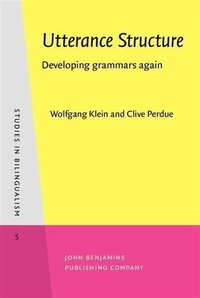
Utterance Structure
Developing grammars again
1st Edition
Published on 13. August 1992
XVI, 354 pages
978-90-272-8288-0 (ISBN)
Description

This volume presents the results of part of the ESF project 'Second language acquisition by adult immigrants'. The present study deals specifically with structure of utterances in learner varieties. The authors have attempted to find general principles which determine the form of utterances from the very beginning to relatively advanced stages. Chapter 1 and 2 provide the framework for the study and here the guiding hypotheses are sketched on the basis of a pilot analysis. The empirical part of the study is contained in Chapters 3-6, in which data are given for the acquisition of, respectively, English (by Punjabi and Italian learners), German (Italian and Turkish learners), Dutch (Turkish and Moroccon learners) and French (Moroccon and Spanish learners), thus allowing for crosslinguistic comparisons in various ways. For each data-set the learner's linguistic repertoire is established, and then the utterance patterns recurrent in his/her production and the constraints these patterns are subject to. In Chapter 7 the general and theoretical implications are discussed.
More details
Other editions
Additional editions
Book
08/1992
John Benjamins Publishing Co
€127.20
Shipment within 10-15 days
Persons
Content
- UTTERANCE STRUCTURE
- Editorial page
- Title page
- Copyright page
- Table of contents
- Preface
- Acknowledgements
- 1. Introduction
- 1.1 Aims and scope
- 1.2 "Second language acquisition by adult immigrants": The European Science Foundation project
- 1.2.1 Motivation and organisation
- 1.2.2 Design
- 1.3 Data base: The Charlie Chaplin retelling
- Notes
- 2. Framework
- 2.1 Introduction
- 2.2 The learner's problem of arranging words
- 2.3 Transfer and universal principles
- 2.4 A sample analysis: Vito
- 2.4.1 The informant
- 2.4.2 Vito's linguistic repertoire
- 2.4.3 The shipyard episode
- 2.4.4 Vito's basic patterns
- 2.4.5 Summary
- 2.5 Some guiding hypotheses
- 2.5.1 Phrasal conditions
- 2.5.2 Semantic constraints
- 2.5.3 Pragmatic factors
- 2.5.4 Summary
- Notes
- 3. The acquisition of English
- 3.1 Introduction
- 3.1.1 The informants and data
- 3.1.2 Some notes on spoken English
- 3.1.3 Some notes on Punjabi
- 3.1.4 A note on spoken Italian
- 3.2 Punjabi - English: Madan
- 3.2.1 The informant
- 3.2.2 Cycle I
- 3.2.3 Cycle II
- 3.2.4 Cycle III
- 3.3 Punjabi - English: Comparative data
- 3.3.1 Ravinder
- 3.3.2 Punjabi - English: Summary
- 3.4 Italian - English: Andrea
- 3.4.1 The informant
- 3.4.2 Cycle I
- 3.4.3 Cycle II
- 3.4.4 Cycle III
- 3.4.5 Conclusions
- 3.5 Italian - English: Comparative data
- 3.5.1 Santo
- 3.5.2 Italian - English: Summary
- 3.6 Summary of learners of English
- 3.6.1 Patterns
- 3.6.2 Referent introduction and reference maintenance
- 3.6.3 Verbal morphology and subordination
- Notes
- 4. The acquisition of German
- 4.1 Introduction
- 4.1.1 Presentationof the chapter
- 4.1.2 Word order in German
- 4.1.3 A quote on word order in Turkish
- 4.2 Italian - German: Tino
- 4.2.1 The informant
- 4.2.2 Cycle I
- 4.2.3 Cycle II
- 4.2.4 Cycle III
- 4.2.5 Short summary
- 4.3 Italian - German: Angelina
- 4.3.1 The informant
- 4.3.2 Cycle I
- 4.3.3 Cycle II
- 4.3.4 Cycle III
- 4.3.5 Summary
- 4.4 Italian - German: Comparative data
- 4.4.1 Gina
- 4.4.2 Cycle I
- 4.4.3 Changesin the second and third cycle
- 4.4.4 A note on Vito
- 4.5 Summary of Italian learners
- 4.6 Turkish - German: Çevdet
- 4.6.1 The informant
- 4.6.2 Cycle I
- 4.6.3 Cycle II
- 4.6.4 Cycle III
- 4.6.5 Summary
- 4.7 Turkish - German: Ayshe
- 4.7.1 The informant
- 4.7.2 Cycle I
- 4.7.3 Cycle II
- 4.7.4 Cycle III
- 4.7.5 Summary of Turkish informants
- 4.8 Summary of German learners
- 4.8.1 Principles
- 4.8.2 Finite and infinite utterance organisation
- 4.8.3 Semantic and pragmatic constraints
- 4.8.4 Conclusion
- Notes
- 5. The acquisition of Dutch
- 5.1 Introduction
- 5.1.1 Presentation of the chapter
- 5.1.2 Word order in Dutch
- 5.1.3 Some notes on Moroccan Arabic
- 5.2 Turkish - Dutch: Mahmut
- 5.2.1 The informant
- 5.2.2 Cycle II: First retelling
- 5.2.3 Cycle III: Second retelling
- 5.2.4 Cycle I: Personal narrative
- 5.2.5 A short summary
- 5.3 Turkish - Dutch: Ergiin
- 5.3.1 The informant
- 5.3.2 Cycle II: First retelling
- 5.3.3 Cycle III: Second retelling
- 5.3.4 Cycle I: Personal narrative
- 5.3.5 A short summary
- 5.4 Moroccan - Dutch: Fatima
- 5.4.1 The informant
- 5.4.2 Cycle II: First retelling
- 5.4.3 CycleIII: Second retelling
- 5.4.4 Cycle I: Personal narrative
- 5.4.5 A short summary
- 5.5 Moroccan - Dutch: Mohamed
- 5.5.1 The informant
- 5.5.2 Cycle II: First retelling
- 5.5.3 Cycle III: Second retelling
- 5.5.4 Cycle I: Personal narrative
- 5.5.5 A short summary
- 5.6 Summary of learners of Dutch
- 6. The acquisition of French
- 6.1 Introduction
- 6.1.1 Presentation of the chapter
- 6.1.2 Word order in spoken French
- 6.1.3 The native speaker retelling
- 6.1.4 A note on word order in spoken Spanish
- 6.2 Moroccan - French: Zahra
- 6.2.1 The informant
- 6.2.2 Cycle I
- 6.2.3 Cycle II
- 6.2.4 Cycle III
- 6.3 Moroccan - French: Comparative data
- 6.3.1 Abdelmalek
- 6.3.2 Summary and comparison with conversational data
- 6.4 Spanish - French: Paula
- 6.4.1 The informant
- 6.4.2 Cycle I
- 6.4.3 Cycle II
- 6.4.4 Cycle III
- 6.5 Spanish - French: Comparative data
- 6.5.1 Introduction
- 6.5.2 Pattern A.
- 6.5.3 Pattern B.
- 6.5.4 Pattern C.
- 6.5.5 Internal structure of NP and pattern D.
- 6.5.6 Subordination
- 6.5.7 Summary
- 6.6 Summary of learners of French
- 6.6.1 The representativity of the data
- 6.6.2 Linguistic repertoire
- 6.6.3 The acquisition of patterns
- Notes
- 7. Conclusions
- 7.1 Introduction
- 7.2 Focus last, Controller first, and the finite-nonfinite distinction
- 7.2.1 Topic-focus, quaestio, and the interrelation between text and utterance
- 7.2.2 Finite-nonfinite and the control asymmetry
- 7.3 The "basic variety" - what it looks like, how it is approached, and why development goes beyond
- 7.3.1 The basic variety
- 7.3.2 Towards the basic variety
- 7.3.3 Why go beyond the basic variety?
- 7.4 Competing constraints: development beyond the basic variety
- 7.4.1 Development of a third person pronoun system
- 7.4.2 Focalisation devices
- 7.4.3 Development of verb morphology and means for subordination
- 7.5 Possible influences of the source language
- 7.6 Uncontrolled factors
- 7.6.1 The retelling in relation to other activities
- 7.6.2 Individual variation
- 7.7 Towards a theory of the logic of acquisition
- Notes
- Glossary
- References
- Author Index
- Subject Index
