

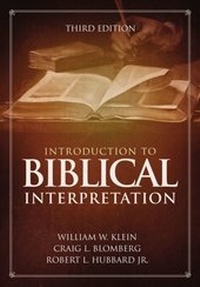
Introduction to Biblical Interpretation
Description

Introduction to Biblical Interpretation, now in its third edition, is a classic hermeneutics textbook that sets forth concise, logical, and practical guidelines for discovering the truth in God's Word.
With updates and revisions throughout that keep pace with current scholarship, this book offers students the best and most up-to-date information needed to interpret Scripture.
Introduction to Biblical Interpretation:
- Defines and describes hermeneutics, the science of biblical interpretation
- Suggests effective methods to understand the meaning of the biblical text
- Surveys the literary, cultural, social, and historical issues that impact any text
- Evaluates both traditional and modern approaches to Bible interpretation
- Examines the reader's role as an interpreter of the text and helps identify what the reader brings to the text that could distort its message
- Tackles the problem of how to apply the Bible in valid and significant ways today
- Provides an extensive and revised annotated list of books that readers will find helpful in the practice of biblical interpretation
Used in college and seminary classrooms around the world, this volume is a trusted and valuable tool for students and other readers who desire to understand and apply the Bible.
More details
Other editions
Additional editions
Persons
William W. Klein (PhD, Aberdeen) is professor of New Testament at Denver Seminary. He is author of The New Chosen People: A Corporate View of Election and a commentary on Ephesians in the Expositor's Bible Commentary: Revised Edition and serves as both editor and co-author of Introduction to Biblical Interpretationwith Craig Blomberg and Robert Hubbard. Bill and his wife have two daughters and reside in Littleton, Colorado.
X
Content
- Cover Page
- Title Page
- Copyright Page
- Dedication
- Table of Contents
- Abbreviations
- Preface to Third Edition
- Preface to Second Edition
- Introduction
- Part I: The Task of Interpretation
- Chapter 1: The Need for Interpretation
- Why Hermeneutics?
- Hermeneutics Defined
- The Art and Science of Interpretation
- The Role of the Interpreter
- The Meaning of the Message
- The Text
- The Author and the Audience
- Some Challenges of Bible Interpretation
- Distance of Time
- Cultural Distance
- Geographical Distance
- Distance of Language
- Eternal Relevance-The Divine Factor
- The Goal of Hermeneutics
- Conclusion
- Chapter 2: The History of Interpretation
- Jewish Interpretation
- Inner-Biblical Allusion
- Post-Biblical Interpretation: The Transition
- Hellenistic Judaism
- The Qumran Community
- Rabbinic Judaism
- The Apostolic Period (ca. AD 30-100)
- The Patristic Period (ca. AD 100-590)
- The Apostolic Fathers (ca. AD 100-150)
- The Alexandrian School (ca. AD 150-400)
- Church Councils (ca. AD 400-590)
- The Middle Ages (ca. AD 590-1500)
- The Reformation (ca. AD 1500-1650)
- The Post-Reformation Period (ca. AD 1650-1750)
- The Modern Period (ca. AD 1750-Present)
- The Nineteenth Century
- The Twentieth Century
- Post-World War I
- Post-World War II
- The Twenty-First Century
- Chapter 3: Literary and Social-Scientific Approaches to Interpretation
- Literary Criticism
- Narrative Criticism
- Applications
- Critique
- Poststructuralism/Postmodernism
- Reader-Response Criticism
- Deconstruction
- Social-Scientific Approaches to Scripture
- Classification
- Social History
- Application of Social-Scientific Theories
- Advocacy Groups
- Liberation Hermeneutics
- Cultural Criticism
- Feminist Hermeneutics
- LGBT Hermeneutics
- Conclusion
- Chapter 4: The Canon and Translations
- The Biblical Canon
- The Canon of the Old Testament
- The Development of the Canon
- The Order of the Canon
- The Canon of the New Testament
- The Development of the Canon
- The Order of the Canon
- Criteria of Canonicity
- Canon Criticism
- Texts and Translations
- Textual Criticism
- Techniques of Translation
- The Major English Translations
- Choosing a Translation
- Part II: The Interpreter and the Goal
- Chapter 5: The Interpreter
- Qualifications of the Interpreter
- A Reasoned Faith In the God Who Reveals
- Willingness to Obey Its Message
- Illumination of the Holy Spirit
- Membership In the Church
- Willingness to Employ Appropriate Methods
- Presuppositions for Correct Interpretation
- Presuppositions About the Nature of the Bible
- Divinely Inspired Revelation
- Authoritative and True
- A Spiritual Document
- Characterized By Both Unity and Diversity
- An Understandable Document
- Forming the Canon of Holy Scripture
- Presuppositions About Methodology
- Presuppositions About the Ultimate Goal of Hermeneutics
- Preunderstandings of the Interpreter
- Definition of Preunderstanding
- The Role of Preunderstanding
- A Philosophy of Interpretation As Preunderstanding
- Testing Preunderstandings
- A Christian Preunderstanding
- Preunderstandings Change With Understanding
- Preunderstandings and Objectivity In Interpretation
- Chapter 6: The Goal of Interpretation
- Speech Acts
- Levels of Meaning
- Does the Text Have One Fixed Meaning or Several Levels of Meaning?
- Author-Centered Textual Meaning
- Author-Centered Textual Meaning Is the Goal of Interpretation
- Definition of Author-Centered Textual Meaning
- The Challenge of Reader-Oriented Interpretation
- The Bible As Literature
- The Question of Historicity
- The Place of the Reader In "Constructing" Meaning
- Baptism
- Millennium
- Assessment
- Validating Our Interpretation
- Agree to Disagree: "That They May Be One"
- Part III: Understanding Literature
- Chapter 7: General Rules of Hermeneutics: Prose
- The Literary Context
- The Importance of Literary Context
- Context Establishes the Flow-of-Thought
- Context Provides Accurate Meaning of Words
- Context Delineates Correct Relationships Among Units: Words, Sentences, Paragraphs
- Principles of Interpretation Relating to Literary Context
- Circles of a Literary Contextual Study
- Immediate Context
- Literary Context of the Entire Bible
- Context of the Entire Bible
- Historical-Cultural Background
- The Significance of the Historical-Cultural Background
- The Issue of Perspective
- The Issue of Mindset
- The Matter of Contextualization
- Principles for Historical-Cultural Interpretation
- The Original Historical-Cultural Background
- The Original Impact
- The Correct Expression
- The Priority of the Plain Sense
- Retrieving Historical-Cultural Background
- Exploring the General Background of the Book
- Examining the Historical-Cultural Factors of a Specific Passage
- Word Meanings
- Crucial Matters About the Nature of Words
- Words Are Arbitrary Signs
- Words Have a Range of Meanings
- Word Meanings Overlap
- Word Meanings Change Over Time
- Words Have Connotative and Denotative Meanings
- Steps for Performing Word Studies
- Grammatical-Structural Relationships
- The Importance of Grammatical Relationships
- Steps for Discovering Structural Relationships
- Natural Divisions
- Flow of Thought
- Verbs
- Connectives
- Adjectives and Adverbs
- Pronouns
- Chapter 8: General Rules of Hermeneutics: Biblical Poetry
- The Dynamics of Poetry
- The Sounds of Hebrew Poetry
- Rhyme and Meter
- The Sounds of Poetic Words
- The Structure of Hebrew Poetry
- Parallelism
- Basic Units of Parallelism
- How Parallelism Works
- Types of Parallelism
- Other Poetic Structures
- The Language of Poetry
- Imagery
- Devices of Poetic Language
- Similes and Metaphors
- Other Poetic Devices
- Interpreting Poetic Language
- Larger Units of Poetry
- Sense Units
- Part IV: Understanding Bible Genres
- Chapter 9: Genres of the Old Testament
- The Nature of Genre
- Narratives
- Old Testament Narrative Genres
- Reports
- Principles of Interpretation-Reports
- Heroic Narrative
- Prophet Story
- Principles of Interpretation-Heroic Narratives and Prophet Stories
- Comedy
- Principles of Interpretation-Comedy
- Farewell Speech
- Principles of Interpretation-Farewell Speech
- Interpreting a Sample Narrative: Judges 7:1-15
- Embedded Genres
- Popular Proverbs and Blessings
- Riddles, Fables, and Parables
- Songs
- Lists
- Principles of Interpretation-Embedded Genres
- Law
- Forms of Old Testament Legal Material
- Casuistic Law
- Unconditional Law
- Legal Series
- Legal Instruction
- Principles of Interpretation-Law
- A Sample Legal Text: Exodus 21:7-11
- Deuteronomy
- Principles of Interpretation-Deuteronomy
- Poetry
- Types of Old Testament Poetry
- Prayers
- Songs
- Liturgies
- Wisdom Psalms
- Principles of Interpretation-Poetry
- Principles of Interpretation-Psalms
- The Books of the Psalms: An Overview
- Prophecy
- Basic Types of Prophecy
- Prophecy of Disaster
- Prophecy of Salvation
- Woe Speech
- Prophetic Dirge
- Prophetic Hymn
- Prophetic Liturgy
- Prophetic Disputation
- Prophecies Against Foreign Nations
- Prophetic Vision Report
- Prophetic Narratives
- General Principles for Interpreting Old Testament Prophecy
- Interpreting Prophetic "Forthtelling"
- Interpreting Prophetic "Foretelling"
- The Many Ways of Fulfillment
- Specific Principles for Interpretation-Prophecy
- A Sample Prophetic Text: Isaiah 5:1-7
- Apocalyptic Prophecy
- Principles of Interpretation-Old Testament Apocalyptic
- Wisdom
- Types of Wisdom Literature
- Proverbs
- Principles of Interpretation-Proverbs
- Instruction
- Principles of Interpretation-Instruction
- Example Story and Reflection
- Principles of Interpretation-Example Story and Reflection
- Disputation Speeches
- Principles of Interpretation-Job
- A Sample Wisdom Text: Proverbs 30:24-28
- Conclusion
- How to Write a Structural Outline
- Chapter 10: Genres of the New Testament
- Gospels
- Implications for Interpretation
- Historical Trustworthiness
- Reading Horizontally and Vertically
- The Gospels' First Audiences
- Key Theological Issues
- The Kingdom of God
- The Ethics of Jesus
- The Forms Within the Gospels
- Parables
- Miracle Stories
- Pronouncement Stories
- Other Forms
- Acts
- Implications for Interpretation
- Thinking Vertically
- The Significance of Pentecost
- Acts As Narrative
- Epistles
- Implications for Interpretation
- General Considerations
- Specific Considerations
- Distinctives of Hebrews and the General Epistles
- Individual Forms In the Epistles
- Creeds and Hymns
- The Domestic Code
- Slogans
- Vice and Virtue Lists
- Key Theological Questions for the Pauline Epistles
- Is There a Center of Pauline Theology?
- Is There Development In Paul's Writings?
- Revelation
- Revelation As an Epistle
- Revelation As Prophecy
- Revelation As Apocalyptic
- Conclusion
- Part V: The Fruits of Interpretation
- Chapter 11: Using the Bible Today
- To Gain Information and Understanding
- To Motivate and Enrich Worship
- To Create Liturgy
- To Formulate Theology
- How Biblical and Systematic Theology Differ
- The Problem of Preunderstanding
- Must We Choose Between Biblical and Systematic Theology?
- How to Formulate Theology: Key Principles
- What About Church Tradition?
- To Preach
- To Teach
- To Provide Pastoral Care
- To Promote Spiritual Formation In the Christian Life
- To Enjoy Its Beauty As Literature
- Summary
- Chapter 12: Application
- The Importance of Application
- Avoiding Mistakes In Application
- Total Neglect of Any Context
- Partial Neglect of the Literary or Historical Context of a Passage
- Insufficiently Analogous Situations
- A Four-Step Methodology for Legitimate Application
- Determine the Original Application(s)
- Evaluate the Level of Specificity of the Original Application(s)
- Identify the Cross-Cultural Principles
- Levels of Authority
- Find Appropriate Applications That Embody the Broader Principles
- The Role of the Holy Spirit
- Annotated Bibliography-Hermeneutical Tools
- Indexes
- Scripture Index
- Extra Biblical Literature Index
- Subject Index
- Author Index
