

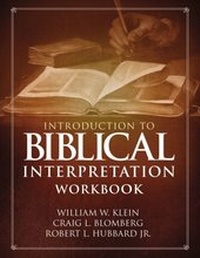
Introduction to Biblical Interpretation Workbook
Description

This workbook accompanies the third edition of Introduction to Biblical Interpretation by William W. Klein, Craig L. Blomberg, and Robert L. Hubbard Jr. Following the textbook's structure, it offers readings, activities, and exercises designed to teach students how to understand and apply the Bible.
This workbook gives students a chance to get hands-on experience in interpreting biblical texts as they are guided along by insightful questions and pointers from the authors. Ultimately the workbook is designed to get students interacting with the content of the textbook and with the biblical text in a way that helps reinforce classroom learning, while at the same time giving both student and instructor a way to gauge how well the student is learning the material from the textbook.
The third edition of a classic hermeneutics textbook sets forth concise, logical, and practical guidelines for discovering the truth in God's Word. A valuable tool for readers who desire to understand and apply the Bible, this text:
- Defines and describes hermeneutics, the science of biblical interpretation
- Suggests effective methods to understand the meaning of the biblical text
- Surveys the literary, cultural, social, and historical issues that impact any text
- Evaluates both traditional and modern approaches to Bible interpretation
- Examines the reader's role as an interpreter of the text and helps identify what the reader brings to the text that could distort its message
- Tackles the problem of how to apply the Bible in valid and significant ways today
- Provides an extensive and revised annotated list of books that readers will find helpful in the practice of biblical interpretation
More details
Other editions
Additional editions
Persons
William W. Klein (PhD, Aberdeen) is professor of New Testament at Denver Seminary. He is author of The New Chosen People: A Corporate View of Election and a commentary on Ephesians in the Expositor's Bible Commentary: Revised Edition and serves as both editor and co-author of Introduction to Biblical Interpretationwith Craig Blomberg and Robert Hubbard. Bill and his wife have two daughters and reside in Littleton, Colorado.
X
Content
- Cover Page
- Title Page
- Copyright Page
- Table of Contents
- Introduction
- Part I: The Task of Interpretation
- Chapter 1: The Need for Interpretation
- Lesson 1.1a: Observation Exercise: The Student, the Fish, and Agassiz
- Philippians 2:16-17
- Lesson 1.1b: Observation Exercise: Mark 7:1-4
- Lesson 1.1c: Observation Exercise: 1 Kings 17:1-4
- Lesson 1.1d: Observation Exercise: Amos 5:20-24
- Lesson 1.2: Study Questions
- Lesson 1.3: Exercise: Bridging the Gaps
- Chapter 2: The History of Interpretation
- Lesson 2.1: Study Questions
- Chapter 3: Literary and Social-Scientific Approaches to Interpretation
- Literary Criticism
- Lesson 3.1a: Study Questions
- Lesson 3.1b: Exercise: Narrative Study of 2 Samuel 12:1-4
- Social-Scientific Approaches to Scripture
- Lesson 3.2: Study Questions
- Lesson 3.3: Exercise: Social History
- Lesson 3.4: Exercise: Experience-Shaping Factors
- Chapter 4: The Canon and Translations
- The Biblical Canon
- Lesson 4.1: Study Questions
- Part II: The Interpreter and the Goal
- Chapter 5: The Interpreter
- Lesson 5.1: Study Questions
- Chapter 6: The Goal of Interpretation
- Lesson 6.1: Study Questions
- Lesson 6.2: Exercise: Levels of Meaning
- Part III: Understanding Literature
- Chapter 7: General Rules of Hermeneutics: Prose
- Literary Context
- Lesson 7.1: Study Questions
- Lesson 7.2: Lab Report: Literary Context
- Historical-Cultural Background
- Lesson 7.3: Study Questions
- Lesson 7.4: Lab Report: Historical-Cultural Background
- Word Meanings
- Lesson 7.5: Study Questions
- Lesson 7.6: Lab Report: Word Studies
- Grammatical-Structural Relationships
- Lesson 7.7: Study Questions
- Lesson 7.8: Lab Report: Grammar
- Chapter 8: General Rules of Hermeneutics: Biblical Poetry
- The Dynamics of Poetry
- Lesson 8.1: Study Questions
- The Structure of Hebrew Poetry
- Lesson 8.2: Study Questions
- Parallelism
- Lesson 8.3: Lab Report: Poetic Parallelism
- The Language of Poetry
- Lesson 8.4: Lab Report: Figures of Speech
- Part IV: Understanding Bible Genres
- Chapter 9: Genres of the Old Testament
- The Nature of Genre
- Lesson 9.1: Study Questions
- Narratives
- Lesson 9.2a: Lab Report: Old Testament Narrative-Ruth
- Lesson 9.2b: Lab Report: Old Testament Narrative-Esther
- Law
- Lesson 9.3: Study Questions
- Lesson 9.4: Exercise
- Poetry
- Lesson 9.5: Study Questions
- Lesson 9.6: Lab Report: Poetry
- Prophecy
- Lesson 9.7: Study Questions
- Lesson 9.8: Lab Report: Old Testament Prophecy-Jonah
- Lesson 9.9: Lab Report: Old Testament Prophecy-Micah
- Wisdom
- Lesson 9.10: Study Questions
- Lesson 9.11a: Lab Report: Old Testament Wisdom Literature-Proverbs 19:12
- Lesson 9.11b: Lab Report: Old Testament Wisdom Literature-Proverbs 19:13
- Lesson 9.11c: Lab Report: Old Testament Wisdom Literature-Proverbs 19:14
- Lesson 9.11d: Lab Report: Old Testament Wisdom Literature-Proverbs 19:15
- How to Write a Structural Outline
- Lesson 9.12: Exercise: Write a Structural Outline
- Chapter 10: Genres of the New Testament
- Gospels
- Lesson 10.1: Study Questions
- Lesson 10.2a: Lab Report: Parable-Luke 15:11-32
- Lesson 10.2b: Lab Report: Parable-Luke 18:1-8
- Acts
- Lesson 10.3: Study Questions
- Lesson 10.4a: Lab Report: Narrative Study-Acts 5:12-41
- Lesson 10.4b: Lab Report: Narrative Study-Samaria/Samaritans
- Lesson 10.4c: Lab Report: Narrative Study-Character Development
- Epistles
- Lesson 10.5: Study Questions
- Revelation
- Lesson 10.6: Study Questions
- Lesson 10.7: Lab Report: Epistle
- Lesson 10.8: Lab Report: Apocalypse
- Part V: The Fruits of Interpretation
- Chapter 11: Using the Bible Today
- Lesson 11.1a: Study Questions: Part I
- Lesson 11.1b: Study Questions: Part II
- Lesson 11.2: Lab Report: Biblical Theology
- Lesson 11.3: Exercise: Using the Bible Today
- Chapter 12: Application
- Lesson 12.1: Study Questions
- Lesson 12.2: Lab Report: Application
- Chapter 13: Putting It All Together
- Lesson 13.1: Inductive Bible Study: Ephesians 5:6-14
- Lesson 13.2: Bible Analysis Paper: Hebrews 12:1-13
- Lesson 13.3: Bible Analysis Paper: Deuteronomy 8:1-20
