

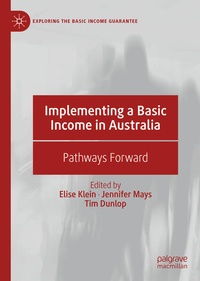
Implementing a Basic Income in Australia
Description

This book brings together scholars from the fields of politics, philosophy, sociology, anthropology and economics, to explore pathways towards implementing a Basic Income in Australia. It is the first book of its kind to outline avenues for implementation of a basic income specifically for Australia and responds to a gap in the existing basic income literature and published titles to provide a distinct standpoint in the exploration of basic income within the Australian contemporary policy landscape. The first section of the book outlines some of the continuing substantive and philosophical issues regarding BI implementation. In the second section of the book, authors offer practical strategies and models for progressing BI in Australia.
More details
Other editions
Additional editions
Persons
Elise Klein is a Senior Lecturer of Development Studies at the University of Melbourne. Dr Klein has research projects spanning conditionality in Indigenous policy, psy-expertise in development interventions, women's economic empowerment and economic rights. She is a life member of the Basic Income Earth Network and has written extensively on issues of Basic Income and economic security. She has advised the UN High Level Panel on Women's Economic Development and has worked on the Human Rights Committee within the United Nations General Assembly.
Jennifer Mays is an academic in the School of Public Health and Social Work, Queensland University of Technology. She is recognized as an international expert on basic income and has a long history in researching, writing and advocating on basic income. She is involved in international research collaborations and symposiums around basic income to progress policy debates on the scheme. She has been committed researching in areas of basic income, poverty, social policy, social justice, disability and social citizenship. She is Co-Coordinator of Basic Income Guarantee Australia (BIGA).
Tim Dunlop is a writer, author and academic. He teaches new media at the Centre for Advancing Journalism at the University of Melbourne, Australia. He has been involved in a number of new media startups, and has a background in business. He has been a columnist for the Australian Broadcasting Corporation (ABC), as well for News Ltd. He writes on the future of work for The Guardian and speaks regularly in public and professional forums on the same topic. His latest books include Why The Future Is Workless and The Future of Everything: Democracy, Technology and a Life In Common .
