

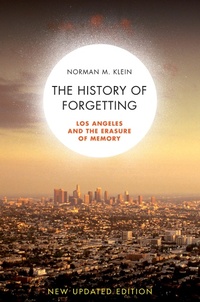
The History of Forgetting
Los Angeles and the Erasure of Memory
Published on 5. May 2020
342 pages
978-1-78960-413-9 (ISBN)
Description

Los Angeles is a city which has long thrived on the continual re-creation of own myth. In this extraordinary and original work, Norman Klein examines the process of memory erasure in LA. Using a provocative mixture of fact and fiction, the book takes us on an 'anti-tour' of downtown LA, examines life for Vietnamese immigrants in the City of Dreams, imagines Walter Benjamin as a Los Angeleno, and finally looks at the way information technology has recreated the city, turning cyberspace into the last suburb.
In this new edition, Norman Klein examines new models for erasure in LA. He explores the evolution of the Latino majority, how the Pacific economy is changing the structure of urban life, the impact of collapsing infrastructure in the city, and the restructuring of those very districts that had been 'forgotten'.
In this new edition, Norman Klein examines new models for erasure in LA. He explores the evolution of the Latino majority, how the Pacific economy is changing the structure of urban life, the impact of collapsing infrastructure in the city, and the restructuring of those very districts that had been 'forgotten'.
More details
Edition
Ebook UK & RoW
Language
English
Place of publication
London
United Kingdom
Target group
College/higher education
Professional and scholarly
Product notice
Reflowable
ISBN-13
978-1-78960-413-9 (9781789604139)
Copyright in bibliographic data and cover images is held by Nielsen Book Services Limited or by the publishers or by their respective licensors: all rights reserved.
Schweitzer Classification
Other editions
Additional editions
Book
08/2008
2nd Edition
Verso Books
€33.00
Shipment within 3-4 weeks
Person
Norman M. Klein is a critic and historian of mass culture, editor of Fragile Moments: A History of Media-Induced Experience, and author of Seven Minutes: The Life and Death of the American Animated Cartoon from Verso. He teaches at the California Institute of the Arts in Los Angeles.
Content
- Cover Page
- Halftitle Page
- Title Page
- Copyright Page
- Contents
- Preface to the 2008 Edition
- Introduction: Histories of Forgetting
- Part I: Building the Social Imaginary: 1885-1997
- Chapter One: Booster Myths, Urban Erasure
- Chapter Two: L. A. Noir and Forgetting
- Chapter Three: Building Blade Runner
- Chapter Four: Movie Locations
- Unsprung
- Falling Down: When East L.A. Conquered the Pacific
- City of Lights
- Chapter Five: The Panic: Imagined Fears after April 1992
- Chapter Six: Two Neighborhoods
- Part II: Imaginary Vietnamese in Los Angeles
- Chapter Seven: Stories in an English I Don't Speak: A Novel
- Part III: Docufables
- Chapter Eight: Witnesses after the Fact
- Chapter Nine: Fictions
- Asi es la Vida
- The Phoenix Tree
- The Unreliable Narrator
- Noir as the Ruins of the Left
- Part IV: Forgetting on the Screen
- Chapter Ten: The Most Photographed and Least Remembered City in the World
- Chapter Eleven: The Imaginary LAPD
- Part V: Conclusion
- Chapter Twelve: Suburban Noir and Cyberspace
- Appendix: Where is Forgetting Located?
- Afterword: Borges' Father
- Epilogue: The Future of Forgetting until 2050
- Notes
- Index
