
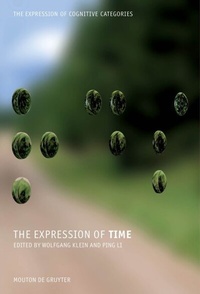
The Expression of Time
Description
Alles über E-Books | Antworten auf Fragen rund um E-Books, Kopierschutz und Dateiformate finden Sie in unserem Info- & Hilfebereich.
Time is the most fundamental category of human cognition and action, and all human languages have developed many devices to express it. These include verbal categories, such as tense and aspect, but also adverbials, particles, and principles of discourse organisation. This book is intended as a tutorial for the study of how time is expressed in natural languages. Its chapters take the reader through a number of foundational issues, such as the various notions of time and the various means to express it; other chapters are devoted to more specific questions, such as the acquisition of time, its modelling in formal semantics and in computational linguistics, or how its expression can be empirically investigated.
More details
Other editions
Additional editions
Persons
Content
- Frontmatter
- Contents
- Introduction
- Concepts of time
- How time is encoded
- Temporal anaphora in a tenseless language
- Tenses in compositional semantics
- Temporality in first and second language acquisition
- New perspectives in analyzing aspectual distinctions across languages
- Verb aspect and the mental representation of situations
- Computational modeling of the expression of time
- Backmatter

System requirements
File format: PDF
Copy protection: Watermark-DRM (Digital Rights Management)
System requirements:
- Computer (Windows; MacOS X; Linux): Use the free software Adobe Reader, Adobe Digital Editions, or any other PDF viewer of your choice (see eBook Help).
- Tablet/Smartphone (Android; iOS): Install the free app Adobe Digital Editions or another reading app for eBooks, e.g., PocketBook (see eBook Help).
- E-reader: Bookeen, Kobo, Pocketbook, Sony, Tolino and many more (only limited: Kindle).
The file format PDF always displays a book page identically on any hardware. This makes PDF suitable for complex layouts such as those used in textbooks and reference books (images, tables, columns, footnotes). Unfortunately, on the small screens of e-readers or smartphones, PDFs are rather annoying, requiring too much scrolling.
This eBook uses Watermark-DRM, a „soft” copy protection. This means that there are no technical restrictions to prevent illegal distribution. However, there is a personalised watermark embedded in the eBook that can be used to identify the purchaser of the eBook in the event of misuse and to provide evidence for legal purposes.
For more information, see our eBook Help page.