

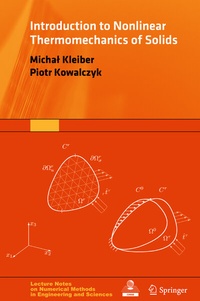
Introduction to Nonlinear Thermomechanics of Solids
Description

Reviews / Votes
"This book introduces thermomechanics mathematically. . The book is a good introduction for beginners who want to do research in solid mechanics and/or thermomechanics. It can be used as a textbook for courses involving solid mechanics/thermomechanics. For computer professionals dealing with engineering problems, this is a good introduction." (Maulik A. Dave, Computing Reviews, computingreviews.com, October, 2016)
More details
Other editions
Additional editions
Persons
Content
1. Introduction.- 1.1. General remarks on the book content.- 1.2. Nonlinear continuum thermomechanics as a field of research and its industrial applications.- 2. Fundamental concepts of mechanics.- 2.1. Statics of a bar.- 2.2. Trusses.- 2.3. Two-dimensional continuum generalization.- 3. Fundamentals of tensor algebra and analysis.- 3.1. Introduction.- 3.1.1. Euclidean space and coordinate systems.- 3.1.2. Scalars and vectors.- 3.1.3. Basis of vector space.- 3.2. Tensors.- 3.2.1. Definitions.- 3.2.2. Operations on tensors.- 3.2.3. Isotropic tensors.- 3.3. Second order tensors.- 3.3.1. Definitions and properties.- 3.3.2. Tensor eigenproblem.- 3.3.3. Spectral decomposition of symmetric tensor.- 3.3.4. Polar decomposition of tensor.- 3.4. Tensor functions and fields.- 3.4.1. Integration and differentiation of tensor fields.- 3.4.2. Gauss-Ostrogradski theorem.- 3.5. Curvilinear coordinate systems.- 3.6. Notations used in tensor description.- 4. Motion, deformation and strain in materialcontinuum.- 4.1. Motion of bodies.- 4.2. Strain.- 4.2.1. Definitions.- 4.2.2. Physical meaning of strain in one dimension.- 4.2.3. Physical meaning of strain components.- 4.2.4. Some other strain tensor properties.- 4.3. Area and volumetric deformation.- 4.4. Strain rate and strain increments.- 4.4.1. Time derivative of a tensor field. Lagrangian and Eulerian description of motion.- 4.4.2. Increments and rates of strain tensor measures.- 4.4.3. Strain increments and rates in one dimension.- 4.5. Strain compatibility equations.- 5. Description of stress state.- 5.1. Introduction.- 5.1.1. Forces, stress vectors and stress tensor in continuum.- 5.1.2. Principal stress directions. Extreme stress values.- 5.2. Description of stress in deformable body.- 5.2.1. Cauchy and Piola-Kirchhoff stress tensors.- 5.2.2. Objectivity and invariance of stress measures.- 5.3. Increments and rates of stress tensors.- 5.4. Work of internal forces. Conjugate stress-strain pairs.- 6. Conservation laws in continuum mechanics.- 6.1. Mass conservation law.- 6.2. Momentum conservation law.- 6.3. Angular momentum conservation law.- 6.4. Mechanical energy conservation law.- 7. Constitutive equations.- 7.1. Introductory remarks.- 7.2. Elastic materials.- 7.2.1. Linear elasticity.- 7.2.2. Nonlinear elasticity.- 7.3. Viscoelastic materials.- 7.3.1. One-dimensional models.- 7.3.2. Continuum formulation.- 7.3.3. Energy dissipation in viscoelastic materials.- 7.4. Elastoplastic materials.- 7.4.1. One-dimensional models.- 7.4.2. Three-dimensional formulation in plastic flow theory.- 8. Fundamental system of solid mechanics equations.- 8.1. Field equations and initial-boundary conditions.- 8.2. Incremental form of equations.- 8.3. Some special cases.- 8.4. Example of analytical solution.- 9. Fundamentals of thermomechanics and heat conduction problem.- 9.1. Laws of thermodynamics.- 9.1.1. The first law of thermodynamics.- 9.1.2. The second law of thermodynamics.- 9.2. Heat conduction problem.- 9.3. Fundamental system of solid thermomechanics equations. Thermomechanical Couplings.- 9.4. Thermal expansion in constitutive equations of linear elasticity.- 10. Variational formulations in solid thermomechanics.- 10.1. Variational principles - introduction.- 10.2. Variational formulations for linear mechanics problems.- 10.2.1. Virtual work principle and potential energy.- 10.2.2. Extended variational formulations.- 10.3. Variational formulations for nonlinear mechanics problems.- 10.3.1. Elasticity at large deformations.- 10.3.2. Incremental problem of nonlinear mechanics.- 10.4. Variational formulations for heat conduction problems.- 11. Discrete formulations in thermomechanics.- 11.1. Discrete formulations in heat conduction problems.- 11.1.1. Linear problem of stationary heat conduction.- 11.1.2. General form of the heat conduction problem.- 11.2. Discrete formulations in solid mechanics problems.- 11.2.1. Linear problem of statics.- 11.2.2. Linear problem of dynamics.- 11.2.3. Nonlinear elastic problem with large deformations.- 11.2.4. Incremental form of nonlinear mechanics problem.- 11.3. Weighted residual method.- 12. Fundamentals of finite element method.- 12.1. Introduction.- 12.1.1. FEM formulation for linear heat conduction problem.- 12.1.2. FEM formulation for linear static elasticity problem.- 12.2. FEM approximation at the element level.- 12.2.1. Simple one-dimensional elements.- 12.2.2. Constant strain elements.- 12.2.3. Isoparametric elements.- 13. Solution of FEM equation systems.- 13.1. Introduction.- 13.2. Solution methods for linear algebraic equation systems.- 13.2.1. Elimination methods.- 13.2.2. Iterative methods.- 13.3. Multigrid methods.- 13.4. Solution methods for nonlinear algebraic equation systems.- 13.5. Solution methods for linear and nonlinear systems of first order ordinary differential equations.- 13.6. Solution methods for linear and nonlinear systems of second order ordinary differential equations.- Bibliography.- Index.
