
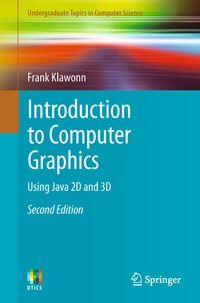
Introduction to Computer Graphics
Description
Alles über E-Books | Antworten auf Fragen rund um E-Books, Kopierschutz und Dateiformate finden Sie in unserem Info- & Hilfebereich.
More details
Other editions
Additional editions
Previous edition
Person
Dr. Frank Klawonn is a Professor in the Department of Computer Science and Head of the Data Analysis and Pattern Recognition Laboratory at Ostfalia University of Applied Sciences, Germany. He is also Head of the Bioinformatics and Statistics group at the Helmholtz Centre for Infection Research, Braunschweig, Germany. He is a co-author of the Springer textbook Guide to Intelligent Data Analysis .
Content
Introduction.- Basic Principles of Two-Dimensional Graphics.- Drawing Lines and Curves.- Areas, Text and Colours.- Basic Principles of Three-Dimensional Graphics.- Modelling Three-Dimensional Objects.- Visible Surface Determination.- Illumination and Shading.- Special Effects and Virtual Reality.- Useful Links.- Example Programs.- References to Java 2D Classes and Methods.- References to Java 3D Classes and Methods.

System requirements
File format: PDF
Copy protection: Watermark-DRM (Digital Rights Management)
System requirements:
- Computer (Windows; MacOS X; Linux): Use the free software Adobe Reader, Adobe Digital Editions, or any other PDF viewer of your choice (see eBook Help).
- Tablet/Smartphone (Android; iOS): Install the free app Adobe Digital Editions or another reading app for eBooks, e.g., PocketBook (see eBook Help).
- E-reader: Bookeen, Kobo, Pocketbook, Sony, Tolino and many more (only limited: Kindle).
The file format PDF always displays a book page identically on any hardware. This makes PDF suitable for complex layouts such as those used in textbooks and reference books (images, tables, columns, footnotes). Unfortunately, on the small screens of e-readers or smartphones, PDFs are rather annoying, requiring too much scrolling.
This eBook uses Watermark-DRM, a „soft” copy protection. This means that there are no technical restrictions to prevent illegal distribution. However, there is a personalised watermark embedded in the eBook that can be used to identify the purchaser of the eBook in the event of misuse and to provide evidence for legal purposes.
For more information, see our eBook Help page.