

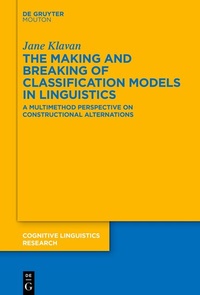
The Making and Breaking of Classification Models in Linguistics
Description

The book provides a methodological blueprint for the study of constructional alternations - using corpus-linguistic methods in combination with different types of experimental data. The book looks at a case study from Estonian. This morphologically rich language is typologically different from Indo-European languages such as English. Corpus-based studies allow us to detect patterns in the data and determine what is typical in the language. Experiments are needed to determine the upper and lower limits of human classification behaviour. They give us an idea of what is possible in a language and show how human classification behaviour is susceptible to more variation than corpus-based models lead us to believe. Corpora and forced choice data tell us that when we produce language, we prefer one construction. Acceptability judgement data tell us that when we comprehend language, we judge both constructions as acceptable. The book makes a theoretical contribution to the what, why, and how of constructional alternations.
More details
Other editions
Additional editions
Person
Content
- Intro
- Preface
- Contents
- List of figures
- List of tables
- Chapter 1 Introduction
- Chapter 2 Usage-based linguistics and constructional alternations
- Chapter 3 A methodological blueprint for the study of constructional alternations
- Chapter 4 Modelling constructional alternations: Machine classification
- Chapter 5 Human classification behaviour: Choosing and rating constructional alternations
- Chapter 6 Leap of faith: From behaviour to cognition
- Chapter 7 Summary and conclusions
- Appendix: The alternation between exterior locative cases and the corresponding postpositions in Estonian
- References
- Index
