

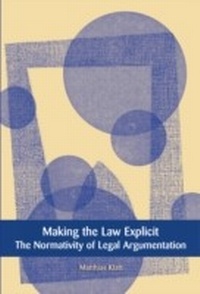
Making the Law Explicit
The Normativity of Legal Argumentation
1st Edition
Published on 8. September 2008
256 pages
978-1-84731-456-7 (ISBN)
Description

Legal argumentation consists in the interpretation of texts. Therefore, it has a natural connection to the philosophy of language. Central issues of this connection, however, lack a clear answer. For instance, how much freedom do judges have in applying the law? How are the literal and the purposive approaches related to one another? How can we distinguish between applying the law and making the law?
This book provides answers by means of a complex and detailed theory of literal meaning. A new legal method is introduced, namely the further development of the law. It is so far unknown in Anglo-American jurisprudence, but it is shown that this new method helps in solving some of the most crucial puzzles in jurisprudence.
At its centre the book addresses legal indeterminism and refutes linguistic-philosophical reasons for indeterminacy. It spells out the normative character of interpretation as emphasized by Raz and, with the help of Robert Brandom's normative pragmatics, it is shown that the relativism of interpretation from a normative perspective does not at all justify scepticism. On the contrary, it supports the claim that legal argumentation can be objective, and maintains that statements on the meaning of a statute can be right or wrong, and take on inter-subjective validity accordingly.
This book breaks new ground in transferring Brandom's philosophy to legal theoretical problems and presents an original and exciting analysis of the semantic argument in legal argumentation. It was the recipient of the European Award for Legal Theory in 2002.
'This book represents, on the one hand, a reception of Robert Brandom's important theory including applications of this theory in the field of legal philosophy and, on the other, an exploration of the limits of an appeal in legal interpretation to the text. The enquiry thereby impinges upon the central juridico-philosophical themes of meaning, objectivity, and normativity. The author's work counts as a significant contribution to analytical jurisprudence and is deserving of a wide readership.' Robert Alexy, Professor for Public Law and Legal Philosophy, Kiel.
'Klatt focuses on a very profound theory of concept formation and uses this theory in a creative way to solve classical problems of legal argumentation.' Aleksander Peczenik
This book provides answers by means of a complex and detailed theory of literal meaning. A new legal method is introduced, namely the further development of the law. It is so far unknown in Anglo-American jurisprudence, but it is shown that this new method helps in solving some of the most crucial puzzles in jurisprudence.
At its centre the book addresses legal indeterminism and refutes linguistic-philosophical reasons for indeterminacy. It spells out the normative character of interpretation as emphasized by Raz and, with the help of Robert Brandom's normative pragmatics, it is shown that the relativism of interpretation from a normative perspective does not at all justify scepticism. On the contrary, it supports the claim that legal argumentation can be objective, and maintains that statements on the meaning of a statute can be right or wrong, and take on inter-subjective validity accordingly.
This book breaks new ground in transferring Brandom's philosophy to legal theoretical problems and presents an original and exciting analysis of the semantic argument in legal argumentation. It was the recipient of the European Award for Legal Theory in 2002.
'This book represents, on the one hand, a reception of Robert Brandom's important theory including applications of this theory in the field of legal philosophy and, on the other, an exploration of the limits of an appeal in legal interpretation to the text. The enquiry thereby impinges upon the central juridico-philosophical themes of meaning, objectivity, and normativity. The author's work counts as a significant contribution to analytical jurisprudence and is deserving of a wide readership.' Robert Alexy, Professor for Public Law and Legal Philosophy, Kiel.
'Klatt focuses on a very profound theory of concept formation and uses this theory in a creative way to solve classical problems of legal argumentation.' Aleksander Peczenik
More details
Series
Edition
1. Auflage
Language
English
Place of publication
London
United Kingdom
Publishing group
Bloomsbury Publishing PLC
Target group
Professional and scholarly
ISBN-13
978-1-84731-456-7 (9781847314567)
Copyright in bibliographic data and cover images is held by Nielsen Book Services Limited or by the publishers or by their respective licensors: all rights reserved.
Schweitzer Classification
Other editions
Additional editions
Book
09/2008
1st Edition
Hart Publishing
€125.40
Shipment within 15-20 days
Person
Matthias Klatt is Juliana Cuyler Matthews Junior Research Fellow in Law at New College, Oxford University.
Content
Introduction 1
I. The Doctrine of the Limits of the Wording
II. Interpretation and Invention in English Legal Reasoning
III. Towards a Common European Approach
IV. The Possibility of the Rule of Law Defended
V. The Sceptical Challenge: Indeterminacy and Vagueness
VI. The Rationality and Objectivity of Legal Reasoning
VII. At a Glance
Chapter 1: The Doctrine of the Limits of the Wording
I. The Limits of the Wording in Hermeneutic Legal Theory
II. The Limits of the Wording in Analytic Legal Theory
III. The Deconstructivistic Challenge of the Structuring Legal Theory
IV. The Results of the First Chapter
Chapter 2: Normativity and Objectivity of Linguistic Meaning
I. Introduction
II. The Normativity of Linguistic Meaning
III. The Objectivity of Linguistic Meaning
IV. The Results of the Second Chapter
Chapter 3: Semantic Normativity in the Law
I. Addressing the Three Central Issues
II. The Theory of the Limits of the Wording
III. The Results of the Third Chapter
I. The Doctrine of the Limits of the Wording
II. Interpretation and Invention in English Legal Reasoning
III. Towards a Common European Approach
IV. The Possibility of the Rule of Law Defended
V. The Sceptical Challenge: Indeterminacy and Vagueness
VI. The Rationality and Objectivity of Legal Reasoning
VII. At a Glance
Chapter 1: The Doctrine of the Limits of the Wording
I. The Limits of the Wording in Hermeneutic Legal Theory
II. The Limits of the Wording in Analytic Legal Theory
III. The Deconstructivistic Challenge of the Structuring Legal Theory
IV. The Results of the First Chapter
Chapter 2: Normativity and Objectivity of Linguistic Meaning
I. Introduction
II. The Normativity of Linguistic Meaning
III. The Objectivity of Linguistic Meaning
IV. The Results of the Second Chapter
Chapter 3: Semantic Normativity in the Law
I. Addressing the Three Central Issues
II. The Theory of the Limits of the Wording
III. The Results of the Third Chapter
