

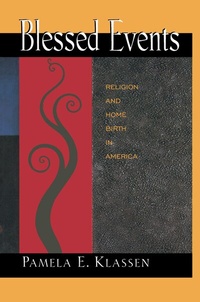
Blessed Events
Religion and Home Birth in America
1st Edition
Published on 7. June 2021
336 pages
978-1-4008-2851-7 (ISBN)
Description

Blessed Events explores how women who give birth at home use religion to make sense of their births and in turn draw on their birthing experiences to bring meaning to their lives and families. Pamela Klassen introduces a surprisingly diverse group of women, in their own words, while also setting their birth stories within wider social, political, and economic contexts. In doing so, she emerges with a study that disrupts conventional views of both childbirth and religion by blurring assumed divisions between conservative and feminist women and by taking childbirth seriously as a religious act.
Most American women who have a choice give birth in a hospital and request pain medication. Yet enough women choose and advocate unmedicated home birth--and do so for carefully articulated reasons, social resistance among them--to constitute a movement. Klassen investigates why women whose religious affiliations range from Old Order Amish to Reform Judaism to goddess-centered spirituality defy majority opinion, the medical establishment, and sometimes the law to have their babies at home. In considering their interpretations--including their critiques of the dominant medical model of childbirth and their views on labor pain--she examines the kinds of agency afforded to or denied women as they derive religious meanings from childbirth. Throughout, she identifies tensions and affinities between feminist and traditionalist appraisals of the symbolic meaning of birth and the power of women.
What does home birth--a woman-centered movement working to return birth to women's control--mean in practice for women's gender and religious identities? Is this supreme valuing of procreation and motherhood constraining, or does it open up new realms of cultural and social power for women? By asking these questions while remaining cognizant of religion's significance, Blessed Events challenges both feminist and traditionalist accounts of childbearing while broadening our understanding of how religion is ''lived'' in contemporary America.
Most American women who have a choice give birth in a hospital and request pain medication. Yet enough women choose and advocate unmedicated home birth--and do so for carefully articulated reasons, social resistance among them--to constitute a movement. Klassen investigates why women whose religious affiliations range from Old Order Amish to Reform Judaism to goddess-centered spirituality defy majority opinion, the medical establishment, and sometimes the law to have their babies at home. In considering their interpretations--including their critiques of the dominant medical model of childbirth and their views on labor pain--she examines the kinds of agency afforded to or denied women as they derive religious meanings from childbirth. Throughout, she identifies tensions and affinities between feminist and traditionalist appraisals of the symbolic meaning of birth and the power of women.
What does home birth--a woman-centered movement working to return birth to women's control--mean in practice for women's gender and religious identities? Is this supreme valuing of procreation and motherhood constraining, or does it open up new realms of cultural and social power for women? By asking these questions while remaining cognizant of religion's significance, Blessed Events challenges both feminist and traditionalist accounts of childbearing while broadening our understanding of how religion is ''lived'' in contemporary America.
More details
Other editions
Additional editions
Book
10/2001
Princeton University Press
€74.28
Article exhausted; check different version
Book
10/2001
Princeton University Press
€39.20
Shipment within 10-20 days
Person
Pamela E. Klassen is Assistant Professor in the Department and Centre for the Study of Religion at the University of Toronto. She is the author of Going by the Moon and the Stars: Stories of Two Russian Mennonite Women.
Content
- Cover Page
- Half-title Page
- Title Page
- Copyright Page
- Dedication Page
- Contents
- Preface: Motherhood Issues
- 1. Procreation Stories: An Introduction
- 2. Cultural Contexts of Home Birth
- 3. Risk, Fear, and the Ethics of Home Birth
- 4. Procreating Religion: Spirituality, Religion, and the Transformations of Birth
- 5. A Sense of Place: Meanings of Home
- 6. Natural Women: Bodies and the Work of Birth
- 7. Sliding between Pain and Pleasure: Home Birth and Visionary Pain
- Epilogue: The Miracle of Birth
- Appendix A: Interview Guide
- Appendix B: The Women in the Study
- Notes
- Bibliography
- Index
