

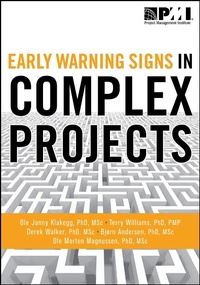
Early Warning Signs in Complex Projects
Published on 1. December 2010
187 pages
978-1-62825-169-2 (ISBN)
Description

Complex projects are often the most high-profile projects within an organization. How can early warning signs be identified and acted upon, so that problems are avoided and projects are successful in delivering the expected value for their owners and other stakeholders? What signals should we look for? Looking for early warning signs takes more than a keen eye. Collaborating with the Norwegian University of Science and Technology in Trondheim and the University of Southampton in the United Kingdom, Ole Jonny Klakegg, Terry Williams, Derek Walker, Bjørn Andersen, and Ole Morten Magnussen have expanded on their research of governance frameworks and guidelines as well as provided interviews with experts and case studies from Australia, Norway, and the United Kingdom. This international report identifies early warning signs in highly complex projects and offers tips on how to combat them.
More details
Other editions
Additional editions
Ole Jonny Klakegg | Terry Williams | Derek Walker
Early Warning Signs in Complex Projects
Book
12/2010
Project Management Institute
€69.46
Article exhausted; check different version
Content
- Cover
- Copyright Page
- Title Page
- Table of Contents
- Executive Summary
- 1. Introduction
- 1.1. Previous Work by the Research Teams
- 1.2. Definitions and Basic Concepts
- 1.3. Scope and Limitations
- 1.4. Research Questions and Methodology
- 1.5. Research Methodology and Structure of the Report
- 2. Literature
- 2.1. Introduction
- 2.2. Governance
- 2.3. What is Project Success?
- 2.4. Why do Projects Fail?
- 2.5. What Sorts of Assessments are There?
- 2.6. What should be Measured?
- 2.7. Why do Methods Fail to Pick Up Early Warning Signs?
- 2.8. Futuristic Ideas
- 3. Reference Model
- 3.1. Introduction: The Concept of a Reference Model
- 3.2. The Rational Logic of Project Assessments
- 3.3. The Structure of a Coarse Project Reference Model
- 3.4. The Reference Model: Actors and Stakeholders
- 3.5. The Reference Model-Project Assessments
- 3.6. Summary: Reference Model
- 4. Guidelines for Project Assessments
- 4.1. Early Warnings-Early Processes
- 4.2. Examples of frameworks and their assessments
- 4.2.1. Examples from the UK
- 4.2.2. Examples from Australia
- 4.2.3. Examples from Norway
- 4.3. Analysis and Comparison of Guidelines
- 4.3.1. Existence of Governance Frameworks and how Common are Assessments
- 4.3.2. Process and Procedures for Assessments
- 4.3.3. Guidelines and Early Warning Signs
- 4.4. Summary: Project Assessments and Early Warning Signs
- 5. Interview Analysis
- 5.1. Introduction
- 5.2. Context and Experience
- 5.3. Current Practice in Project Assessments
- 5.4. Identifying Areas for Early Warning Signs
- 5.5. The use and Usefulness of Early Warning Signs
- 5.6. Summary: Individual Experts' Views
- 6. Case Studies
- 6.1. Introduction
- 6.2. Analysis of Eight Case Studies
- 6.2.1. About Project Reviews
- 6.2.2. What was Good Practice or Practice that Seemed to Work?
- 6.2.3. What Early Warning Signs were Detected and/or Acted Upon?
- 6.2.4. What was Missed or Could have been done Differently in Retrospect?
- 6.2.5. What Effect did Complexity Have?
- 6.2.6. Barriers to Detecting Early Warning Signals Identified
- 6.2.7. Assessments or "Gut Feeling" Approaches: Possibilities for Early Detection
- 6.3. Case studies: Description of the Content
- 6.3.1. Brief Description of Four Anonymous Case Studies
- 6.3.2. Case Study [N1]: Tyrihans Oil & Gas Field Development
- 6.3.3. Case Study [N2]: Ring 3 Ulven-Sinsen, City Development
- 6.3.4. Case study [U1]: C-NOMIS Software Development and Implementation
- 6.3.5. Case Study: Australian University IT Services (ITS)
- 6.4. Summary: Important Lessons from the Case Studies
- 7. Looking through Complexity
- 7.1. The Big Picture
- 7.2. Answering the Research Questions
- 7.3. The Early Warning Signs Revisited
- 7.4. Contributions and Further Research
- References
- Appendix: Interview Guide
