

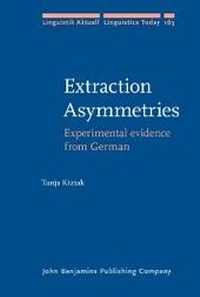
Extraction Asymmetries
Experimental evidence from German
1st Edition
Published on 29. July 2010
XVI, 273 pages
978-90-272-8794-6 (ISBN)
Description

This monograph addresses divergent views in the linguistic literature on whether German displays the that-trace effect and other subject/object asymmetries commonly found for long extractions in English and other languages. Using newly developed rating methodologies, the author exposes consistent and robust subject/object asymmetries in German - a surprisingly unequivocal result given that the existence of these effects is controversial. This finding raises important questions: how can one account for the discrepancy between the clear experimental evidence on the one hand, and the lack of consensus in the linguistic literature on the other? And secondly, it raises again the old question of why subject extractions are dispreferred. This work also provides intriguing new insights into the long-standing question on how to analyse German constructions such as Wer glaubst du hat recht? - the 'parenthesis versus extraction debate'. In this work decisive evidence points in favour of the parenthetical analysis.
More details
Other editions
Additional editions
Book
07/2010
John Benjamins Publishing Co
€111.30
Shipment within 10-15 days
Person
Content
- Extraction Asymmetries
- Editorial page
- Title page
- LCC data
- Dedication page
- Table of contents
- List of figures
- Preface and acknowledgements
- Chapter 1. An introduction to long extraction
- 1.1. The movement metaphor
- 1.2. Long extraction - four basic factors
- 1.3. The four factors in linguistic theory
- 1.3.1. Factor I: Mobility
- 1.3.2. Factor II: Permeability
- 1.3.3. Factor III: Bridge quality
- 1.3.4. Factor IV: Movement type
- 1.4. The scope of this monograph
- Chapter 2. Judgement studies
- 2.1. Why judgement studies?
- 2.2. Collecting the data
- 2.2.1. Designing the materials for our experiments
- 2.2.2. Elicitation method
- 2.2.3. Experimental procedure
- 2.3. Evaluating the data
- 2.3.1. Visual inspection
- 2.3.2. Statistical analysis
- 2.4. Cardinal well-formedness values
- Chapter 3. Subject/object asymmetries in German
- 3.1. Subject/object asymmetries in dass-extractions
- 3.1.1. Views from the literature
- 3.1.2. Investigating mobility: Subject/object asymmetries with dative extraction?
- 3.1.3. Investigating movement type: Wh-movement versus long topicalization
- 3.2. Subject/object asymmetries with wh-islands
- 3.2.1. Views from the literature
- 3.2.2. Exp 3: Design
- 3.2.3. Exp 3: Results and discussion
- 3.3. An excursus on adjunct/argument asymmetries
- 3.3.1. Experiment 2 revisited: Design
- 3.3.2. Experiment 2 revisited: Results
- 3.4. Conclusions
- Chapter 4. A controversial case
- 4.1. Two competing analyses
- 4.2. Discussion in the literature
- 4.3. Evidence from predicate restrictions
- 4.3.1. dass-extraction and controversial construction
- 4.3.2. Open question I: Dependent V2-clauses
- 4.3.3. Open question II: Other integrated parentheticals
- 4.3.4. Discussion
- 4.4. Evidence from subject/object asymmetries
- 4.4.1. Exp 3 revisited: Design
- 4.4.2. Exp 3 revisited: Results
- 4.4.3. Exp 3 revisited: Discussion
- 4.4.4. Excursus: Featherston's interpretation of similar data
- 4.5. Conclusions
- Chapter 5. Locating the explanation for the subject/object asymmetry in the matrix clause
- 5.1. The role of morphological case-marking
- 5.1.1. The predictions of Andersson & Kvam (1984)
- 5.1.2. Our experimental approach to the agreement clash hypothesis
- 5.2. The role of local ambiguity
- 5.2.1. Fanselow & Frisch (2006)
- 5.2.2. Subject/object asymmetries with interrogative pronouns
- 5.2.3. Extraction from infinitival clauses as the source of local ambiguity
- 5.3. Case-ambiguous extracted DPs in self-paced reading studies
- 5.3.1. Farke (1994)
- 5.3.2. Contra Farke (1994)
- 5.4. Judgement studies on case-ambiguous extracted DPs
- 5.4.1. A first study on case-ambiguous extracted elements
- 5.4.2. Comparing case-ambiguous and case-unambiguous extracted DPs
- 5.4.3. General remarks on testing case-ambiguous extracted DPs
- 5.5. Our extraction data and the `good enough' approach
- 5.5.1. A general outline of the `good enough' approach
- 5.5.2. Applying the `good enough' approach to our extraction data in general
- 5.5.3. Applying the `good enough' approach to experiment 9
- 5.6. Conclusions
- Chapter 6. Locating the explanation for the subject/object asymmetry in the embedded clause
- 6.1. Considering the constellation in the embedded clause
- 6.1.1. Exp 10: Design
- 6.1.2. Exp 10: Results
- 6.1.3. The `good enough' approach revisited
- 6.1.4. Summary
- 6.2. Characteristics of the extraction site
- 6.3. Testing long extraction of `atypical' subjects
- 6.3.1. An experiment on ND- versus DN-verbs
- 6.3.2. A study on long extraction in passive and unaccusative contexts
- 6.3.3. A follow-up study on subject extraction in passive contexts
- 6.3.4. Overall conclusion from experiment 12 and 13
- 6.4. Testing the interaction of scrambling and long extraction
- 6.4.1. Exp 14: Design
- 6.4.2. Exp 14: Results and discussion
- 6.4.3. Summary
- 6.5. The LA-account revisited
- 6.6. Conclusion
- Chapter 7. Conclusions
- The parenthesis versus extraction debate
- Subject/object asymmetries in long extractions
- Experimental evidence for accounts A to C
- On the indispensability of accounts A to C
- On the causal character of accounts A to C
- Comparing long extraction in English and in German
- Extraction contexts other than long wh-movement
- Final remarks
- Bibliography
- Appendix A
- Cardinal value examples
- Experiment 1
- Experiment 2
- Experiment 3
- Experiment 4
- Experiment 5
- Experiment 6
- Experiment 7
- Experiment 8
- Experiment 9
- Experiment 10
- Experiment 11
- Experiment 12
- Experiment 13
- Experiment 14
- Index
- The series Linguistik Aktuell/Linguistics Today
