

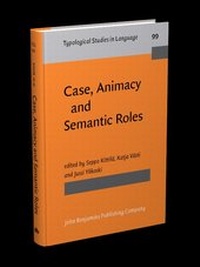
Case, Animacy and Semantic Roles
1st Edition
Published on 28. September 2011
VI, 354 pages
978-90-272-8481-5 (ISBN)
Description

The chapters of this volume scrutinize the interplay of different combinations of case, animacy and semantic roles, thus contributing to our understanding of these notions in a novel way. The focus of the chapters lies on showing how animacy affects argument marking. Unlike previous studies, these chapters primarily deal with lesser studied phenomena, such as animacy effects on spatial cases and the differences between cases and adpositions in the coding of spatial relations. In addition, theoretical and diachronic issues related to case and semantic roles are also discussed; for example, what is case, how do cases develop and what are the functional differences between cases and adpositions? The chapters deal with a variety of different languages including Uralic languages, Indo-European languages, Basque, Korean and Vaeakau-Taumako. The book is appealing to anyone interested in case, animacy and/or semantic roles.
More details
Other editions
Additional editions
Seppo Kittilae | Katja Vaesti | Jussi Ylikoski
Case, Animacy and Semantic Roles
Book
09/2011
John Benjamins Publishing Co
€104.94
Shipment within 10-15 days
Persons
Content
- Case, Animacy and Semantic Roles
- Editorial page
- Title page
- LCC data
- Table of contents
- Introduction to case, animacy and semantic roles
- 1. Introduction
- 2. Defining the concepts
- 2.1 Case
- 2.2 Animacy
- 2.3 Semantic roles
- 3. Cases and semantic roles
- 4. Animacy and semantic roles
- 5. Case and animacy
- 6. Contents of this volume
- Abbreviations
- Acknowledgements
- References
- PART I. Semantic roles and animacy
- Remarks on the coding of goal, recipient and vicinal goal in European Uralic
- 1. Introduction
- 2. The roles
- 3. The data
- 3.1 Preliminaries
- 3.2 The typology
- 3.2.1 Type 1: G1 ? G2 ? R ? VG (case)
- 3.2.2 Type 2: G1 ? G2 = R ? VG (case)
- 3.2.3 Type 3: G1 ? G2 = R ? VG (postposition)
- 3.2.4 Type 4: G ? R ? VG (postposition)
- 3.2.5 Type 5: G = R ? VG (postposition)
- 3.2.6 Type 6: G1 ? G2 ? R = VG (case)
- 4. Discussion
- 5. Conclusion
- Abbreviations
- Acknowledgments
- Research material
- References
- A case in search of an independent life
- 1. Introduction
- 2. Functions of the Finnish allative case
- 2.1 The allative among the other cases
- 2.2 The allative with animate referents
- 3. Research frame
- 3.1 Related research
- 3.2 Data
- 3.3 Theoretical base: A frame semantic approach to non-elliptic clauses
- 3.4 Methods: Intuitive analysis and paraphrase test
- 3.5 Terminological note
- 4. Interpreting the paraphrase test
- 4.1 The verbless allative-initial construction vs. finite allative-initial constructions
- 4.2 The analytical tools
- 4.2.1 Argument roles
- 4.2.2 Syntactic roles
- 5. The allative in the verbless construction
- 5.1 Actor
- 5.2 Purchaser
- 5.3 Target group
- 5.4 Exploiter
- 5.5 Receiver
- 5.6 Affected
- 5.7 Implicated actor
- 5.8 Encounterer
- 5.9 Summary
- 6. Conclusions
- Abbreviations
- Acknowledgements
- References
- Appendix
- The headlines in the paraphrase test
- PART II. Semantic roles and cases vs. adpositions
- The division of labour between synonymous locative cases and adpositions
- 1. Introduction
- 2. On Estonian locative cases and adpositions with special focus on the adessive and the adposition peal 'on'
- 2.1 The Estonian adessive case
- 2.2 The adposition peal 'on'
- 2.3 The parallel use of the Estonian adessive and the adposition peal 'on'
- 3. Experimental design: Predictions
- 3.1 Type of relation between Trajector and Landmark
- 3.2 Type of Landmark
- 3.3 Type of contact between Trajector and Landmark
- 4. Method
- 4.1 Stimuli
- 4.1.1 Production task
- 4.1.2 Forced choice task
- 4.1.3 The factors
- 4.2 Participants
- 4.3 Procedure
- 4.3.1 Production task
- 4.3.2 Forced choice task
- 5. Results and discussion
- 6. Conclusion
- Abbreviations
- Acknowledgements
- References
- Appendix
- List of sentences and photos used in the linguistic tasks
- Type of relation between Trajector and Landmark
- Is there a future for the Finnish comitative?
- 1. Introduction
- 2. Has the comitative become unproductive?
- 3. Is the comitative giving way?
- 4. Does the kanssa construction cover the functions of the comitative?
- 5. No overlap: three main differences in the use of -ine and kanssa
- 6. The functional domains of the comitative and the kanssa construction differ substantially
- 7. Conclusion
- Abbreviations
- Acknowledgements
- Corpus
- References
- PART III. Animacy and case
- Animacy and spatial cases
- 1. Introduction
- 2. Two particularities of humans or animates in the conceptualization and expression of spatial relationships
- 2.1 Particularities in the concrete vs. metaphorical uses of some spatial markers
- 2.2 Orientation in relation to a person vs. orientation in relation to a person's usual residence
- 2.2.1 Conventionalized ellipsis in the expression of orientation with respect to a person's usual residence
- 2.2.2 Specialized adpositions possibly resulting from the grammaticalization of nouns meaning 'house'
- 2.2.3 Orientation with respect to a person's usual residence as a possible reading of cases or adpositions encoding proximity
- 2.2.4 Orientation with respect to a person's usual residence as a possible reading of spatial cases unspecified for configuration
- 2.3 Conclusion of Section 2
- 3. The affinity of human nouns with heavy spatial marking
- 3.1 Eastern Armenian
- 3.2 Classical Nahuatl
- 3.3 Conclusion of Section 3
- 4. Animate nouns and spatial marking in Standard Basque
- 4.1 The expression of spatial relations in Basque
- 4.2 The spatial forms of nouns in Standard Basque
- 4.3 The use of the spatial forms of animate nouns
- 5. Variations in the spatial marking of animate nouns in Basque dialects
- 6. Animate nouns and spatial marking in the history of Basque
- 6.1 General remarks
- 6.2 The use of gan and baita in ancient texts
- 6.2.1 The use of gan in the spatial marking of animate pronouns
- 6.2.2 The use of gan in the spatial marking of animate nouns
- 6.2.3 The use of gan in the spatial marking of inanimate nouns and pronouns
- 6.2.4 The use of baita
- 6.3 Direct affixation of spatial case markers in ancient texts
- 6.3.1 Spatial case markers directly affixed to animate pronouns
- 6.3.2 Spatial case markers directly affixed to animate nouns
- 6.4 The problem of buru
- 6.5 Summary of Section 6: The evolution
- 7. The etymology of the formatives involved in the spatial marking of Basque animate nouns
- 7.1 The etymology of gan
- 7.2 The etymology of baita
- 8. Conclusion
- Abbreviations
- Sources
- References
- There's more than "more animate"
- 1. Introduction
- 2. The Organization/Document Construction in Korean
- 3. The locative-marked nominal in the ODC: grammatical properties
- 3.1 Subject properties
- 3.1.1 Plural Copy
- 3.1.2 Controller of PRO
- 3.2 Oblique properties
- 3.3 Summary: the locative-marked nominal in the ODC
- 4. Inferred animacy and the zone of responsibility
- 4.1 Inferred animacy: sentience, intentionality and responsibility
- 4.2 Limited or total zone of responsibility: Locative or nominative case?
- 5. Concluding remarks
- Abbreviations
- References
- PART IV. Diachrony and case
- The coding of spatial relations with human landmarks
- 1. Introduction
- 2. Latin
- 2.1 Location and direction in Latin
- 2.2 From Latin to Romance
- 3. Grammaticalization of the word for 'home'
- 4. Adverb/preposition meaning 'on the side', 'where'
- 4.1 Italian
- 4.2 Spanish
- 5. Extension of comitative
- 5.1 The reflexes of in and ad in Portuguese and Spanish
- 5.2 Direction
- 5.3 Location
- 6. Generalization of the same marker
- 7. Summary and conclusion
- Abbreviations
- Acknowledgements
- References
- A survey of the origins of directional case suffixes in European Uralic
- 1. Introduction
- 1.1 The genetic classification of the Uralic languages
- 1.2 Proto-Uralic morphosyntax: Cases and postpositions
- 2. The directional cases in European Uralic
- 2.1 The inventory of the directional cases
- 2.2 Terminative and approximative cases
- 2.3 "Tertiary" cases in Permic
- 2.4 "Familial local cases" in Hungarian
- 3. European Uralic directional case suffixes by their origins
- 3.1 Directional cases originating in postpositions
- 3.2 Directional cases descending from the Proto-Uralic case system
- 3.3 Directional cases with etymologically obscure coaffixes
- 3.3.1 Mari and Permic cases with -l-
- 3.3.2 Finno-Volgaic cases with *-s(-)
- 3.4 Directional cases with deviate origins: Obvious and obscure past of terminative cases
- 4. Discussion and conclusion
- 4.1 Explaining the emergence of case markers: Remarks on the basic tenets of Uralists and others
- 4.2 Semantic functions of directional cases in light of their historical development
- Abbreviations
- Acknowledgments
- References
- PART V. Theoretical issues
- Dutch spatial case
- 1. Introduction
- 2. Forms of case
- 3. Dutch R-forms
- 4. Case and position
- 5. Case typing
- 6. Discussion
- Abbreviations
- Acknowledgements
- References
- Case on the margins
- 1. Introduction
- 2. Case in Polynesian: an overview
- 3. Argument marking in Vaeakau-Taumako
- 3.1 Basic word order and the agentive preposition e
- 3.2 The personal marker a
- 3.3 Types of pragmatic salience: a vs. ko
- 4. Marginal markers: Case, or what?
- 4.1 Diachronic perspectives
- 4.2 Case-like functions of a and e
- 4.3 Pragmatic case?
- 4.4 Argument discrimination revisited
- 5. Conclusion
- Abbreviations
- References
- Why should beneficiaries be subjects (or objects)?
- 1. Introduction
- 2. Benefactive constructions
- 3. Beneficiaries and grammatical relations
- 3.1 Afficiaries as adjuncts
- 3.2 Afficiaries as objects
- 3.3 Afficiaries as subjects
- 4. Conclusion
- Acknowledgements
- References
- General index
- Language index
