

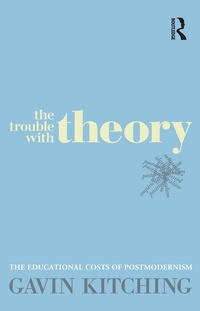
The Trouble with Theory
The educational costs of postmodernism
1st Edition
Published on 23. July 2020
240 pages
978-1-000-24721-3 (ISBN)
Description

Postmodern theory has engaged the hearts and heads of the brightest students because of its apparent political and social radicalism. Despite this Professor Gavin Kitching claims that, 'At the heart of postmodernism is very poor, deeply confused and misbegotten philosophy. As a result even the very best students who fall under its sway produce radically incoherent ideas about language, meaning, truth and reality.'
This is not another conservative attack on postmodernism. Rather, it is a carefully considered analysis from a dedicated university teacher who is convinced that we have gone terribly astray. He shows that postmodern theory is at best irrelevant to, and at worst undermining of, persuasive political arguments, and reveals the basic philosophical confusion at its heart which makes this so.
Essential reading for any student writing a thesis in the humanities and the social sciences, and for their teachers.
'It is the strongest and best attack on the ravages of routine post-modernism that I have ever read. I applaud the way he lists the good causes that students warmly espouse, and then suggests a simpler way to support them without the self-destructive it's all just language that is implicit in their work.' - Professor Sir Bernard Crick, Emeritus Professor of Politics, Birkbeck College, University of London
'Gavin Kitching rattles the cages. Will the inmates hear this? They should, if only for the reason that there is virtue in learning to argue against yourself. This is a serious book.' - Professor Peter Beilharz, Sociology, La Trobe University
'Required reading for anyone who wants to understand how and why postmodernism has had such disastrous pedagogical consequences.' - Professor David G. Stern, Philosophy, University of Iowa
This is not another conservative attack on postmodernism. Rather, it is a carefully considered analysis from a dedicated university teacher who is convinced that we have gone terribly astray. He shows that postmodern theory is at best irrelevant to, and at worst undermining of, persuasive political arguments, and reveals the basic philosophical confusion at its heart which makes this so.
Essential reading for any student writing a thesis in the humanities and the social sciences, and for their teachers.
'It is the strongest and best attack on the ravages of routine post-modernism that I have ever read. I applaud the way he lists the good causes that students warmly espouse, and then suggests a simpler way to support them without the self-destructive it's all just language that is implicit in their work.' - Professor Sir Bernard Crick, Emeritus Professor of Politics, Birkbeck College, University of London
'Gavin Kitching rattles the cages. Will the inmates hear this? They should, if only for the reason that there is virtue in learning to argue against yourself. This is a serious book.' - Professor Peter Beilharz, Sociology, La Trobe University
'Required reading for anyone who wants to understand how and why postmodernism has had such disastrous pedagogical consequences.' - Professor David G. Stern, Philosophy, University of Iowa
Reviews / Votes
'It is the strongest and best attack on the ravages of routine post-modernism that I have ever read. I applaud the way he lists the good causes that students warmly espouse, and then suggests a simpler way to support them without the self-destructive it's all just language that is implicit in their work.' - Professor Sir Bernard Crick, Emeritus Professor of Politics, Birkbeck College, University of London'Gavin Kitching rattles the cages. Will the inmates hear this? They should, if only for the reason that there is virtue in learning to argue against yourself. This is a serious book.' - Professor Peter Beilharz, Sociology, La Trobe University
'Required reading for anyone who wants to understand how and why postmodernism has had such disastrous pedagogical consequences.' - Professor David G. Stern, Philosophy, University of Iowa
More details
Edition
1. Auflage
Language
English
Place of publication
London
United Kingdom
Publishing group
Taylor & Francis Ltd
Target group
College/higher education
Product notice
Reflowable
ISBN-13
978-1-000-24721-3 (9781000247213)
Copyright in bibliographic data and cover images is held by Nielsen Book Services Limited or by the publishers or by their respective licensors: all rights reserved.
Schweitzer Classification
Other editions
Additional editions
Book
09/2008
Pennsylvania State University Press
€94.19
Article exhausted; check different version
Book
08/2008
1st Edition
Allen & Unwin
€34.10
Shipment within 3-4 weeks
Person
Gavin Kitching is Professor of Politics in the School of Social Sciences and International Studies at the University of New South Wales. He is a Fellow of the Australian Academy of Social Sciences and has research interests in the philosophy of Wittgenstein, globalisation, and agricultural development in the Third World.
Content
Preface
Acknowledgements
Introduction
Addendum: Research methodology and book structure
PART I TIED IN KNOTS: THEORY AND CONFUSION
1 Doing theory', or creating a landscape
2 Relationships', or arranging objects in the landscape
3 Zapping landscapes and setting objects alight: Power
4 The social construction of reality: Equivocations
5 Language and discourse
PART II LOOSENING THE COILS: WITTGENSTEIN
6 An outsider's view of the world: The contemplative stance of the theorist
7 Theory and Tractatus epistemology
Addendum: The Philosophical Investigations, the Tractatus Logico-Philosophicus and the Augustinian picture' of language: An aside on a technical but relevant issue in Wittgensteinian exegesis
8 The last and most tangled knot: The linguistic construction of subjectivity
Addendum: Wittgenstein's conception of language as a city, or theory as
Acknowledgements
Introduction
Addendum: Research methodology and book structure
PART I TIED IN KNOTS: THEORY AND CONFUSION
1 Doing theory', or creating a landscape
2 Relationships', or arranging objects in the landscape
3 Zapping landscapes and setting objects alight: Power
4 The social construction of reality: Equivocations
5 Language and discourse
PART II LOOSENING THE COILS: WITTGENSTEIN
6 An outsider's view of the world: The contemplative stance of the theorist
7 Theory and Tractatus epistemology
Addendum: The Philosophical Investigations, the Tractatus Logico-Philosophicus and the Augustinian picture' of language: An aside on a technical but relevant issue in Wittgensteinian exegesis
8 The last and most tangled knot: The linguistic construction of subjectivity
Addendum: Wittgenstein's conception of language as a city, or theory as
