

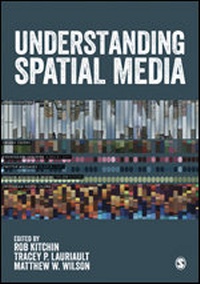
Understanding Spatial Media
1st Edition
Published on 6. February 2017
264 pages
978-1-4739-8743-2 (ISBN)
Description

Over the past decade, a new set of interactive, open, participatory and networked spatial media have become widespread. These include mapping platforms, virtual globes, user-generated spatial databases, geodesign and architectural and planning tools, urban dashboards and citizen reporting geo-systems, augmented reality media, and locative media. Collectively these produce and mediate spatial big data and are re-shaping spatial knowledge, spatial behaviour, and spatial politics.
Understanding Spatial Media brings together leading scholars from around the globe to examine these new spatial media, their attendant technologies, spatial data, and their social, economic and political effects.
The 22 chapters are divided into the following sections:
Spatial media technologies
Spatial data and spatial media
The consequences of spatial media
Understanding Spatial Media is the perfect introduction to this fast emerging phenomena for students and practitioners of geography, urban studies, data science, and media and communications.
Understanding Spatial Media brings together leading scholars from around the globe to examine these new spatial media, their attendant technologies, spatial data, and their social, economic and political effects.
The 22 chapters are divided into the following sections:
Spatial media technologies
Spatial data and spatial media
The consequences of spatial media
Understanding Spatial Media is the perfect introduction to this fast emerging phenomena for students and practitioners of geography, urban studies, data science, and media and communications.
More details
Language
English
Place of publication
London
United Kingdom
Target group
College/higher education
ISBN-13
978-1-4739-8743-2 (9781473987432)
Copyright in bibliographic data and cover images is held by Nielsen Book Services Limited or by the publishers or by their respective licensors: all rights reserved.
Schweitzer Classification
Other editions
Additional editions
Rob Kitchin | Tracey P. Lauriault | Matthew W. Wilson
Understanding Spatial Media
Book
02/2017
1st Edition
SAGE Publications Ltd
€205.01
Shipment within 15-20 days
Persons
Rob Kitchin is a Professor in Maynooth University Social Sciences Institute and Department of Geography. He was a European Research Council Advanced Investigator on the Programmable City project (2013-2018) and a principal investigator on the Building City Dashboards project (2016-2020) and for the Digital Repository of Ireland (2009-2017). He is the (co)author or (co)editor of 31 other academic books, and (co)author of over 200 articles and book chapters. He has been an editor of Dialogues in Human Geography, Progress in Human Geography and Social and Cultural Geography, and was the co-Editor-in-Chief of the International Encyclopedia of Human Geography. He was the 2013 recipient of the Royal Irish Academy's Gold Medal for the Social Sciences. Tracey P. Lauriault is a Programmable City project postdoctoral researcher focussing on how digital data are generated and processed about cities and their citizens. She is actively engaged in research on open data, big data, indicators, and spatial data infrastructures and she has just become a Silicon Republic top 100 women in Science, Technology, Engineering and Math. She is a member of the international Research Data Alliance Legal (RDA) Interoperability Working Group, the Canadian Roundtable on Geomatics Legal and Policy Interest Group, and the advisory board of the Dublin City Council Homelessness Data Task Force.
At the Geomatics and Cartographic Research Centre, in Canada, she investigated data, infrastructures and geographical imaginations, the preservation of and access geomatics data; legal and policy issues associated with geospatial, administrative and civil society data; olfactory cartography; and cybercartography. She was the managing editor of Cybercartography: Theory and Practice, and co-editor of Developments in the Theory and Practice of Cybercartography. With the International Research on Permanent Authentic 8 Records in Electronic Systems (InterPARES 2 Project) based at the University of British Columbia she investigated issues pertaining to the accuracy, reliability and authenticity of scientific data, data portals, and led the Cybercartographic Atlas of Antarctica Case Study. As a consultant she advises the Federal Government of Canada on topics pertaining to the long term preservation of geospatial data. She has also helped numerous non-profit organizations build indicator projects, develop community based data consortia, community mapping and open data strategies.
Matthew W. Wilson is an assistant professor in the Department of Geography at the University of Kentucky and a visiting scholar at the Center for Geographic Analysis at Harvard University. He co-founded and co-directs the New Mappings Collaboratory which studies and facilitates new engagements with geographic representation. His research in critical GIS draws upon STS and urban political geography to understand the development and proliferation of location-based technologies, with particular attention to the consumer electronic sector. He has previously taught at the Harvard Graduate School of Design, and his current research project focuses on the founding of the Laboratory for Computer Graphics at Harvard in 1965, a catalyzing moment in the advent of the digital map. His work has been published in leading journals and collections including, Society & Space, Landscape & Urban Planning, Geoforum, The Professional Geographer, Annals of the Association of American Geographers, Cartographica, Social & Cultural Geography, Gender, Place & Culture, and Environment & Planning A.
At the Geomatics and Cartographic Research Centre, in Canada, she investigated data, infrastructures and geographical imaginations, the preservation of and access geomatics data; legal and policy issues associated with geospatial, administrative and civil society data; olfactory cartography; and cybercartography. She was the managing editor of Cybercartography: Theory and Practice, and co-editor of Developments in the Theory and Practice of Cybercartography. With the International Research on Permanent Authentic 8 Records in Electronic Systems (InterPARES 2 Project) based at the University of British Columbia she investigated issues pertaining to the accuracy, reliability and authenticity of scientific data, data portals, and led the Cybercartographic Atlas of Antarctica Case Study. As a consultant she advises the Federal Government of Canada on topics pertaining to the long term preservation of geospatial data. She has also helped numerous non-profit organizations build indicator projects, develop community based data consortia, community mapping and open data strategies.
Matthew W. Wilson is an assistant professor in the Department of Geography at the University of Kentucky and a visiting scholar at the Center for Geographic Analysis at Harvard University. He co-founded and co-directs the New Mappings Collaboratory which studies and facilitates new engagements with geographic representation. His research in critical GIS draws upon STS and urban political geography to understand the development and proliferation of location-based technologies, with particular attention to the consumer electronic sector. He has previously taught at the Harvard Graduate School of Design, and his current research project focuses on the founding of the Laboratory for Computer Graphics at Harvard in 1965, a catalyzing moment in the advent of the digital map. His work has been published in leading journals and collections including, Society & Space, Landscape & Urban Planning, Geoforum, The Professional Geographer, Annals of the Association of American Geographers, Cartographica, Social & Cultural Geography, Gender, Place & Culture, and Environment & Planning A.
Content
Understanding spatial media - Rob Kitchin, Tracey P. Lauriault and Matthew W. Wilson
Part 1: Spatial media technologies
GIS - Britta Ricker
Digital Mapping - Jeremy Crampton
Digitally augmented geographies - Mark Graham
Locative and sousveillant media - Jim Thatcher
Social Media - Jessa Lingel
Urban dashboards - Shannon Mattern
Geodesign - Stephen Ervin
Part 2: Spatial data and spatial media
Open spatial data - Tracey P. Lauriault
Geospatial big data - Dan Sui
Indicators, benchmarks and urban informatics - Rob Kitchin, Gavin McArdle & Tracey P. Lauriault
Volunteered Geographic Information and Citizen Science - Muki Haklay
Geo-Semantic Web - Peter Pulsifer and Glenn Brauen
Spatial data analytics - Harvey Miller
Legal rights and spatial media - Teresa Scassa
Part 3: The consequences of spatial media
Spatial knowledge and behaviour - Leighton Evans and Sung-Yueh Perng
Leveraging finance and producing capital - Rob Kitchin
Openness, transparency, participation - Tracey P. Lauriault and Mary Francoli
Producing smart cities - Mike Batty
Surveillance and control - Francisco Klauser and Sarah Widmer
Spatial profiling, sorting and prediction - David Murakami Wood
Geoprivacy - Agnieszka Leszczynski
Part 1: Spatial media technologies
GIS - Britta Ricker
Digital Mapping - Jeremy Crampton
Digitally augmented geographies - Mark Graham
Locative and sousveillant media - Jim Thatcher
Social Media - Jessa Lingel
Urban dashboards - Shannon Mattern
Geodesign - Stephen Ervin
Part 2: Spatial data and spatial media
Open spatial data - Tracey P. Lauriault
Geospatial big data - Dan Sui
Indicators, benchmarks and urban informatics - Rob Kitchin, Gavin McArdle & Tracey P. Lauriault
Volunteered Geographic Information and Citizen Science - Muki Haklay
Geo-Semantic Web - Peter Pulsifer and Glenn Brauen
Spatial data analytics - Harvey Miller
Legal rights and spatial media - Teresa Scassa
Part 3: The consequences of spatial media
Spatial knowledge and behaviour - Leighton Evans and Sung-Yueh Perng
Leveraging finance and producing capital - Rob Kitchin
Openness, transparency, participation - Tracey P. Lauriault and Mary Francoli
Producing smart cities - Mike Batty
Surveillance and control - Francisco Klauser and Sarah Widmer
Spatial profiling, sorting and prediction - David Murakami Wood
Geoprivacy - Agnieszka Leszczynski
