

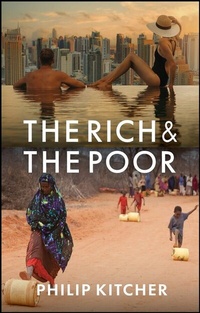
The Rich and the Poor
Description

Philip Kitcher, one of the world's most eminent philosophers, offers a new account of how ethics and politics should mix. The world needs to explore and reprioritize ethical questions, through inclusive deliberation that is both factually informed and mutually engaged with other perspectives. Achieving that end is hard, but without aspiring to it, we are likely to condemn our successors to lives of great hardship. Climate change demands global cooperation of a kind that can only be obtained by returning to ethical inquiry. The divorce between ethics and economics threatens disaster for all.
More details
Other editions
Additional editions
Person
Content
1 The Erosion of Kindness
2 Rethinking Aid
3 Ethical Inquiry
4 The World is Out of Joint
5 Nothing to be Done?
Notes
Index
Preface
The seed from which this book has grown was planted in my young adulthood, half a century ago. It was embedded as I came to recognize how extraordinarily fortunate I had been. My life, I saw, was on track to be different from those of my parents, or indeed of any of my forebears. Unlike my father, who had left school at 12, or my mother, whose education had finished when she was 14, I had been able to attend one great university as an undergraduate, to receive a doctorate from another great university, and to have been given the opportunity of embarking on an academic career. Later, when I attempted to trace my ancestry further, I realized that the relatives I knew had been comparatively lucky. For their parents and grandparents had almost certainly been siphoned off into the workforce before they reached the age of 10, assigned to the exhausting low-paying jobs in which they would pass their lives, subservient to masters whose orders they must obey, and reprimanded whenever they were taken to have made an error. The men toiled as day laborers on richer men's farms; the women were servants in the houses of the wealthy.
I had been born, I came to see, in one of the rare right places at one of the rare right times. After the Second World War, the Labour government, led by Clement Atlee, designed and set in place the British welfare state.1 As one small part of their achievement, local education authorities received funds to enable needy students to attend universities. In my case, given the low income of my parents, I was awarded a grant not only to pay the fees but also to cover the costs of daily life. It was sufficiently generous to allow me to send a little money home. Originally, though, when I had presented the form to my mother for her (necessary) signature, she had hesitated. Universities were not for "people like us." With the education I had already received, I could "get a good job." I could, for example, become an accountant or an actuary. It took some persuasion before the form was ready to submit.
For more than 20 years, the reforms providing increased opportunities to Britain's poorer people were accepted by later governments, even when Conservatives were in power. Beginning around 1980, however, the generosity I had enjoyed began to be retracted. The policy of providing grants to needy students was abolished; it was one of the many victims of the 1990s assault on public goods. Part of my luck resulted from the electoral success temporarily enjoyed by a party genuinely concerned with opening possibilities to working people - and their children. Another part stemmed from a strange convergence between the sympathies of a Tudor monarch and the judgment of a primary school teacher.
Towards the end of his brief reign, Edward VI, the only male heir of Henry VIII, was moved by a sermon preached by Bishop Ridley (who would later be burned at the stake under orders from Edward's sister - and successor - Mary). Shortly before the young king died, he signed the charter to create three institutions for the poor: Christ's Hospital, Bridewell Hospital, and St Thomas' Hospital. Only one of these (St Thomas') is a hospital in the contemporary sense; the other two are schools, originally designed for housing and educating poor children.2 By the early twentieth century, Christ's Hospital had moved out of London, and was open to children from all parts of the British Isles - provided that the family income was sufficiently low. (The ceiling in the mid-twentieth century was £1,000, roughly double what my parents earned in their best year.) It is a school with a distinguished history, and, during my boyhood, the boys' school enjoyed one of the best academic records in the United Kingdom.
The school's quality was well known in some educational circles. That knowledge prompted a master at St Mary's school for boys, my local primary school in Eastbourne, to change my life. One afternoon in 1954, as school was ending, Mr. Manson, assigned to teach the 7-year-olds, took me aside. He asked me if my parents would be at home later - causing me to wonder, of course, what I might have done wrong. His intention, as I found out when he came, was not to report a misdemeanor. He wanted to tell my mother that he thought I would benefit from the fine education Christ's Hospital offered. If I continued on the same trajectory, he explained, I might well succeed in the open entrance exam. His advice was absorbed and pondered. In due course, I applied, took the exam, and was admitted. In consequence I enjoyed an education of a sort I could only dream of for my children and can only dream of for my grandchildren.
My life, then, has been transformed by an odd conjunction of agents: a cluster of progressive politicians, a sensitive boy king, and an unusually thoughtful and kind schoolmaster. And, of course, by three magnificent educational institutions - Christ's Hospital, Cambridge University, and Princeton University - that opened their doors to a serving-class boy.
*
During my career as a professor, spent teaching in American universities, the original sense of my good fortune has only increased. Moreover, as I have compared the opportunities for poor children in the United States in the 1970s and 1980s with those available to kids like me in the 1950s and 1960s, the rhetoric celebrating "the land of opportunity" has only come to appear more vacuous, more nonsensical, and more morally bankrupt. Since the 1980s, of course, the diminishing interest in funding public institutions, especially in programs to enlarge the fortunes of the poor, and the correlative hostility to taxing the rich, on both sides of the Atlantic, have led me to despair of the political condition of the two prosperous nations I know best. Elsewhere in the affluent world, the losses have been less. Vestiges of welfare states still survive. Yet, even in the places apparently most committed to the flourishing of all their citizens - the Nordic countries, for example - it is impossible not to observe a retreat. The army of disposable people is growing, just as the rich grow ever richer.
The repugnance I feel in contemplating the gap between the lives of the rich and the lives of the poor has bubbled away under the surface of my philosophical writing, even when I have been concerned with apparently unrelated topics. In criticizing human sociobiology (and later kindred ventures in evolutionary psychology), I was concerned to expose the flaws in claims that progressive attempts to enhance human opportunities would "rub against the grain of human nature." My reflections on the uses of contemporary biomedicine concluded with a reminder that many human lives are limited not primarily by people's genetic endowment but by the harmful environments in which they live: enthusiasm for molecular adjustments should be matched (or exceeded) by a resolution to provide access to medical care, to safe housing, and to schools in which children might learn. In considering the roles of scientific research in democratic society, I have emphasized the importance of attending to all people. My approach to ethics (presented in chapter 3) has opposed the thought of moral principles delivered from on high, commending instead inquiries that respond to the perspectives of all those affected by an issue. Most explicitly, in proposing that societies should rethink education, I have argued for programs that replace the vision of children as potential contributors to national wealth with emphasis on their development as individuals and as citizens who can cooperate for the common good.3
Themes that have been implicit before become explicit in the chapters that follow. I was led to be more forthright by a message from my undergraduate college, Christ's College Cambridge. In January 2022, the eminent legal scholar, Jane Stapleton, then Master of the College, invited me to give the C. P. Snow Lecture during the academic year 2022-23. The series, honoring Snow, a former College Fellow, had enjoyed a distinguished succession of lecturers in the late twentieth and early twenty-first centuries, before a roughly 10-year hiatus. I accepted eagerly, but felt a heavy responsibility - to prepare something worth hearing.
In considering a topic, I began in the obvious way, by returning to the Rede Lecture, delivered in Cambridge in 1959, with which Snow has been identified ever since. The first part of that lecture, in which Snow distinguished two cultures, one scientific and one humanistic, and went on to urge greater emphasis on science in British education, gave rise to heated debate. Yet when I reread the lecture, and pondered Snow's retrospective reflections on it (available in the excellent edition edited by Stefan Collini4), I discovered something I had never previously noted. Snow identified his main thesis as developed in the second part of the lecture. Science should have greater prominence in the curriculum, he claimed, because the transformation in standards of living achieved in the affluent world through science-directed technology ought to be extended to the people of all nations. Closing the gap in the quality of lives between the rich and the poor was, for him, a morally and politically important task.
And in the world of the 1950s, in a country with a flourishing welfare state, none of his hearers dissented from that.
Fast forward to the present and the recent past. The part of the lecture...
