

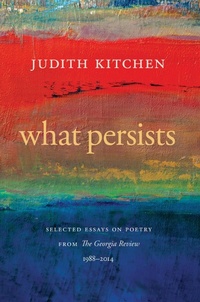
What Persists
Description

What Persists contains eighteen of the nearly fifty essays on poetry that Judith Kitchen published in The Georgia Review over a twenty-five-year span. Coming at the genre from every possible angle, this celebrated critic discusses work by older and younger poets, most American but some foreign, and many of whom were not yet part of the contemporary canon. Her essays reveal a cultural history from the dismantling of the Berlin Wall, through 9/11 and the Iraq War, and move into today's political climate. They chronicle personal interests while they also make note of what was happening in contemporary poetry by revealing overall changes of taste, both in content and in the use of craft. Over time, they fashion a comprehensive overview of the contemporary literary scene.
At its best, What Persists shows what a wide range of poetry is being written-by women, men, poets who celebrate their ethnicity, poets who show a fierce individualism, poets whose careers have soared, promising poets whose work has all but disappeared.
More details
Other editions
Additional editions
Person
Content
- Cover
- Half Title
- Title
- Copyright
- Dedication
- Contents
- Foreword
- Author's Preface
- Summer 1988: "Speaking Passions": On William Stafford, Heather McHugh, Linda Pastan, Brigit Pegeen Kelly, Li-Young Lee
- Spring 1991: "Auditory Imagination: The Sense of Sound": On Pamela Gross, Jane Kenyon, Li-Young Lee, Thomas Lux, Wayne Dodd
- Spring 1992: "Excellent Excesses": On Stanley Plumly, William Matthews, Pamela Stewart, Albert Goldbarth, Les Murray
- Fall 1993: "Skating on Paper": On C. K. Williams, W. S. Merwin, Judith Hall, Deborah Pope, Gerald McCarthy,
- Summer 1996: "The Ladybug and the Universe": On Stanley Kunitz, Donald Justice, Gerald Stern, Michael Harper
- Summer 1997: "What Persists": On Charles Wright, Robert Hass, Maxine Kumin, Paul Zimmer, Lisel Mueller, Leslie Norris
- Winter 1998: "Against": On Mary Karr, Billy Collins, Thylias Moss, Ted Hughes
- Summer 1999: "Tensions,": On George Szirtes, Paul Muldoon, Albert Goldbarth, Suzanne Paola, Naomi Shihab Nye
- Winter 2000: "In Pursuit of Elegance": On Les Murray, Yehuda Amichai, Derek Walcott, Jane Cooper, Robert Wrigley, James Richardson, Gregory Djanikian, Stephen Dunn
- Winter 2002: "Interlude": On Madeline DeFrees, Linda Gregerson, Li-Young Lee, Philip Schultz, Natasha Trethewey
- Fall 2005: "The Fact of the Room": On Albert Goldbarth, Quan Barry, Joseph Stroud, Ann Townsend, Kevin Prufer, Linda Bierds
- Fall 2007: "Raindrops on Roses . . . ": On Albert Goldbarth, Carl Phillips, Robert Wrigley, Rebecca McClanahan, Bruce Beasley, Paul Zimmer, John Engels
- Spring 2008: "The Omnivorous Omnibus": On Michael O'Brien, Meghan O'Rourke, Robert Hass, Philip Schultz, Stanley Plumly
- Fall 2010: "Puzzles": On Tony Hoagland, Terrance Hays, Connie Wanek, Peggy Shumaker
- Summer 2011: "Walking the Line": On James Richardson, Robert Wrigley, Elizabeth Bradfield, Robert Cording
- Summer 2012: "A Question Takes": On Marvin Bell, Jane Hirshfield, Kevin Prufer, Kevin Goodan
- Winter 2012: "With a Little Help from My Friends": On Natasha Trethewey, Kathleen Flenniken, John Hodgen, Alice Derry, Lola Haskins
- Winter 2014: "Da Capo al Coda": On Michael Mlekoday, Kerrin McCadden, David Koehn, Laura Donnelly, Kasey Jueds
- Appendix: Notes on the Other Twenty-Eight Essays
