

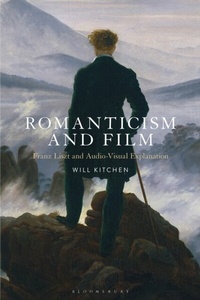
Romanticism and Film
Franz Liszt and Audio-Visual Explanation
1st Edition
Published on 26. November 2020
264 pages
978-1-5013-6134-0 (ISBN)
Description

The relationship between Romanticism and film remains one of the most neglected topics in film theory and history, with analysis often focusing on the proto-cinematic significance of Richard Wagner's music-dramas. One new and interesting way of examining this relationship is by looking beyond Wagner, and developing a concept of audio-visual explanation rooted in Romantic philosophical aesthetics, and employing it in the analysis of film discourse and representation.
Using this concept of audio-visual explanation, the cultural image of the Hungarian pianist and composer Franz Liszt, a contemporary of Wagner and another significant practitioner of Romantic audio-visual aesthetics, is examined in reference to specific case studies, including the rarely-explored films Song Without End (1960) and Lisztomania (1975).
This multifaceted study of film discourse and representation employs Liszt as a guiding-thread, structuring a general exploration of the concept of Romanticism and its relationship with film more generally. This exploration is supported by new theories of representation based on schematic cognition, the philosophy of explanation, and the recently-developed film theory of Jacques Ranciere.
Individual chapters address the historical background of audio-visual explanation in Romantic philosophical aesthetics, Liszt's role in the historical discourses of film and film music, and various filmic representations of Liszt and his compositions. Throughout these investigations, Will Kitchen explores the various ways that films explain, or 'make sense' of things, through a 'Romantic' aesthetic combination of sound and vision.
Using this concept of audio-visual explanation, the cultural image of the Hungarian pianist and composer Franz Liszt, a contemporary of Wagner and another significant practitioner of Romantic audio-visual aesthetics, is examined in reference to specific case studies, including the rarely-explored films Song Without End (1960) and Lisztomania (1975).
This multifaceted study of film discourse and representation employs Liszt as a guiding-thread, structuring a general exploration of the concept of Romanticism and its relationship with film more generally. This exploration is supported by new theories of representation based on schematic cognition, the philosophy of explanation, and the recently-developed film theory of Jacques Ranciere.
Individual chapters address the historical background of audio-visual explanation in Romantic philosophical aesthetics, Liszt's role in the historical discourses of film and film music, and various filmic representations of Liszt and his compositions. Throughout these investigations, Will Kitchen explores the various ways that films explain, or 'make sense' of things, through a 'Romantic' aesthetic combination of sound and vision.
Reviews / Votes
With topics ranging from the archaeology of film music to the representational politics of musicians' biopics, Romanticism and Film is an expansive and theoretically savvy addition to the study of the relationship between film and musical aesthetics. * Carlo Cenciarelli, Lecturer, School of Music, Cardiff University, UK * A very high order of organisation...[this volume] addresses a real need in film musicology. * Charles Francis Leinberger, Professor of Music, The University of Texas at El Paso * This carefully researched book is an important contribution to understanding the intersections between Romantic culture and the history of film. The author has cleverly chosen Liszt as a central focus. This provides a coherent thread through diverse topics such as the uses of Romantic music in film, cinematic representations of Romantic figures, and the impact of Romantic ideals on filmmaking. Romanticism and Film will provoke you to rethink the relevance of Romanticism today." * David Dennen, Assistant Professor of English, Chihlee University of Technology *More details
Edition
1. Auflage
Language
English
Place of publication
New York
United States
Publishing group
Bloomsbury Publishing PLC (Digital)
Target group
Professional and scholarly
Illustrations
18 bw illus
ISBN-13
978-1-5013-6134-0 (9781501361340)
Copyright in bibliographic data and cover images is held by Nielsen Book Services Limited or by the publishers or by their respective licensors: all rights reserved.
Schweitzer Classification
Other editions
Additional editions
Book
05/2022
Bloomsbury Academic USA
€57.19
Shipment within 15-20 days
Book
11/2020
Bloomsbury Academic USA
€163.68
Shipment within 15-20 days
Person
Will Kitchen is Teaching Fellow in Film Studies at the University of Southampton, UK. He is Academic Editor for the journal Romance, Revolution and Reform.
Content
Introduction
1.Culture and Transcendence: Three Explanations of Romanticism
2.The Archaeology of Film Music: Wagner, Liszt and the Symphonic Poem
3.Audio-Visual Explanations of Franz Liszt and His Music: Cultural Image and Schematic Types
4.'Nothing untrue, simply convenient': Song Without End (1960) and the Hollywood Composer Biopic
5.'Piss off, Brahms!': Lisztomania (1975) and Ken Russell in 1975
Conclusion
Appendix A. Music and Language
Appendix B. Wagnerian Terminology and Film
Bibliography
Index
1.Culture and Transcendence: Three Explanations of Romanticism
2.The Archaeology of Film Music: Wagner, Liszt and the Symphonic Poem
3.Audio-Visual Explanations of Franz Liszt and His Music: Cultural Image and Schematic Types
4.'Nothing untrue, simply convenient': Song Without End (1960) and the Hollywood Composer Biopic
5.'Piss off, Brahms!': Lisztomania (1975) and Ken Russell in 1975
Conclusion
Appendix A. Music and Language
Appendix B. Wagnerian Terminology and Film
Bibliography
Index
