

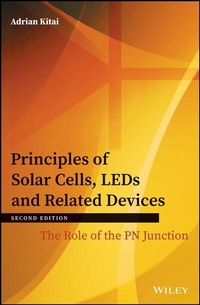
Principles of Solar Cells, LEDs and Related Devices
Description

The second edition of the text that offers an introduction to the principles of solar cells and LEDs, revised and updated
The revised and updated second edition of Principles of Solar Cells, LEDs and Related Devices offers an introduction to the physical concepts required for a comprehensive understanding of p-n junction devices, light emitting diodes and solar cells. The author - a noted expert in the field - presents information on the semiconductor and junction device fundamentals and extends it to the practical implementation of semiconductors in both photovoltaic and LED devices. In addition, the text offers information on the treatment of a range of important semiconductor materials and device structures including OLED devices and organic solar cells.
This second edition contains a new chapter on the quantum mechanical description of the electron that will make the book accessible to students in any engineering discipline. The text also includes a new chapter on bipolar junction and junction field effect transistors as well as expanded chapters on solar cells and LEDs that include more detailed information on high efficiency devices. This important text:
- Offers an introduction to solar cells and LEDs, the two most important applications of semiconductor diodes
- Provides a solid theoretical basis for p-n junction devices
- Contains updated information and new chapters including better coverage of LED out-coupling design and performance and improvements in OLED efficiency
- Presents student problems at the end of each chapter and worked example problems throughout the text
Written for students in electrical engineering, physics and materials science and researchers in the electronics industry, Principles of Solar Cells, LEDs and Related Devices is the updated second edition that offers a guide to the physical concepts of p-n junction devices, light emitting diodes and solar cells.
More details
Other editions
Additional editions
Person
Adrian Kitai, PhD, is Professor in the Departments of Materials Science and Engineering, and Engineering Physics at McMaster University (Canada). He is a world leader in electroluminescent science and technology. His research interests include solar cell materials and devices, and LED materials and devices, and he is involved in start-up companies in both solar cells and display systems using LED devices.
Content
Introduction xi
Acknowledgements xv
1 Introduction to Quantum Mechanics 1
1.1 Introduction 2
1.2 The Classical Electron 2
1.3 Two Slit Electron Experiment 4
1.4 The Photoelectric Effect 7
1.5 Wave Packets and Uncertainty 10
1.6 The Wavefunction 12
1.7 The Schrödinger Equation 14
1.8 The Electron in a One-Dimensional Well 18
1.9 Electron Transmission and Reflection at Potential Energy Step 24
1.10 Expectation Values 26
1.11 Spin 26
1.12 The Pauli Exclusion Principle 29
1.13 Summary 30
Further Reading 32
Problems 33
2 Semiconductor Physics 37
2.1 Introduction 38
2.2 The Band Theory of Solids 38
2.3 Bloch Functions 40
2.4 The Kronig-Penney Model 42
2.5 The Bragg Model 47
2.6 Effective Mass 48
2.7 Number of States in a Band 50
2.8 Band Filling 52
2.9 Fermi Energy and Holes 53
2.10 Carrier Concentration 55
2.11 Semiconductor Materials 65
2.12 Semiconductor Band Diagrams 67
2.13 Direct Gap and Indirect Gap Semiconductors 72
2.14 Extrinsic Semiconductors 74
2.15 Carrier Transport in Semiconductors 79
2.16 Equilibrium and Non-Equilibrium Dynamics 83
2.17 Carrier Diffusion and the Einstein Relation 86
2.18 Quasi-Fermi Energies 88
2.19 The Diffusion Equation 91
2.20 Traps and Carrier Lifetimes 94
2.21 Alloy Semiconductors 98
2.22 Summary 100
References 103
Further Reading 103
Problems 105
3 The p-n Junction Diode 111
3.1 Introduction 112
3.2 Diode Current 113
3.3 Contact Potential 117
3.4 The Depletion Approximation 119
3.5 The Diode Equation 127
3.6 Reverse Breakdown and the Zener Diode 139
3.7 Tunnel Diodes 141
3.8 Generation/Recombination Currents 143
3.9 Metal-Semiconductor Junctions 145
3.10 Heterojunctions 156
3.11 Alternating Current (AC) and Transient Behaviour 157
3.12 Summary 159
Further Reading 160
Problems 161
4 Photon Emission and Absorption 165
4.1 Introduction to Luminescence and Absorption 166
4.2 Physics of Light Emission 167
4.3 Simple Harmonic Radiator 169
4.4 Quantum Description 170
4.5 The Exciton 174
4.6 Two-Electron Atoms 176
4.7 Molecular Excitons 184
4.8 Band-to-Band Transitions 186
4.9 Photometric Units 190
4.10 Summary 194
References 195
Further Reading 195
Problems 197
5 p-n Junction Solar Cells 201
5.1 Introduction 202
5.2 Light Absorption 204
5.3 Solar Radiation 207
5.4 Solar Cell Design and Analysis 207
5.5 Thin Solar Cells, G = 0 214
> 0 218
5.7 Solar Cell Generation as a Function of Depth 220
5.8 Surface Recombination Reduction 224
5.9 Solar Cell Efficiency 225
5.10 Silicon Solar Cell Technology: Wafer Preparation 230
5.11 Silicon Solar Cell Technology: Solar Cell Finishing 233
5.12 Silicon Solar Cell Technology: Advanced Production Methods 237
5.13 Thin-Film Solar Cells: Amorphous Silicon 238
5.14 Telluride/Selenide/Sulphide Thin-Film Solar Cells 245
5.15 High-efficiency Multi-junction Solar Cells 247
5.16 Concentrating Solar Systems 251
5.17 Summary 253
References 254
Further Reading 255
Problems 257
6 Light-Emitting Diodes 265
6.1 Introduction 266
6.2 LED Operation and Device Structures 267
6.3 Emission Spectrum 269
6.4 Non-radiative Recombination 271
6.5 Optical Outcoupling 272
6.6 GaAs LEDs 275
6.7 GaAs1-x Px LEDs 277
6.8 Double Heterojunction Alx Ga1-x As LEDs 278
6.9 AlGaInP LEDs 285
6.10 Ga1-xInxN LEDs 286
6.11 LED Structures for Enhanced Outcoupling and High Lumen Output 294
6.12 Summary 299
References 300
Further Reading 301
Problems 303
7 Organic Semiconductors, OLEDs, and Solar Cells 307
7.1 Introduction to Organic Electronics 308
7.2 Conjugated Systems 309
7.3 Polymer OLEDs 314
7.4 Small-Molecule OLEDs 320
7.5 Anode Materials 323
7.6 Cathode Materials 324
7.7 Hole Injection Layer 325
7.8 Electron Injection Layer 326
7.9 Hole Transport Layer 326
7.10 Electron Transport Layer 328
7.11 Light-Emitting Material Processes 330
7.12 Host Materials 332
7.13 Fluorescent Dopants 334
7.14 Phosphorescent and Thermally Activated Delayed Fluorescence Dopants 335
7.15 Organic Solar Cells 340
7.16 Organic Solar Cell Materials 344
7.17 Summary 349
References 352
Further Reading 352
Problems 353
8 Junction Transistors 359
8.1 Introduction 359
8.2 Bipolar Junction Transistor 360
8.3 Junction Field-Effect Transistor 367
8.4 BJT and JFET Symbols and Applications 371
8.5 Summary 372
Further Reading 373
Problems 375
Appendix 1: Physical Constants 377
Appendix 2: Derivation of the Uncertainty Principle 379
Appendix 3: Derivation of Group Velocity 383
Appendix 4: The Boltzmann Distribution Function 385
Appendix 5: Properties of Semiconductor Materials 391
Index 392
Introduction
In the twenty-first century, p-n junction diode devices are revolutionising electronics, much as transistors did in the twentieth century. Diodes had been developed well before the transistor, and the properties of diodes were initially exploited in power supplies, radios, early logic circuits, and other more specialised applications. Diodes took a distant second place to transistors in the hierarchy of electronic devices after the transistor was developed. This paradigm has now changed decisively: Two semiconductor devices based directly on the p-n junction diode are currently enjoying unparalleled industrial growth. These two devices are the photovoltaic () solar cell and the light-emitting diode ().
The consequences of this development constitute a revolution in two major industrial sectors:
- Energy production has relied on hydrocarbons and nuclear power, and although these will continue to be important, the direct conversion of solar radiation into useful power is the key to a long-term, sustainable energy supply. Ninety-seven per cent of all renewable energy on earth is in the form of solar radiation. The twenty-first century has already seen the rapid growth of a global solar PV industry in conjunction with the involvement of governments worldwide. A scale of production and deployment of PVs that is unprecedented is now underway. The worldwide consumption of silicon semiconductor material for the entire microelectronics industry has been overtaken by its use for solar cells alone.
- The twenty-first century has already witnessed the ongoing displacement of incandescent lamps, fluorescent lamps, and discharge lamps by LEDs. The world's major lighting companies are now dedicating their efforts to LED lighting products. Governments are recognising the benefits of LED lighting in their quest for sustainability.
- More recently, both inorganic LEDs and organic light-emitting diodes (s) are enabling self-emissive displays in key display markets including handheld devices, televisions, and digital billboards. LEDs have also completely replaced fluorescent lamp backlighting in the well-established liquid crystal display () industry.
The purpose of this book is to present the physical concepts required for a thorough understanding of p-n junctions starting with introductory quantum mechanics, solid state physics, and semiconductor fundamentals. This leads to both inorganic and organic semiconductors and the associated p-n junction devices with a major emphasis on PV and LEDs. An introduction to transistors is also included since it builds readily on the p-n junction.
The book is aimed at senior undergraduate levels (years 3 and 4). The theory of the p-n junction can be quite dry in the absence of context. Students are inspired and motivated as they readily appreciate the relevance of both solar cells and LEDs. Chapter 1 motivates and presents introductory quantum mechanics for students who have not seen this elsewhere. As such, this book is designed to be accessible to all students with an interest in semiconductor devices. This is intentional since solar cells and LEDs involve a wide range of science and engineering concepts.
In Chapter 2, the physics of solid-state electronic materials is covered in detail starting from the basic behaviour of electrons in crystals. The quantitative treatment of electrons and holes in energy bands is presented along with the important concepts of excess carriers that become significant once semiconductor devices are connected to sources of power or illuminated by sunlight. A series of semiconductor materials and their important properties are reviewed. The behaviour of semiconductor surfaces and trapping concepts are introduced since they play an important role in solar cell and LED device performance.
In Chapter 3, the basic physics and important models of p-n junction devices are presented. The diode is presented as a semiconductor device that can be understood from band theory covered in Chapter 2. Diode device concepts are extended to include tunnelling, thermionic emission, metal-semiconductor contact phenomena, and the heterojunction.
Chapter 4 introduces the theory of radiation, a topic frequently overlooked in books on semiconductor devices. The deeper understanding of photon emission and absorption processes gained from this chapter is highly relevant to subsequent chapters on solar cells and LEDs. In this chapter, the physics of photon creation is explained with a minimum of mathematical complexity. Radiation theory of the oscillating electronic dipole is treated classically and then using simple quantum mechanics. The key role of the exciton in organic molecules is presented as preparation for OLEDs and organic solar cells in Chapter 7. In addition, line-shapes predicted for direct-gap semiconductors are derived. Finally, the subject of photometric units introduces the concepts of luminance and colour coordinates that are essential to a discussion of organic and inorganic LED devices.
Chapter 5 covers inorganic solar cells. The p-n junction fundamentals introduced in Chapter 3 are further developed to include illumination of the p-n junction. Readily understood modelling is used to explain the behaviour of a solar cell. Realistic solar cell structures and models are presented along with the attendant surface recombination and bulk absorption issues that must be understood in practical solar cells. A series of solar cell technologies are reviewed starting with bulk single and multicrystalline silicon solar cell technology. Amorphous silicon materials and device concepts are presented. Solar cells made using semiconductors such as CdTe are introduced followed by multijunction solar cells using layered, lattice-matched III-V semiconductor stacks.
Chapter 6 considers the basic LED structure and its operating principles. The measured lineshape of III-V LEDs is compared with the predictions of Chapter 4. LEDs are engineered to maximise radiative recombination, and key energy loss mechanisms are discussed. The series of developments that marked the evolution of today's high-efficiency LED devices is presented starting from the semiconductors and growth techniques of the 1960s. This is followed by an in-depth presentation of wider band-gap semiconductors culminating in nitride materials and their synthesis methods for the LED industry. The double heterojunction is introduced and the resulting energy well is analyzed. Strategies to optimise optical outcoupling are discussed. Finally, the concept of spectral down-conversion using phosphor materials and the white LED are introduced along with topics of current importance including the 'green gap'.
Chapter 7 introduces new concepts required for an understanding of organic semiconductors, in which conjugated molecular bonding gives rise to p bands and HOMO and LUMO levels. The organic LED is introduced by starting with the simplest single active layer polymer-based LED followed by successively more complex small-molecule LED structures. The roles of the various layers, including electrodes and carrier injection and transport layers, are discussed and the relevant candidate molecular materials are described. Concepts from Chapter 4, including the molecular exciton and singlet and triplet states, are used to explain efficiency limitations in the light generation layer of small-molecule OLEDs. In addition, the opportunity to use phosphorescent and delayed-fluorescence host-guest light-emitting layers to improve device efficiency is explained. The organic solar cell is introduced and the concepts of exciton generation and exciton dissociation are described in the context of the heterojunction and the bulk heterojunction. The interest in the use of fullerenes and other related nanostructured materials is explained for the bulk heterojunction. The most recent breakthrough in perovskites as a revolutionary hybrid organic/inorganic semiconductor material is presented.
Finally, Chapter 8 introduces, carefully explains, and models the two transistor types for which the p-n junction is most clearly relevant. Both the bipolar junction transistor () and the junction field effect transistor () permit the use of this book for introductory semiconductor device courses that are designed to include three-terminal devices and the concept of amplification. This lays the groundwork for subsequent courses on metal oxide field-effect transistors (s) and other devices.
This Second Edition has been brought up to date throughout and colour has been added liberally throughout the book. A much improved and expanded set of homework problems has been developed. In addition to two new chapters, a more thorough treatment of solid-state physics to better develop band theory is included. Recent developments in telluride/selenide/sulfide solar cells, cadmium-free thin film solar cells, perovskite solar cells, triplet-harvesting strategies for OLEDs, phosphorescent, and thermally activated delayed fluorescence dopants, and LED optical outcoupling are included. A discussion of the LED colour-rendering index has been added, and a more in-depth analysis of carrier diffusion and recombination in solar...
