

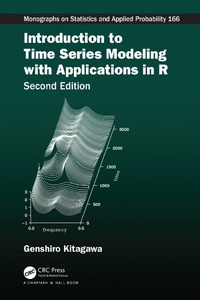
Introduction to Time Series Modeling with Applications in R
2nd Edition
Published on 10. August 2020
340 pages
978-0-429-58452-7 (ISBN)
Description

Praise for the first edition:
[This book] reflects the extensive experience and significant contributions of the author to non-linear and non-Gaussian modeling. ... [It] is a valuable book, especially with its broad and accessible introduction of models in the state-space framework.
-Statistics in Medicine
What distinguishes this book from comparable introductory texts is the use of state-space modeling. Along with this come a number of valuable tools for recursive filtering and smoothing, including the Kalman filter, as well as non-Gaussian and sequential Monte Carlo filters.
-MAA Reviews
Introduction to Time Series Modeling with Applications in R, Second Edition covers numerous stationary and nonstationary time series models and tools for estimating and utilizing them. The goal of this book is to enable readers to build their own models to understand, predict and master time series. The second edition makes it possible for readers to reproduce examples in this book by using the freely available R package TSSS to perform computations for their own real-world time series problems.
This book employs the state-space model as a generic tool for time series modeling and presents the Kalman filter, the non-Gaussian filter and the particle filter as convenient tools for recursive estimation for state-space models. Further, it also takes a unified approach based on the entropy maximization principle and employs various methods of parameter estimation and model selection, including the least squares method, the maximum likelihood method, recursive estimation for state-space models and model selection by AIC.
Along with the standard stationary time series models, such as the AR and ARMA models, the book also introduces nonstationary time series models such as the locally stationary AR model, the trend model, the seasonal adjustment model, the time-varying coefficient AR model and nonlinear non-Gaussian state-space models.
About the Author:
Genshiro Kitagawa is a project professor at the University of Tokyo, the former Director-General of the Institute of Statistical Mathematics, and the former President of the Research Organization of Information and Systems.
[This book] reflects the extensive experience and significant contributions of the author to non-linear and non-Gaussian modeling. ... [It] is a valuable book, especially with its broad and accessible introduction of models in the state-space framework.
-Statistics in Medicine
What distinguishes this book from comparable introductory texts is the use of state-space modeling. Along with this come a number of valuable tools for recursive filtering and smoothing, including the Kalman filter, as well as non-Gaussian and sequential Monte Carlo filters.
-MAA Reviews
Introduction to Time Series Modeling with Applications in R, Second Edition covers numerous stationary and nonstationary time series models and tools for estimating and utilizing them. The goal of this book is to enable readers to build their own models to understand, predict and master time series. The second edition makes it possible for readers to reproduce examples in this book by using the freely available R package TSSS to perform computations for their own real-world time series problems.
This book employs the state-space model as a generic tool for time series modeling and presents the Kalman filter, the non-Gaussian filter and the particle filter as convenient tools for recursive estimation for state-space models. Further, it also takes a unified approach based on the entropy maximization principle and employs various methods of parameter estimation and model selection, including the least squares method, the maximum likelihood method, recursive estimation for state-space models and model selection by AIC.
Along with the standard stationary time series models, such as the AR and ARMA models, the book also introduces nonstationary time series models such as the locally stationary AR model, the trend model, the seasonal adjustment model, the time-varying coefficient AR model and nonlinear non-Gaussian state-space models.
About the Author:
Genshiro Kitagawa is a project professor at the University of Tokyo, the former Director-General of the Institute of Statistical Mathematics, and the former President of the Research Organization of Information and Systems.
More details
Series
Edition
2nd edition
Language
English
Place of publication
London
United Kingdom
Publishing group
Taylor & Francis Ltd
Target group
Professional and scholarly
ISBN-13
978-0-429-58452-7 (9780429584527)
Copyright in bibliographic data and cover images is held by Nielsen Book Services Limited or by the publishers or by their respective licensors: all rights reserved.
Schweitzer Classification
Other editions
Additional editions
Book
08/2022
2nd Edition
Chapman & Hall/CRC
€74.10
Shipment within 15-20 days
Book
08/2020
2nd Edition
Chapman & Hall/CRC
€187.90
Shipment within 15-20 days
Person
Genshiro Kitagawa is a project professor at the University of Tokyo, the former Director-General of the Institute of Statistical Mathematics, and the former President of the Research Organization of Information and Systems.
Content
1. Introduction and Preparatory Analysis. 2. The Covariance Function. 3. The Power Spectrum and the Periodogram. 4. Statistical Modeling. 5. The Least Squares Method. 6. Analysis of Time Series Using ARMA Models. 7. Estimation of an AR Model. 8. The Locally Stationary AR Model. 9. Analysis of Time Series with a State-Space Model. 10. Estimation of the ARMA Model. 11. Estimation of Trends. 12. The Seasonal Adjustment Model. 13. Time-Varying Coefficient AR Model. 14. Non-Gaussian State-Space Model. 15. The Sequential Monte Carlo Filter. 17. Simulations.
