

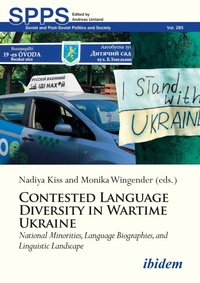
Contested Language Diversity in Wartime Ukraine
Description

This collected volume focuses on the language situation in wartime Ukraine. The research employs the methods of language biography, linguistic landscape as well as media and discourse analysis. The contributions depict a holistic picture of the language situation, use, and attitudes. The volume's novelty is in presenting rich empirical data and a detailed description of various linguistic minorities in Ukraine (Hungarians, Romanians, Gagauz, and others), their language behavior and attitudes towards state and regional language policy. The language biography interview and sociolinguistic survey data shed light on the processes of language shifts that occur in Ukraine and are accelerated by the war situation. Furthermore, the volume elucidates the impact of the war on the language situation and compares national and regional perspectives of language use. The volume's contributors are: Bohdan Azhniuk, Ivanna Car, Maryna Deliusto, Lesia Hychko, Nadiya Kiss, Andrii Kolesnykov, , Nataliia Matvieeva, Svitlana Nemyrovska, Anastasiia Onatii, Liudmyla Pidkuimukha, Olena Ruda, Vasyl Sharkan, Halyna Shumytska, Svitlana Sokolova, and Taras Tkachuk.
Reviews / Votes
"This book covers interdisciplinary research that goes beyond language policy and planning in wartime Ukraine. It offers a unique opportunity to trace how the entire society, attitudes, education, world views, and languages changed during the Russian invasion. Special attention is paid to the fate of minorities and people who were forced to migrate to other parts of the country. The topics are treated rigorously and thoroughly, contributing to the wider field of study exploring languages and cultures in war time. The intended audience is not restricted to language specialists but includes career diplomats, journalists, historians, sociologists, and those interested in Ukraine and Eastern Europe. -Alex Krouglov, Professor of Russian and Ukrainian, University College LondonMore details
Other editions
Additional editions
Persons
Dr Nadiya Kiss is a Gerda Henkel Fellow at the University of Erfurt. Previously, she worked as a Postdoctoral Researcher at the Giessen Center for the East European Studies of the Justus Liebig University and as Associate Professor of Ukrainian Language at the Kyiv-Mohyla Academy. Kiss is a co-founder of the research network "Vision Ukraine: Education, Language, Migration." Her previous book includes "Together We Are Power!" The Rhetoric of Ukrainian Resistance (Klio 2015, in Ukrainian). Her papers have been published in, among others, Cognitive Studies, European Yearbook of Minority Issues, Journal of Belonging, Identity, Language and Diversity, as well as the European Dictionary of Philosophies and Ukrainian Decolonial Glossary.
Dr Monika Wingender is Professor for Slavic Linguistics at the Justus Liebig University of Giessen. Since 2006, she is also Managing Director of the Giessen Center for Eastern European Studies (GiZo). Wingender was, among others, principal investigator for two Volkswagen Foundation projects on bi-/multilingualism and contested language diversity in Eastern Europe. Out of this, emerged her co-edited collected volume Language Politics, Language Situations and Conflicts in Multilingual Societies: Case Studies from Contemporary Russia, Ukraine and Belarus (Harrassowitz 2021). Wingender's papers have been published in, among others, Die Welt der Slaven, Sotsiolingvistika, European Yearbook of Minority Issues, Osteuropa, as well as collected volumes and handbooks.
Content
- Intro
- Contents
- Introduction
- Section I - Influence of the War on Language Use and Attitudes
- Language Behavior of Ukrainians Against the Background of the Full-Scale War : Trends of Change
- Language and War : Language-Related Discourse in Ukraine Since the Beginning of the Full-Scale Invasion
- "Russia Must Be Opposed on All Fronts" : How the Full-Scale War Has Changed Language Situation in the Ukrainian Business Environment
- Totalitarian Echoes : Mapping the Influence on Ukrainian Language Textbooks
- Changes in Language and National Consciousness of Ukrainians in the Period of Russia's Full-Scale War in Ukraine
- Moral Values of the Ukrainian-Speaking and Russian-Speaking Students in Bilingual Settings
- Section II - Indigenous People, National Minorities and Regional Perspectives
- Crimean Tatars in the Context of War, Displacement and Forced Migration : Language Policy and Behavior
- Ethnolinguistic Demarcation of Public Space in the Linguistic Landscape of Transcarpathia, Ukraine
- Language Situation of National Minorities in Transcarpathia : Socio-Communicative Elements of Design and Linguistic Landscape
- Autobiographical Narrative of Linguistic Personality Formation in a Multilingual Border Region : Documentation Based on In-Depth Interviews
- Media Discussions on the Functioning ofMinority Languages in Transcarpathia
- Language Adaptation of Ethnic Russians inthe West of Ukraine
- From the Observations of Dynamics ofLanguage Situation in the Multilingual AreaBetween the Dniester and the Danube Rivers
- Perception of the Ukrainian LanguageAmongst National Minority Representativesin Chernihiv
