

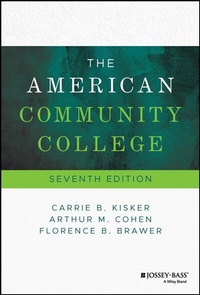
The American Community College
Description

The revised seventh edition of The American Community College is an essential resource for practitioners and graduate students in the field of higher education. This book has been providing up-to-date information and statistics about community colleges for four decades and is a trusted and revered reference. Covering community college students, faculty, curriculum, assessment, finance, governance, and more, this book provide a thorough understanding of the role community colleges play in the American educational system. For educators, policymakers, and philanthropists alike, community colleges are important as the nexus of national efforts to prepare a highly skilled workforce and as the lynchpin of the K-20 education pipeline. This book delivers the facts and context readers need to make informed decisions in the community college space.
Written by leading researchers in the field, The American Community College has been thoroughly revised with a greater focus on equity. Further, this edition includes access to online supplemental materials, including end-of-chapter guiding questions and a guide for transitioning from the 6th to the 7th edition. Additional updates include coverage of collaborations with community, economic, and workforce development organizations; a greater focus on entrepreneurship and innovation; recent efforts to improve student persistence and attainment through guided pathways and equity-minded student supports; and the growing emphasis on preparing a skilled workforce via noncredit training, credit for prior learning, micro-credentials, and community college baccalaureate programs. Readers of The American Community College will:
* Benefit from a comprehensive analysis of the most recent findings and up-to-date information on the American community college.
* Find completely revised and updated information about recent changes in the community college landscape
* Obtain current information on student access and outcomes, instruction, student services, and curricular functions
* Learn from updated tables and graphs that reflect the most current data and incorporate new examples of the services that colleges provide
Since it was first published in 1982, The American Community College has become the primary resource that faculty, administrators, trustees, and researchers look to for information on these quintessentially American institutions.
More details
Other editions
Additional editions
Persons
Carrie B. Kisker is president of Kisker Education and leads the Center for the Study of Community Colleges.
Arthur M. Cohen was professor of higher education at the University of California, Los Angeles from 1964 to 2004 and editor-in-chief of the journal New Directions for Community Colleges.
Florence B. Brawer was research director of the Center for the Study of Community Colleges and associate editor of New Directions for Community Colleges.
Content
Acknowledgments xvii
About the Authors xix
1. Background: Evolving Priorities and Expectations of the Community College 1
2. Students: Diverse Backgrounds and Purposes 47
3. Faculty: Building a Professional Identity 87
4. Governance, Organization, and Administration: Managing the Contemporary College 119
5. Finances: Generating, Sustaining, and Allocating Resources 163
6. Teaching and Learning: Methods, Media, and Effects 201
7. Student Services: Supporting Educational Objectives 231
8. Developmental Education: Enhancing Literacy and the Likelihood of Success in College 265
9. Integrative Education: General Education for the Twenty- First Century 297
10. Liberal Arts and the Transfer Function: Preparation for the University 319
11. Occupational Education: Growth and Change in Workforce Preparation 345
12. Serving the Community: Extending College Services and Training 387
13. Student Progress and Outcomes: A Focus on Equity and Accountability 415
14. Scholarship and Commentary: Perspectives of the Community College 459
15. Toward the Future: Trends, Challenges, and Opportunities 481
Appendix: For- Profit Institutions 511
References 537
Name Index 611
Subject Index 621
Preface
This is the seventh edition of a book published originally in 1982. It is about American community colleges, institutions that offer associate degrees, occupational certificates, and, increasingly, baccalaureate degrees to their students and that provide a variety of other services to the communities in which they are located. These nearly 1,000 institutions range in size from fewer than 100 to more than 60,000 students in a multi-campus district. Less than one-tenth of them, mostly the smaller colleges, are privately supported. The others, the comprehensive, publicly funded institutions, are found in every state.
Audience and Scope
In this edition, as with the previous editions, our purpose is to present a comprehensive, one-volume text useful for everyone concerned with community colleges: administrators, faculty, staff, trustees, graduate students and university-based scholars, and state-level officials. The descriptions and analyses of each of the institution's functions can be used by administrators seeking to learn about practices that have proven effective in other colleges, curriculum planners involved in program revision, faculty members seeking ideas for modifying their courses or participating in shared governance, student services personnel seeking to better support students, and trustees and officials concerned with college policies and student progress and outcomes. Community college scholars, particularly those affiliated with the Council for the Study of Community Colleges, have been largely responsible for extending our understanding of the contemporary college and its students, and many of their studies are reflected in these pages, making this book a useful resource for those seeking a starting point for future research.
The American Community College focuses mainly on the period since 1960, when the rapid growth of the institutions ensured access to college for virtually every American. Over the next 40 years, the number of community colleges more than doubled and the percentage of 18- to 24-year-olds enrolled in college increased from 18% to 36%. (The number of colleges has since declined, but enrollments have increased to 40% of 18- to 24-year-olds.) This book pays particular attention, however, to events and trends occurring in the twenty-first century, as shifts in institutional functioning and financing during these decades are especially useful to those interested in how the community college will carry out its missions and perform a larger social role in the years to come.
The book is written as an interpretive analysis. It provides data on community college students, faculty, curriculum, governance, financing, and many other quantifiable dimensions. It explores shifts in institutional purpose over time, including the rise of occupational education and the blending of career and transfer curricula. It explains how, for a time, students' patterns of college attendance forced a conversion from a linear to a lateral curriculum pattern, from students taking courses in sequence to selecting at will from an à la carte menu of (mostly) introductory options, as well as more recent efforts to reverse the trend and provide incoming students with a structured course map through one of a limited set of program areas. It shows how the developmental, integrative, liberal arts, occupational, and community service functions are interrelated and how advising, counseling, and other support services can be integrated into the instructional program to support student persistence and well-being. It tracks efforts to collect and analyze student progress and outcomes data as educators and policymakers alike became more concerned with institutional accountability and, more recently, student equity. It examines some of the criticism that has been leveled at the community college by those who feel it has failed either in its social role or in various aspects of institutional functioning, and it concludes with a look to the future for these colleges. An appendix discusses the for-profit institutions that similarly offer associate degrees and workforce certificates but have little else in common with community colleges.
New in the Seventh Edition
A revised edition of our work is warranted now because several changes have occurred since the sixth edition appeared in 2014. Some of these changes can be attributed to (or were exacerbated by) the COVID-19 pandemic and its aftermath, but many others are the realization of trends that have been decades in the making. Among the highlights:
- Once likened to herding cats or turning a large ship into the wind, organizational change has not only become a necessity in higher education but is now a process in which community college faculty and staff are much more adept. Certainly, the colleges' quick pivot to virtual instruction in March 2020 hastened this evolution, but years of experimenting with innovative and sometimes entrepreneurial approaches to serving students and communities provided a foundation for this new openness to change.
- As institutions designed to enable greater access to the postsecondary system, over the years community colleges have gradually incorporated an equity-minded approach to teaching and supporting students. In recent years, however, embracing equity in all aspects of institutional functioning has become "an urgent leadership imperative" (McPhail and Beatty, 2021, p. 2), and community colleges once again have an opportunity to modify structures and practices that have historically precluded economic and social mobility for marginalized groups.
- The COVID-19 pandemic laid bare what many in higher education already knew: that unconscionable numbers of students suffer from basic needs insecurities or mental health challenges, and that the most vulnerable are low-income learners; LGBTQ+, transgender, and nonbinary students; students living in rural areas; and those from races and ethnicities that have been historically marginalized in both society and in higher education. Although colleges and universities have ramped up their provision of wrap-around services, supporting these learners in life and in their educational journeys has become a defining challenge and one in which community colleges cannot afford to fail.
- More and more students now view higher education as a choose-your-own adventure in which they can piece together degrees, certificates, apprenticeships, and non-degree credentials in ways that suit their lives and career progressions. Although community colleges have worked hard to integrate liberal arts and occupational pathways, incorporate stackable credentials, and develop transfer agreements between applied associate and bachelor's degree programs, there is far more work to be done to normalize the fluid and flexible ways in which students engage with postsecondary education and to create multiple entry and re-entry points where learners feel welcomed and supported.
Despite these and other changes, many things have remained the same. Hardly any new community colleges have been formed in the past 20 years (in fact, most tallies continue to decline as institutions offering the baccalaureate are moved to four-year categories). The major purposes have remained stable, including a mission to serve the community, although conceptions of these functions continue to evolve. The institutions are still concerned with providing relevant educational services to their clients, who attend for various reasons. And while many of the issues we note at the end of each chapter are new, a few are repeated from earlier editions; the most intractable problems are never solved.
Thus, although the structure of the book remains largely the same, much has changed in this edition. Each chapter reviews the antecedents of practices and policies purposely to show the history underlying contemporary activities and perceptions. But throughout the book, research findings and statistics have been updated, and we have incorporated new examples of services the colleges provide. Perhaps most importantly, this edition breaks from its predecessors in that its guiding perspective is that of a woman born roughly 75 years after junior colleges first emerged in America, whose twenty-first century graduate education and professional experience provides a lens for understanding community colleges and the society in which they operate that is, at times, fundamentally different from that employed by her beloved and much-missed co-authors. In that sense, this edition may feel completely new. It is my hope, however, that the aspects of The American Community College that have proven so useful to educators, scholars, and policymakers over the last 40 years remain intact, and that this book endures as a valuable resource for all those concerned with the progress and success of community colleges in America.
Overview of the Contents
Chapter 1 recounts the social forces that contributed to the expansion and contemporary development of community colleges. It examines the ever-evolving institutional purposes and forms, provides an overview of curricular functions, discusses the community college's place in the academic pipeline, and questions what the shape of American higher education would be if there were no community colleges.
Chapter 2 examines the diverse backgrounds, identities, and purposes of community college students and explores...
