

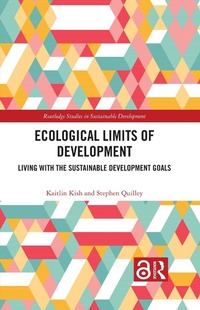
Ecological Limits of Development
Living with the Sustainable Development Goals
1st Edition
Published on 3. November 2021
310 pages
978-1-000-47147-2 (ISBN)
Description

Embracing the reality of biophysical limits to growth, this volume uses the technical tools from ecological economics to recast the Sustainable Development Goals (SDGs) as Ecological Livelihood Goals - policy agendas and trajectories that seek to reconcile the social and spatial mobility and liberty of individuals, with both material security and ecological integrity.
Since the 1970s, mainstream approaches to sustainable development have sought to reconcile ecological constraints with modernization through much vaunted and seldom demonstrated strategies of 'decoupling' and 'dematerialization'. In this context, the UN SDGs have become the orchestrating drivers of sustainability governance. However, biophysical limits are not so easily sidestepped. Building on an ecological- economic critique of mainstream economics and a historical- sociological understanding of state formation, this book explores the implications of ecological limits for modern progressive politics. Each chapter outlines leverage points for municipal engagement in local and regional contexts. Systems theory and community development perspectives are used to explore under- appreciated avenues for the kind of social and cultural change that would be necessary for any accommodation between modernity and ecological limits. Drawing on ideas from H.T. Odum, Herman Daly, Zigmunt Bauman, and many others, this book provides guiding research for a convergence between North and South that is bottom-up, household-centred, and predicated on a re- emerging domain of Livelihood. In each chapter, the authors provide recommendations for reconfiguring the UN's SDGs as Ecological Livelihood Goals - a framework for sustainable development in an era of limits.
This book will be of great interest to students and scholars of ecological economics, socio- ecological systems, political economy, international and community development, global governance, and sustainable development.
Since the 1970s, mainstream approaches to sustainable development have sought to reconcile ecological constraints with modernization through much vaunted and seldom demonstrated strategies of 'decoupling' and 'dematerialization'. In this context, the UN SDGs have become the orchestrating drivers of sustainability governance. However, biophysical limits are not so easily sidestepped. Building on an ecological- economic critique of mainstream economics and a historical- sociological understanding of state formation, this book explores the implications of ecological limits for modern progressive politics. Each chapter outlines leverage points for municipal engagement in local and regional contexts. Systems theory and community development perspectives are used to explore under- appreciated avenues for the kind of social and cultural change that would be necessary for any accommodation between modernity and ecological limits. Drawing on ideas from H.T. Odum, Herman Daly, Zigmunt Bauman, and many others, this book provides guiding research for a convergence between North and South that is bottom-up, household-centred, and predicated on a re- emerging domain of Livelihood. In each chapter, the authors provide recommendations for reconfiguring the UN's SDGs as Ecological Livelihood Goals - a framework for sustainable development in an era of limits.
This book will be of great interest to students and scholars of ecological economics, socio- ecological systems, political economy, international and community development, global governance, and sustainable development.
More details
Series
Edition
1. Auflage
Language
English
Place of publication
London
United Kingdom
Publishing group
Taylor & Francis Ltd
Target group
College/higher education
Product notice
Reflowable
Illustrations
5 Tables, black and white; 17 Line drawings, black and white; 5 Halftones, black and white; 22 Illustrations, black and white
File size
4,61 MB
ISBN-13
978-1-000-47147-2 (9781000471472)
Copyright in bibliographic data and cover images is held by Nielsen Book Services Limited or by the publishers or by their respective licensors: all rights reserved.
Schweitzer Classification
Other editions
Additional editions
Kaitlin Kish | Stephen Quilley
Ecological Limits of Development
Living with the Sustainable Development Goals
Book
05/2023
1st Edition
Routledge
€65.80
Shipment within 15-20 days
Kaitlin Kish | Stephen Quilley
Ecological Limits of Development
Living with the Sustainable Development Goals
Book
11/2021
1st Edition
Routledge
€206.10
Shipment within 15-20 days
Kaitlin Kish | Stephen Quilley
Ecological Limits of Development
Living with the Sustainable Development Goals
Book
10/2021
Routledge
Unfortunately, price unknown
Available (delivery time upon request)
Persons
Kaitlin Kish is Research Associate for the Ecological Footprint Initiative at York University in collaboration with the Global Footprint Network and Lecturer of Ecological Economics at the University of British Columbia's Haida Gwaii Institute, Canada. She is Vice- President - Programs for the Canadian Society for Ecological Economics, a research fellow with Economics for the Anthropocene at McGill University, and held a doctoral research fellowship with the Waterloo Institute for Social Innovation and Resilience at the University of Waterloo.
Stephen Quilley is Associate Professor of Social and Environmental Innovation in the School of Environment, Resources and Sustainability at the University of Waterloo, Canada. Trained in historical sociology and political economy, he has previously held tenured positions at University College Dublin, Ireland, and Keele University in the UK, and a lectureship and a research fellowship at the Moscow School of Economic and Social Science and the University of Manchester.
Stephen Quilley is Associate Professor of Social and Environmental Innovation in the School of Environment, Resources and Sustainability at the University of Waterloo, Canada. Trained in historical sociology and political economy, he has previously held tenured positions at University College Dublin, Ireland, and Keele University in the UK, and a lectureship and a research fellowship at the Moscow School of Economic and Social Science and the University of Manchester.
Content
Part 1: Energy, Complexity, and Livelihood 1. Introduction: 'Me, myself, I' and the political economy of the Sustainable Development Goals 2. Energy and Social Complexity: A primer in ecological economics 3. State, Market and Livelihood: Ideology, politics and political economy in an era of limits 4. Core and periphery in the global economy: how does green politics in the 'north' relate to development in the global South Part 2: Basic Systems of Sustaining Life 5. Human Culture and Life on Land and Sea: Attachment and Scale in Ecology and Society 6. "Energy for All": Ecological Economic Targets for an Energy Transition that Centers Well-being within Planetary Boundaries 7. Livelihood and Limits: We Can Prosper Without Growth 8. Wicked Dilemmas of Growth and Poverty: A Case Study of Agroecology 9. SDG 3, Good Health and Well-being from a Limits Perspective Part 3: Life and Wellbeing Enhancing Systems 10. Education, Livelihood and the Market-State: Towards Radical Subsidiarity 11. Removing the Burden: Valuation of the household and commons in the SDGs 12. Are there environmental limits to achieving equality between humans? 13. A Handmade Future: Makers, microfabrication, and meaning for ecological and resilient production networks Part 4: Politics and Global Partnerships 14. Peace and Justice within Limits: putting the pressure on geopolitics, development and social cohesion 15. Engaging Economies of Change: Equitable Partnerships for Climate Action 16. A Crisis of Identity: the UN Sustainable Development Goals within an Unsustainable Law and Governance Framework 17. Ecological Livelihood Goals
