

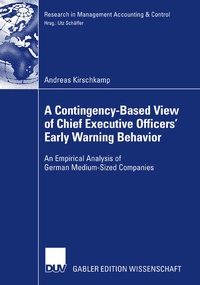
A Contingency-Based View of Chief Executive Officers' Early Warning Behaviour
An Empirical Analysis of German Medium-Sized Companies
1st Edition
Published on 23. January 2008
XXVII, 271 pages
978-3-8350-5504-9 (ISBN)
Description

Foreword With early warning of CEOs in small and medium-sized companies, Andreas Kirschkamp has found a highly relevant and, up to this point, mainly unexplored research area as a field for his dissertation thesis. In a first step, he confirms the results of traditional contingency theory which show a strong link between environmental uncertainty and strategic sensemaking. In a second step and as the actual core of this study, he elaborates on the link between personality traits of CEOs and their strategic sensemaking. Thus, he sees his study in the tradition of an "extended contingency theory". The underlying framework originates from Lewin/Stephens 1994 who distinguish eight attitudes as determinants of organizational design. Kirschkamp empirically shows that six of these attitudes have significant explanatory influence on the design variables. However, egalitarianism and degree of moral reasoning do not have any explanatory power within this context. Regarding the relationship between early warning behavior and success, Kirschkamp finds that successful CEOs differ in their use of sources from their less successful peers. They use internal, impersonal and external, personal sources more than managers of organizations with low success in early warning do. The managers with effective early warning behavior scan with a broader scope, delegate less, interpret with more and different partners, and more intensively. However, no difference can be observed as for the frequency of scanning, tool support and fixity of time for interpretation.
More details
Other editions
Additional editions
Andreas Kirschkamp
A Contingency-Based View of Chief Executive Officers' Early Warning Behaviour
An Empirical Analysis of German Medium-Sized Companies
Book
11/2007
Deutscher Universitätsverlag
€53.49
Shipment within 10-15 days
Persons
Dr. Andreas Kirschkamp promovierte bei Prof. Dr. Utz Schäffer am Lehrstuhl für Controlling der European Business School, Oestrich-Winkel. Er ist im Bereich Mergers & Acquisitions bei der Verlagsgruppe Georg von Holtzbrinck in Stuttgart tätig.
Content
Understanding of Early Warning in Literature and Definition of Important Terms.- Contingency Theory as an Approach to Explain Early Warning Behavior.- Deduction of Hypotheses.- Operationalization of the Research Model.- Methodological Conception of the Analysis.- Results of the Empirical Analysis.- Final Thoughts and Outlook.
A Introduction (p. 1)
1 Motivation and Objectives
"Organizations depend on the environment [.] and often must cope with unstable, unpredictable external events." They can anticipate these events that affect the organization by early warning, a two-step process that comprises scanning the environment and interpreting these data into information about opportunities and risks for the organization.
"[I]dentifying the opportunities and risks" in the organizational environment gives organizations time and the possibility to survive by changing strategy or structure in order to adapt quickly to new trends or by even influencing these trends. Organizations that are aware of potential risks and chances can use this information and shape the environment or adapt to it. So, they have the possibility to avoid a missing fit between the organizational environment and the strategy of the organization which results in declining performance.
In consequence, it is not surprising that organizations anticipating these potential risks and chances tend to be more successful than competitors which are not aware of them. This process helps organizations to outperform peers and leads to a competitive advantage. Therefore, early warning is perceived as a resource defined as "stocks of available factors that are owned or controlled by the firm" which can be deployed by the company. This is supported by the resource based view that assumes "that sustained superior performance arises from sustainable competitive advantages" caused by firm-specific resources.
The relevance and necessity of this anticipation can be illustrated with examples from companies that anticipated trends and therefore gained market dominance. AMAZON foresaw the relevance of the internet as a distribution channel and DELL new methods of production and storage. Both of them were then able to convert this foresight into a benefit for their customers. Examples of companies that were not able to foresee the future also prove the necessity of early warning. On the larger scale, there is a rising number of insolvencies in countries like Germany. On the smaller scale, there are many examples of companies that failed to notice risks and new trends.
The necessity of early warning systems is also reflected by German law. The KonTraG (Gesetz zur Kontrolle und Transparenz im Unternehmensbereich = Law for Control and Transparency in Business) requires an early warning system for stock corporations. It demands these systems mainly because of two reasons: 1) the fast changing environment and 2) the backward orientation of accounting that therefore does not allow the deduction of reliable conclusions about the future. Although the regulatory demands are not completely concordant with those of the organizations, this law has been a milestone in Germany for its importance on early warning in legislation.
In the context of research on early warning there is first of all an important stream of economic literature that focuses on the phenomenon of environmental scanning. At this moment research has focused on the relationship between environmental uncertainty and specific design variables of scanning behavior. But important questions remain and further research has to be done.
The process of early warning consists of two steps: scanning and interpretation. Although the importance of the second step is stressed in literature, empirical studies have not yet focused on this step. In the context of early warning there are only case studies that tried to explore the way managers interpret the organizational environment.
1 Motivation and Objectives
"Organizations depend on the environment [.] and often must cope with unstable, unpredictable external events." They can anticipate these events that affect the organization by early warning, a two-step process that comprises scanning the environment and interpreting these data into information about opportunities and risks for the organization.
"[I]dentifying the opportunities and risks" in the organizational environment gives organizations time and the possibility to survive by changing strategy or structure in order to adapt quickly to new trends or by even influencing these trends. Organizations that are aware of potential risks and chances can use this information and shape the environment or adapt to it. So, they have the possibility to avoid a missing fit between the organizational environment and the strategy of the organization which results in declining performance.
In consequence, it is not surprising that organizations anticipating these potential risks and chances tend to be more successful than competitors which are not aware of them. This process helps organizations to outperform peers and leads to a competitive advantage. Therefore, early warning is perceived as a resource defined as "stocks of available factors that are owned or controlled by the firm" which can be deployed by the company. This is supported by the resource based view that assumes "that sustained superior performance arises from sustainable competitive advantages" caused by firm-specific resources.
The relevance and necessity of this anticipation can be illustrated with examples from companies that anticipated trends and therefore gained market dominance. AMAZON foresaw the relevance of the internet as a distribution channel and DELL new methods of production and storage. Both of them were then able to convert this foresight into a benefit for their customers. Examples of companies that were not able to foresee the future also prove the necessity of early warning. On the larger scale, there is a rising number of insolvencies in countries like Germany. On the smaller scale, there are many examples of companies that failed to notice risks and new trends.
The necessity of early warning systems is also reflected by German law. The KonTraG (Gesetz zur Kontrolle und Transparenz im Unternehmensbereich = Law for Control and Transparency in Business) requires an early warning system for stock corporations. It demands these systems mainly because of two reasons: 1) the fast changing environment and 2) the backward orientation of accounting that therefore does not allow the deduction of reliable conclusions about the future. Although the regulatory demands are not completely concordant with those of the organizations, this law has been a milestone in Germany for its importance on early warning in legislation.
In the context of research on early warning there is first of all an important stream of economic literature that focuses on the phenomenon of environmental scanning. At this moment research has focused on the relationship between environmental uncertainty and specific design variables of scanning behavior. But important questions remain and further research has to be done.
The process of early warning consists of two steps: scanning and interpretation. Although the importance of the second step is stressed in literature, empirical studies have not yet focused on this step. In the context of early warning there are only case studies that tried to explore the way managers interpret the organizational environment.
