

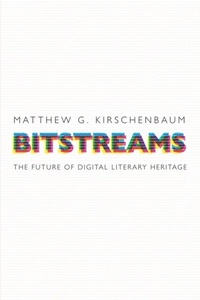
Bitstreams
The Future of Digital Literary Heritage
1st Edition
Published on 23. November 2021
160 pages
978-0-8122-9804-8 (ISBN)
Description

What are the future prospects for literary knowledge now that literary texts-and the material remains of authorship, publishing, and reading-are reduced to bitstreams, strings of digital ones and zeros? What are the opportunities and obligations for book history, textual criticism, and bibliography when literary texts are distributed across digital platforms, devices, formats, and networks? Indeed, what is textual scholarship when the "text" of our everyday speech is a verb as often as it is a noun?
These are the questions that motivate Matthew G. Kirschenbaum in Bitstreams, a distillation of twenty years of thinking about the intersection of digital media, textual studies, and literary archives. With an intimate narrative style that belies the cold technics of computing, Kirschenbaum takes the reader into the library where all access to Toni Morrison's "papers" is mediated by digital technology; to the bitmapped fonts of Kamau Brathwaite's Macintosh; to the process of recovering and restoring fourteen lost "HyperPoems" by the noted poet William Dickey; and finally, into the offices of Melcher Media, a small boutique design studio reimagining the future of the codex.
A persistent theme is that bits-the ubiquitous ones and zeros of computing-are never self-identical, but always inflected by the material realities of particular systems, platforms, and protocols. These materialities are not liabilities: they are the very bulwark on which we stake the enterprise for preserving the future of literary heritage.
These are the questions that motivate Matthew G. Kirschenbaum in Bitstreams, a distillation of twenty years of thinking about the intersection of digital media, textual studies, and literary archives. With an intimate narrative style that belies the cold technics of computing, Kirschenbaum takes the reader into the library where all access to Toni Morrison's "papers" is mediated by digital technology; to the bitmapped fonts of Kamau Brathwaite's Macintosh; to the process of recovering and restoring fourteen lost "HyperPoems" by the noted poet William Dickey; and finally, into the offices of Melcher Media, a small boutique design studio reimagining the future of the codex.
A persistent theme is that bits-the ubiquitous ones and zeros of computing-are never self-identical, but always inflected by the material realities of particular systems, platforms, and protocols. These materialities are not liabilities: they are the very bulwark on which we stake the enterprise for preserving the future of literary heritage.
Reviews / Votes
"Kirschenbaum is both a wordsmith and storyteller at heart. It's as evident in his necessarily speculative approach to the bits and bytes of his chosen archives as in his style of writing. He engages the reader with witty asides, tangential flights of fancy, and extended fictional examples that help concretize the abstractness of digital archaeology...With his careful threading together of wide-ranging examples, Kirschenbaum demonstrates how we can incorporate an attentiveness to the digital details of textual production (what he elsewhere calls digital forensics) into the humanities, and convincingly argues why we must do so now." (Los Angeles Review of Books) "[B]eautifully written and thoroughly researched...Kirschenbaum's book rests precisely in that uncertain, speculative gap between the bitstream and its readers, between literary heritage and literary experience, between intention and act. His is a wonderfully literary exploration of the glorious mess of bookish media and mediated archives now, required reading for the next generation of digital archivists, bibliographers, and textual scholars." (Textual Cultures) "With clear and spare language that deftly breaks down complex concepts for non-specialists without sacrificing the nuance for disciplinary specialists, Bitstreams is an impressive example of how to speak across audiences (e.g., archivists, literary scholars, historians) and undertake the work of translation that is necessary to make the digital legible to the literary and vice versa." (Information & Culture) "Bistreams is necessary reading for scholars interested in the intersection of digital and literary studies, media and textuality. Kirschenbaum makes his case in this book, and across his career effectively: to attend to the digital literary, one must attend to the materiality of that media, to understand enabling friction of the material, and to attend to print, one must attend to the ways in which books are bound up in media ecologies, including digital platforms and technologies." (Digital Scholarship in the Humanities) "How should scholars of literature, textual criticism, and bibliography contend with the complex materiality of the digital data and platforms that constitute the contemporary literary archive? This is the guiding question that animates Matthew G. Kirschenbaum' s excellent Bitstreams...[A]n essential account of [a] portion of digital history and a practical and theoretical foundation that will doubtless remain relevant to bibliography and literary studies, whatever forms future bitstreams may take." (ASAP Journal) "Matthew Kirschenbaum has almost single-handedly taught us how to read digital objects as material texts. Now, in this field-defining achievement, he shows us the future of bibliography. Like the works of D. F. McKenzie before it, Bitstreams will be required reading for generations to come." (Whitney Trettien, University of Pennsylvania)More details
Series
Language
English
Place of publication
Pennsylvania
United States
Target group
College/higher education
Illustrations
12 halftones
File size
3,43 MB
ISBN-13
978-0-8122-9804-8 (9780812298048)
Copyright in bibliographic data and cover images is held by Nielsen Book Services Limited or by the publishers or by their respective licensors: all rights reserved.
Schweitzer Classification
Other editions
Additional editions
Book
11/2021
University of Pennsylvania Press
€28.50
Shipment within 10-20 days
Person
Matthew G. Kirschenbaum is author of Mechanisms: New Media and the Forensic Imagination and Track Changes: A Literary History of Word Processing. He is Professor of English and Digital Studies at the University of Maryland, College Park.
Content
Preface. Actual Facts
Introduction. The Bitstream
Chapter 1. Archives Without Dust
Chapter 2. The Poetics of Macintosh
Chapter 3. The Story of S.
Coda. The Postulate of Normality in Exceptional Times
Notes
Acknowledgments
Index
Introduction. The Bitstream
Chapter 1. Archives Without Dust
Chapter 2. The Poetics of Macintosh
Chapter 3. The Story of S.
Coda. The Postulate of Normality in Exceptional Times
Notes
Acknowledgments
Index
