

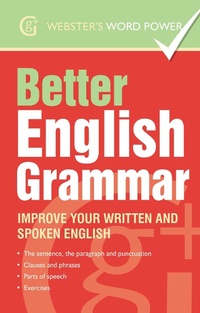
Webster's Word Power Better English Grammar
Improve Your Written and Spoken English
Published on 31. August 2014
384 pages
978-1-84205-785-8 (ISBN)
Description

With questions and answer sections throughout, this book helps you to improve your written and spoken English through understanding the structure of the English language. This is a thorough and useful book with all parts of speech and grammar explained. Used by ELT self-study students.
More details
Other editions
Additional editions
Book
03/2014
Geddes & Grosset
€28.65
Shipment within 3-4 weeks
Person
Betty Kirkpatrick is a lexicographer and has worked for leading dictionary publishers.
Content
- Cover Page
- Title Page
- CONTENTS
- BETTER ENGLISH GRAMMAR
- GRAMMAR
- THE SENTENCE AND THE PARAGRAPH
- The sentence
- Minor sentences
- Major sentences
- Subject and predicate
- Subject
- Predicate
- Object
- Direct object
- Indirect object
- Complement
- Punctuation of sentences
- Types of sentence
- Statements
- Negative sentences
- Questions
- Yes-no questions
- Tag questions
- Wh-questions
- Alternative questions
- Exclamatory questions
- Rhetorical questions
- Question by tone of voice
- Directives
- Exclamations
- Kinds of sentence
- Simple sentences
- Multiple sentences
- Compound sentences
- Complex sentences
- The paragraph
- EXERCISES 1
- ANSWERS 1
- CLAUSES, PHRASES AND PHRASAL VERBS
- Clauses
- Main clause
- Punctuation and main clauses
- Subordinate clause
- Adverbial clause
- Types of adverbial clause
- adverbial clause of time
- adverbial clause of place
- adverbial clause of purpose
- adverbial clause of reason
- adverbial clause of result
- adverbial clause of condition
- adverbial clause of manner
- adverbial clause of concession
- Comparative clause
- Relative clause
- Types of relative clause
- Defining relative clause
- Non-defining relative clause
- Punctuation in relative clauses
- Prepositions in relative clauses
- Noun clause or nominal clause
- Comment clause
- Phrases
- Noun phrase
- Adjective phrase
- Adverb phrase
- Preposition phrase
- Participial phrase
- Phrasal verbs
- Position of object in phrasal verbs
- EXERCISES 2
- ANSWERS 2
- PARTS of Speech I
- Main parts of speech
- Nouns
- Common and proper nouns
- Concrete and abstract nouns
- Countable and uncountable nouns
- Verbal noun
- Collective nouns
- Singular and plural forms of nouns
- Regular singular forms of nouns
- Regular plural forms of nouns
- Irregular plural forms of nouns
- Foreign plural forms of nouns
- Unchanging plural form
- Nouns used only in the plural form
- Gender of nouns
- Dual gender
- Feminine forms
- Person in compound nouns
- Compound nouns
- Plural forms of compound nouns
- Nouns and noun phrases in apposition
- Pronouns
- Personal pronouns
- I and we: the first person personal pronoun
- You: the second person personal pronoun
- He, she, it and they: the third person personal pronoun
- Possessive pronouns
- Reflexive pronouns
- Reciprocal pronouns
- Demonstrative pronouns
- Indefinite pronouns
- Distributive pronouns
- Interrogative pronouns
- Relative pronouns
- EXERCISES 3
- ANSWERS 3
- PARTS OF SPEECH II
- Adjectives
- Gradable and non-gradable adjectives
- Position of adjectives
- Attributive adjectives
- Predicative adjectives
- Post-modifiers
- Qualitative adjectives
- Classifying adjectives
- Colour adjectives
- Number adjectives
- Emphatic adjectives
- Interrogative adjectives
- Demonstrative adjectives
- Possessive adjectives
- Compound adjectives
- Order of adjectives
- Adjectives used as nouns
- Adjective or adverb?
- Comparative forms of adjectives
- Comparative and number of syllables
- Irregular comparatives
- No comparative form
- Superlative forms
- Irregular superlatives
- No superlative form
- Determiners
- Types of determiner
- Definite and indefinite articles
- Definite article
- Indefinite article
- Demonstrative determiners
- Possessive determiners
- Indefinite determiners
- Number determiners
- EXERCISES 4
- ANSWERS 4
- PARTS OF SPEECH III
- Verbs
- Regular verbs
- Irregular verbs
- Categories of irregular verbs
- Tense
- Present tense
- Simple present tense
- Continuous present tense
- Past tense
- Simple past tense
- Continuous past tense
- Perfect tense
- Continuous present perfect tense
- Past perfect tense
- Future tense
- Traditional grammar
- Modern usage
- Other ways of referring to the future
- Mood
- Indicative mood
- Imperative mood
- Subjunctive mood
- Voice
- Active voice
- Passive voice
- Transitive verb and intransitive verb
- Linking verb
- Auxiliary verb
- Modal auxiliary verb
- Concord
- Parts of a verb
- Infinitive
- Participles
- Present participle
- Past participle
- EXERCISES 5
- ANSWERS 5
- PARTS OF SPEECH IV
- Adverbs
- Types of adverb
- Adverbs of time
- Adverbs of frequency
- Adverbs of duration
- Adverbs of place
- Adverbs of manner
- Adverbs of degree
- Adverbs of emphasis
- Interrogative adverbs
- Prepositions
- Simple prepositions
- Complex prepositions
- Conjunctions
- Coordinating conjunctions
- Subordinating conjunctions
- Subordinating conjunctions introducing adverbial clauses
- EXERCISES 6
- ANSWERS 6
- PUNCTUATION
- THE IMPORTANCE OF PUNCTUATION
- Full stop
- The full stop and abbreviations
- The full stop in email and website addresses
- Question mark
- Exclamation mark
- Capital letter
- EXERCISES 7
- ANSWERS 7
- Comma
- The comma as separating device in lists
- The comma as a separating device in a list of adjectives
- Commas and relative clauses
- Commas and subordinate clauses
- The comma as a separating device in clauses joined by coordinating conjunctions
- The comma as separating device with initial phrases
- The comma with terms of address
- The comma with question tags
- The comma with interjections
- The comma used in pairs as a means of separation or parenthesis
- The comma with nouns or phrases in apposition
- The comma and numbers
- EXERCISES 8
- ANSWERS 8
- Brackets
- Dash
- Semicolon
- The semicolon as a link
- The semicolon as a separation device in lists
- The semicolon as separation device in lists of word groups already containing commas
- The semicolon as a separation device before certain adverbs
- Colon
- The colon as a separating device in a two-part sentence
- The colon as a linking device or introduction
- EXERCISES 9
- ANSWERS 9
- Hyphen
- The hyphen in word-breaks
- EXERCISES 10
- ANSWERS 10
- Quotation marks
- Quotation marks and direct speech
- Quotation marks and paragraphs
- Quotation marks and dialogue
- Other uses of quotation marks
- Quotation marks and titles
- Quotation marks and a direct quotation
- EXERCISES 11
- ANSWERS 11
- Other punctuation marks
- Apostrophe
- Asterisk
- Three-dot ellipsis
- Oblique
- EXERCISES 12
- ANSWERS 12
- DEVELOPING YOUR OWN STYLE
- STYLE
- Sentence style
- Sentence length
- The middle way
- Sentence structure
- Compound sentences
- Complex sentences
- Vocabulary
- Active and passive vocabulary
- Increasing your word power
- Dictionaries and thesauruses
- Register
- Keep it simple
- Adding variety
- EXERCISES 13
- ANSWERS 13
- EXERCISES 14
- ANSWERS 14
- WORDS THAT MAY CONFUSE
- IDIOMS, CLICHÉS AND EVERYDAY PHRASES
- Common idioms
- Clichés
- Everyday phrases
- Homophones
- Homonyms
- Homographs and heteronyms
- Copyright
- OTHER TITLES IN THIS SERIES
- Back Cover
