

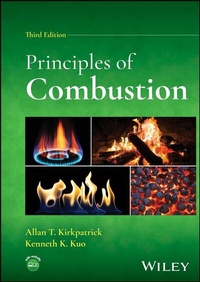
Principles of Combustion
Description

The new edition of a classic textbook on combustion principles and processes, covering the latest developments in fuels and applications in a student-friendly format
Principles of Combustion provides clear and authoritative coverage of chemically reacting flow systems. Detailed and accessible chapters cover key combustion topics such as chemical kinetics, reaction mechanisms, laminar flames, droplet evaporation and burning, and turbulent reacting flows. Numerous figures, end-of-chapter problems, extensive reference materials, and examples of specific combustion applications are integrated throughout the text.
Newly revised and expanded, Principles of Combustion makes it easier for students to absorb and master each concept covered by presenting content through smaller, bite-sized chapters. Two entirely new chapters on turbulent reacting flows and solid fuel combustion are accompanied by additional coverage of low carbon fuels such as hydrogen, natural gas, and renewable fuels. This new edition contains a wealth of new homework problems, new application examples, up-to-date references, and access to a new companion website with MATLAB files that students can use to run different combustion cases.
Fully updated to meet the needs of today's students and instructors, Principles of Combustion:
- Provides problem-solving techniques that draw from thermodynamics, fluid mechanics, and chemistry
- Addresses contemporary topics such as zero carbon combustion, turbulent combustion, and sustainable fuels
- Discusses the role of combustion emissions in climate change and the need for reducing reliance on carbon-based fossil fuels
- Covers a wide range of combustion application areas, including internal combustion engines, industrial heating, and materials processing
Containing both introductory and advanced material on various combustion topics, Principles of Combustion, Third Edition, is an essential textbook for upper-level undergraduate and graduate courses on combustion, combustion theory, and combustion processes. It is also a valuable reference for combustion engineers and scientists wanting to better understand a particular combustion problem.
More details
Other editions
Additional editions
Persons
Allan T. Kirkpatrick is an Emeritus Professor of Mechanical Engineering at Colorado State University, where he developed and taught a wide variety of courses in the thermal science areas. As an internationally recognized authority in the applied thermal-fluid sciences, Dr. Kirkpatrick has published four books and more than 100 publications on internal combustion engines, emissions, combustion instability, fluid jets, and engineering education.
Kenneth K. Kuo was a Distinguished Professor of Mechanical Engineering and Director of the High Pressure Combustion Laboratory (HPCL) in the Department of Mechanical and Nuclear Engineering at The Pennsylvania State University. The author of three books, Professor Kuo was widely recognized as a leading researcher and expert in propulsion-related combustion.
Content
About the Authors xiii
Preface xv
Acknowledgments xvii
About the Companion Website xix
1 Introduction to Combustion 1
1.1 Introduction 1
1.2 Combustion Applications 2
1.3 Organization of Text 2
1.4 Solution Methods for Combustion Problems 3
1.5 Fuels Background 4
1.6 Hydrocarbon Fuel Chemistry 5
1.7 Gaseous and Liquid Fuels for Combustion Engines 9
1.8 Fuels for Rocket Engines 20
1.9 Solid Fuels 21
1.10 Additional Reading 23
References 24
Homework Problems 24
2 Chemical Thermodynamics 27
2.1 Introduction 27
2.2 Properties of Gas Mixtures 28
2.3 Liquid-Vapor-Gas Mixtures 35
2.4 Standard Enthalpies of Formation 40
2.5 Relationship Between Bond Energy and Enthalpy of Formation 41
2.6 Fugacity and Real-Gas Equations of State 44
2.7 Conservation of Mass 48
2.8 The First Law of Thermodynamics 50
2.9 The Second Law of Thermodynamics 51
2.10 Stoichiometric Chemical Reactions 55
2.11 Mixture Fraction f 58
2.12 First Law Analysis of Combustion 61
2.13 Second Law Analysis of Cyclic Engines 67
2.14 Equilibrium Constant K p 71
2.15 Chemical Equilibrium Using Lagrange Multipliers 74
2.16 Chemical Equilibrium Using Equilibrium Constants 78
2.17 Thermodynamic Properties of Combustion Products 82
References 84
Homework Problems 84
3 Chemical Kinetics 87
3.1 Introduction 87
3.2 Rates of Reaction and Their Functional Dependence 87
3.3 One-Step Chemical Reactions of Various Orders 101
3.4 Chain Reactions 110
3.5 Chain-Branching Reactions and Explosions 111
3.6 Pressure Dependence of Rate Coefficients 115
3.7 Surface Reactions 117
3.8 Surface Reaction Kinetics 122
3.9 Experimental Methods for Measurement of Gas-Phase Reaction Rates 128
3.10 Experimental Methods to Study Surface Reactions 136
References 138
Homework Problems 140
4 Reaction Mechanisms 143
4.1 Introduction 143
4.2 Multiple Reactions 143
4.3 Steady-State Approximation 144
4.4 Partial Equilibrium 144
4.5 Hydrogen H 2 Reaction Mechanisms 145
4.6 Ammonia NH 3 Reaction Mechanisms 148
4.7 Hydrocarbon Reaction Mechanisms 149
4.8 Additional Hydrocarbon Reaction Mechanisms 156
4.9 Reduced Mechanism of Hydrocarbon Combustion 164
4.10 Chemical Mechanism Reduction 169
4.11 Sensitivity Analysis 171
4.12 Reaction Flow Analysis 178
4.13 Computational Singular Perturbation (CSP) 181
References 183
Homework Problems 185
5 Transport Processes 189
5.1 Introduction 189
5.2 Definitions of Concentrations, Velocities, and Mass Fluxes 190
5.3 Fick's Law of Diffusion 192
5.4 Dimensionless Ratios of Transport Coefficients 193
5.5 Theory of Mass Diffusion in Gases at Low Density 193
5.6 Continuity Equation and Species Mass Conservation Equations 195
5.7 Conservation of Momentum 198
5.8 Conservation of Energy 207
5.9 Physical Derivation of the Multicomponent Diffusion Equation 210
5.10 Shvab-Zel'dovich Formulation 214
5.11 Boundary Conditions at an Interface 218
5.12 Turbulent Flow Fields 227
5.13 Turbulent Length, Velocity, and Time Scales 230
5.14 Reynolds and Favre Averaging 235
5.15 Turbulence Modeling 237
5.16 Probability Density Function (PDF) Models 242
5.17 Further Reading 247
References 247
Homework Problems 247
6 Premixed Flames 251
6.1 Introduction 251
6.2 Laminar Flame Speed Modeling 252
6.3 Zeldovich, Frank-Kamenetsky, and Semenov Flame Model 255
6.4 Diagnostic Methods for Flame Speed and Structure 261
6.5 Laminar Flame Speeds of Hydrocarbon/Air Mixtures 267
6.6 Numerical Analysis of Laminar-Flame Problems 271
6.7 Stretched Laminar Premixed Flames 275
6.8 Stabilization of Combustion Flames in Laminar Flows 288
6.9 Ignition 292
6.10 Flame Quenching 295
6.11 Flammability Limits of Premixed Laminar Flames 298
6.12 Turbulent Flame Propagation 300
6.13 Example: Turbulent Flame Propagation in a Spark Ignition Engine 304
6.14 Stabilization of Turbulent Combustion Flames 306
6.15 Turbulent Flame Models 307
Further Reading 312
References 312
Homework Problems 315
7 Detonation Waves 319
7.1 Introduction 319
7.2 Qualitative Differences Between Detonation and Deflagration Waves 319
7.3 The Hugoniot Curve 321
7.4 Burned Gas Properties and the C-J Detonation-Wave Velocity 328
7.5 Zel'dovich-von Neumann-Döring (ZND) One-Dimensional Wave Model 340
7.6 Multidimensional Detonation Wave Structure 343
7.7 Deflagration-to-Detonation Transition (DDT) in Gaseous Mixtures 348
7.8 Detonability Limits 352
7.9 Detonability Limits of Confined Fuel Mixtures 358
7.10 Engineering Applications of Detonation 361
7.11 Possible Measures for Reducing Potential of Detonation 363
References 364
Homework Problems 366
8 Non-premixed Flames 369
8.1 Introduction 369
8.2 Scale Analysis of Laminar and Turbulent Jet Flames 370
8.3 Laminar Jet Flames 373
8.4 Coaxial Jet Flames 380
8.5 Combustion Chemistry of Laminar Jet Flames 387
8.6 Turbulent Gaseous Fuel Jets 393
8.7 Measurements of Non-Premixed Turbulent Flames 397
8.8 Models of Non-Premixed Turbulent Flames 400
8.9 Buoyant Flames 403
References 405
Homework Problems 406
9 Droplet Combustion 409
9.1 Introduction 409
9.2 Droplet Evaporation in Quiescent Environments 409
9.3 Combustion of a Fuel Droplet in a Quiescent Environment 415
9.4 Droplet Formation in Convective Environments 421
9.5 Fuel Droplet Evaporation in a Convective Environment 426
9.6 Droplet Combustion in Supercritical Environments 436
9.7 Application: Compression Ignition Engine Combustion 446
References 452
Homework Problems 454
10 Emissions 457
10.1 Introduction 457
10.2 Nitrogen Oxides 458
10.3 Carbon Monoxide 473
10.4 Particulate Matter 475
10.5 Soot Radiation 480
10.6 Emissions Control in Internal Combustion Engines 485
References 490
Homework Problems 491
11 Solid Fuel Combustion 495
11.1 Introduction 495
11.2 Drying of Solid Fuels 495
11.3 Biomass Pyrolysis 500
11.4 Char Oxidation 504
11.5 Solid Fuel Ignition 509
11.6 Example: Biomass Cookstove 518
11.7 Gasification of Solid Fuels 521
References 522
Homework Problems 523
A Conversion Factors and Physical Constants 525
Reference 526
B Thermal and Transport Properties of Air 527
B.1 Introduction 527
References 529
C Thermodynamic Property Tables for Various Ideal Gases 531
Reference 538
D Curve-Fit Equations for Thermodynamic Properties of Gaseous Fuels and Combustion Products 539
References 543
E Transport Properties of Gases: Mass Diffusion, Viscosity, and Thermal Conductivity 545
E.1 Introduction 545
E.2 Binary Diffusion Coefficients DAB 545
E.3 Dynamic Viscosity µ 547
E.4 Thermal Conductivity k 549
E.5 Curve-Fits and Coefficients for Viscosity, Thermal Conductivity, and Specific Heat 549
References 551
F Equations of State 553
F.1 Introduction 553
F.1.1 Ideal-Gas Equation of State 553
F.1.2 Van der Waals Equation of State 553
F.1.3 Redlich-Kwong Equation of State 554
F.1.4 Soave (SRK) and Peng-Robinson Equations of State 554
F.1.5 Virial Equation of State 555
F.1.6 Beattie-Bridgeman Equation of State 555
F.1.7 Benedict-Webb-Rubin Equation of State 556
F.1.8 Ideal-Gas Mixing Rules 556
F.1.9 Mixing Rules for Redlich-Kwong Types of Equation of State 557
F.1.10 Benedict-Webb-Rubin Mixing Rules 557
F.1.11 Virial Equation Mixing Parameters 557
F.2 Thermodynamic Derivatives 558
References 559
G Mathematical Relations 561
G.1 Numerical Solution of Equilibrium Combustion Equations 561
G.2 Gaussian Error Function 564
G.3 Bessel Functions of the First Kind 565
H Computer Programs 567
Index 569
1
Introduction to Combustion
1.1 Introduction
The goal of this book is to provide insight into the modeling and analysis of combustion processes. The term combustion encompasses many high-temperature chemical reactions that involve oxygen. Combustion is a chemical reaction between a fuel and an oxidizer producing heat and light. It is a rapid energy conversion process that converts molecular energy stored in the fuel to thermal energy. The book covers the basic principles of combustion with a focus on the application of the chemical and thermal sciences to better understand combustion processes.
Our society relies heavily on the thermal energy released by combustion to meet a wide variety of needs, as most (85%) of the world's energy use comes from combustion processes. This energy from combustion is primarily used for three purposes: to supply heat, to provide power, and to produce manufactured materials. We use petroleum in the form of gasoline, diesel, or kerosene for transportation, natural gas for heating our buildings and industrial processes, and coal and natural gas for electricity generation.
The mix of U.S. energy production and consumption has changed over time. Fossil fuels have dominated the U.S. energy mix for more than 100 years, but the mix has changed. Currently, in 2023, about a third of the U.S. energy production is petroleum based and another third is natural gas, with the remaining third a combination of renewables, coal, and nuclear energy (Smil 2017).
There are a number of private and governmental initiatives underway to decarbonize, i.e., reduce the amount of greenhouse gas emissions, primarily , from combustion devices. About three-quarters of the worldwide greenhouse gas emissions are due to the combustion of fossil fuels. The goal of decarbonization is to limit global warming to no more than 2.0 °C by 2050. The initiatives include increased use of biofuels and carbon-free fuels such as hydrogen and ammonia and improved combustion and process efficiency. Two technologies have dominated policy discussions about mitigating climate change: renewable energy generation and carbon capture and storage. Renewable technologies for electricity generation now being deployed widely are wind turbines and solar cells. Carbon capture and storage technologies include a process of converting carbon dioxide into fuel. In a two-stage process, the gas is chemically captured and turned into a solid form as calcium carbonate, then heated to drive off the and convert it to carbon monoxide.
1.2 Combustion Applications
- Electrical power generation: Natural gas and coal are burned in the furnaces of electrical power stations to produce steam in order to generate electricity. For many years, most power plants used coal as a fuel, but due to health, economic, and climate change considerations, coal is being replaced by natural gas and also renewable energy sources.
- Transportation: Liquid and gaseous fuels are used as an energy source for transportation by automobiles, trucks, aircraft, and ships due to their high energy density. Gasoline and diesel fuels are the major fuels used in internal combustion engines, and kerosene and natural gas are the major fuels used in gas turbines. There have been significant developments since the late 1960s in internal combustion engine and gas turbine technology in order to reduce their emissions and increase thermal efficiency.
- Process industry for materials manufacturing: Manufacturers of primary metals (iron and steel), nonferrous materials (glass, ceramics, cement, and nanoparticles), chemicals, petroleum products, food, and paper produce these materials through heating and combustion processes. The combustion devices used in materials manufacturing include boilers, furnaces, ovens, and blast furnaces. For example, cement is produced by sintering ground limestone to 1450 °C in large kilns. In the Haber process, hydrogen and nitrogen are reacted together at high temperatures and pressures to produce ammonia, .
- Domestic and industrial heating: Heating of residential homes, commercial buildings, industrial factories, offices, and various types of buildings such as schools and hospitals is accomplished through combustion of natural gas. There is an extensive natural gas network in the United States and many countries which delivers natural gas directly to a domestic and industrial end user.
- Cooking More than 2.5 billion people, about 1/3 of the world's population, rely on solid biomass, kerosene, or coal as their primary cooking fuel. The burning of solid fuels in households for cooking and heating can lead to very low indoor air quality and health issues.
1.3 Organization of Text
In Chapter 1, we introduce various applications of combustion processes, fuels, and emissions from various combustion applications. As discussed below, these applications include electrical power generation, transportation, industrial processes, and heating of domestic and commercial buildings. The major fuels for these combustion processes include natural gas, liquid hydrocarbons (gasoline and diesel fuels), and solids (wood and coal).
Chapter 2 covers chemical thermodynamics, including thermodynamic properties of fuel-air mixtures and equilibrium thermodynamics of multicomponent reacting systems. Chapter 3 reviews chemical kinetics, reaction rates, and the rate of production of combustion products. Chapter 4 introduces detailed reaction mechanisms of various fuels. In Chapter 5, the general conservation equations of mass, momentum, energy, and species for reacting systems are presented. Chapter 5 also introduces turbulence models and turbulent combustion.
In Chapter 6, premixed laminar flames are modeled to determine burning velocities and flammability limits. Chapter 7 examines subsonic deflagration waves and supersonic detonation waves of premixed gases. Chapter 8 covers non-premixed or diffusion flames, including jet mixing and flame length. In Chapter 9, the evaporation and burning of fuel droplets are presented. Chapter 10 discusses the emissions, including nitrogen oxides, carbon monoxide, carbon dioxide, and particulates from combustion processes. The final chapter, Chapter 11, introduces the processes of solid fuel (biomass, i.e., wood and coal) combustion. A Homework Problem section is included at the end of each chapter.
1.4 Solution Methods for Combustion Problems
A combustion problem can be solved using various combinations of analytical, computational, and experimental approaches. The text introduces a number of solution techniques and gives background references for more information. Although the design of many modern combustion systems leans toward calculation and simulation rather than extensive hardware fabrication and testing, diagnostic techniques are still very important.
Indeed, the rise in computational fluid dynamics (CFD) is beginning to allow the evaluation of complex flow and combustion systems over a wide range of design parameters more quickly, inexpensively, and thoroughly than can be accomplished with actual hardware tests. Reactive flows including multistep kinetic considerations have become computationally tractable. For example, there are three major categories of numerical analysis, Reynolds average Navier-Stokes (RANS), large-eddy simulation (LES), and direct numerical simulation (DNS). The predictions of these numerical solution techniques for a diffusion flame are shown in Figure 1.1. A discussion of these methods is provided in Chapter 5.
However, these computational models often require adequate input of kinetic information in the form of sub-models, which are based on specific measurements or basic understanding of the chemical and physical mechanisms derived from experimental observations. In particular, experimental validation of computed results will be necessary to prove the predictive capability of theoretical models and computer codes before they are used for guiding actual designs.
There are a number of software packages available for numerical solution of combustion problems, from commercial, national laboratory, and academic sources. A popular open-source program is Cantera, which is a suite of software tools for problems involving chemical kinetics, thermodynamics, and transport processes. Since Cantera is open source, users can incorporate detailed chemical kinetics and transport models into their calculations. Cantera can be used from Python and Matlab, or in applications written in C/C++ and Fortran 90.
A popular commercial combustion software tool is Chemkin-Pro. Many researchers work with combustion mechanisms in Chemkin format, which has become a de facto standard in the combustion community. The Chemkin software was originally developed in the U.S. Sandia National Laboratories and has since become a standard computational program for combustion engineering as well as in other fields such as fluid dynamics and chemistry. The Chemkin-Pro package is a set of programs which incorporate complex chemical kinetics into simulations of gas-phase and gas-surface reacting flow. The software includes application programs for stirred reactors, plug-flow reactors, premixed and diffusion flames, and opposed-flow diffusion flames. For specific...
