

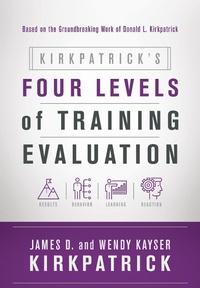
Kirkpatrick's Four Levels of Training Evaluation
Description

A timely update to a timeless model.
Don Kirkpatrick's groundbreaking Four Levels of Training Evaluation is the most widely used training evaluation model in the world. Ask any group of trainers whether they rely on the model's four levels Reaction, Learning, Behavior, and Results in their practice, and you'll get an enthusiastic affirmation.
But how many variations of Kirkpatrick are in use today? And what number of misassumptions and faulty practices have crept in over 60 years? The reality is: Quite a few.
James and Wendy Kirkpatrick have written Kirkpatrick's Four Levels of Training Evaluation to set the record straight. Delve into James and Wendy's new findings that, together with Don Kirkpatrick's work, create the New World Kirkpatrick Model, a powerful training evaluation methodology that melds people with metrics. In Kirkpatrick's Four Levels of Training Evaluation, discover a comprehensive blueprint for implementing the model in a way that truly maximizes your business's results. Using these innovative concepts, principles, techniques, and case studies, you can better train people, improve the way you work, and, ultimately, help your organization meet its most crucial goals.
More details
Other editions
Additional editions
Persons
Dr. Jim Kirkpatrick is a thought leader and change driver in training evaluation and the creator of the New World Kirkpatrick Model. Using his 15 years of experience in the corporate world, he trains and consults for corporate, government, military, and humanitarian organizations around the world.
Wendy Kirkpatrick is a global driving force of the use and implementation of the Kirkpatrick Model, leading companies to measurable success through training and evaluation. She is a recipient of the 2013 Emerging Training Leaders Award from Training magazine.
Together Jim and Wendy are co-owners of Kirkpatrick Partners.
Content
- Four Levels of Training Evaluation
- Copyright
- Contents
- Foreword by Don Kirkpatrick
- Foreword by Elaine Biech
- Preface
- Part 1: Basics of Evaluation
- Chapter 1: Reasons for Evaluating
- Chapter 2: The New World Kirkpatrick Model-An Overview
- c h a p t e r 3
- Chapter 3: Developing an Effective Evaluation Strategy
- Chapter 4: The Kirkpatrick Foundational Principles
- Part 2: Data Collection Guidelines, Methods, and Tools
- Chapter 5: Evaluating Level 1: Reaction
- Chapter 6: Evaluating Level 2: Learning
- Chapter 7: Evaluating Level 3: Behavior
- Chapter 8: Evaluating Level 4: Results
- Chapter 9: Evaluating Beyond Traditional Classroom Training
- Chapter 10: Evaluation Instrument Creation Basics
- Chapter 11: Blended Evaluation® Items and Sample Tools
- Part 3: Data Analysis and Reporting Basics
- Chapter 12: Making Data-Based Decisions
- Chapter 13: Using the Success Case Method to Drive Performance and Results
- Chapter 14: So What? Now What?
- Chapter 15: Reporting Progress and Demonstrating Program Value
- Chapter 16: Avoiding Common Evaluation Pitfalls
- Part 4: Case Studies
- Chapter 17: Common Practice in Leadership Program: Greencore Northampton
- Chapter 18: Service Over and Above the Rest (SOAR) Program: Emirates Airline
- Chapter 19: Sales Graduate Program Pilot: ArjoHuntleigh Getinge Group
- Chapter 20: Accident Reduction Program: Maryland Transit Administration
- Chapter 21: Coaching Program: IHC New Zealand
- Call to Action
- References
- About the Authors
- About the Contributors
- Index
