

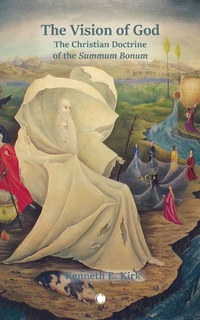
The The Vision of God
The Christian Doctrine of the Summum Bonum
Published on 27. April 2023
228 pages
978-0-227-17902-4 (ISBN)
Description

Based on the 1928 Bampton Lectures, The Vision of God was the first of Kenneth E. Kirk's three major books on moral theology. Drawing inspiration from the ascetic tradition of Christianity, Kirk advocates the priority of worship in ethical thought. Beginning with the sixth beatitude, he places the visio Dei front and centre throughout, placing himself in a eudaimonistic tradition that ranges from Irenaeus to Aquinas and the Shorter Catechism. Worship, he shows, offers the opportunity to discover and acknowledge something more valuable than the self, and thus contains the key to moral instruction.
Although Kirk published an expanded 'complete edition' of The Vision of God in 1931, he notes in the preface to the shorter text presented here that 'what remains approximates to, though it is not quite identical with, the actual lectures as originally delivered.' The reader therefore has in their hands the essence of Kirk's thesis, which continues to prompt debate today.
Although Kirk published an expanded 'complete edition' of The Vision of God in 1931, he notes in the preface to the shorter text presented here that 'what remains approximates to, though it is not quite identical with, the actual lectures as originally delivered.' The reader therefore has in their hands the essence of Kirk's thesis, which continues to prompt debate today.
Reviews / Votes
{\rtf1\fbidis\ansi\ansicpg1252\deff0\deflang2057{\fonttbl{\f0\fswiss\fprq2\fcharset0 Calibri;}{\f1\fnil\fcharset0 Verdana;}}\viewkind4\uc1\pard\ltrpar\sa200\sl276\slmult1\f0\fs22 "It could be argued that Kirk\rquote s \i Vision of God\i0 is the single most significant essay on moral theology written by an Anglican in the twentieth century. . . . It is effectively a prolegomenon to virtue ethics, which, since the advent of Alasdair MacIntyre\rquote s \i After Virtue\i0 , has once again taken pride of place. But Kirk\rquote s argument also directs us towards an integrated vision of theology, where moral, ascetic and doctrinal thought coalesce within one context." Stephen Platten, in \i Theology\i0 , January 2021\par
"We have never read any theological work which has a more direct bearing on practical problems of ecclesiastical statesmanship and religious policy." \i Times Literary Supplement\i0 \par
"A great book." \i Expository Times\i0 \par
\pard\ltrpar\f1\fs17\par
}
This classic 1931 book, praised by Bishop Stephen Platten in Theology (January 2021) as 'the single most significant essay by an Anglican in the twentieth century', has now been republished as an affordable paperback.
Short Notice by Robin Gill, In Theology, 2023, Volume 126, Issue 4.
More details
Language
English
Place of publication
Cambridge
United Kingdom
Target group
College/higher education
File size
5,09 MB
ISBN-13
978-0-227-17902-4 (9780227179024)
Copyright in bibliographic data and cover images is held by Nielsen Book Services Limited or by the publishers or by their respective licensors: all rights reserved.
Schweitzer Classification
Other editions
Additional editions
Book
04/2023
James Clarke & Co Ltd
€37.50
Shipment within 10-20 days
Book
12/1990
James Clarke & Co Ltd
€41.05
Article exhausted; check different version
Person
Kenneth E. Kirk was educated at the Royal Grammar School, Sheffield, and St. John's College, Oxford. After serving as a chaplain in France and Flanders during World War I, he returned to Oxford to become Tutor at Keble College, Fellow of Magdalen College, Fellow and Chaplain of Trinity, and in 1933 Regius Professor of Moral and Pastoral Theology and Canon of Christchurch. He was Bishop of Oxford from 1937 until his death in 1954.
Content
Foreword
Preface
Lecture I. The Vision of God in Pre-Christian Thought
1. The Vision of God
2. Formalism and Rigorism
3. Jewish Anticipations
4. Pagan Anticipations
5. Philo of Alexandria
Lecture II. The New Testament
1. Rigorism and Eschatology in the Teaching of Jesus
2. New Testament Variations
3. The Origin of New Testament Rigorism
4. The Vision of God in the New Testament
Lecture III. Formalism
1. The Beginnings of Codification
2. Codification in the New Testament
3. The Dangers of Formalism
4. The Motive of Reward in the Gospels
Lecture IV. Rigorism
1. The Beginnings of Monasticism
2. Monasticism and The Vision of God
3. The Gnostics
Lecture V. The Reply to Rigorism (I. - Discipline)
1. Rigorists & Humanists
2. The Two Lives
3. The Reform of Monasticism
Lecture VI. The Reply to Rigorism (II. - Doctrine)
1. Naturalism and Christianity
2. St Clement of Alexandria
3. St Augustine
4. St Bernard of Clairvaux
Lecture VII. Confusion and Order
1. The Twelfth Century
2. The School of St Victor
3. St Thomas Aquinas
4. St Ignatius of Loyola
5. St Francis de Sales
Lecture VIII. Law and Promise
1. The Reversal of Tradition
2. 'Worship' and 'Service'
3. Disinterestedness and Pure Love
4. Conclusion
Index
Preface
Lecture I. The Vision of God in Pre-Christian Thought
1. The Vision of God
2. Formalism and Rigorism
3. Jewish Anticipations
4. Pagan Anticipations
5. Philo of Alexandria
Lecture II. The New Testament
1. Rigorism and Eschatology in the Teaching of Jesus
2. New Testament Variations
3. The Origin of New Testament Rigorism
4. The Vision of God in the New Testament
Lecture III. Formalism
1. The Beginnings of Codification
2. Codification in the New Testament
3. The Dangers of Formalism
4. The Motive of Reward in the Gospels
Lecture IV. Rigorism
1. The Beginnings of Monasticism
2. Monasticism and The Vision of God
3. The Gnostics
Lecture V. The Reply to Rigorism (I. - Discipline)
1. Rigorists & Humanists
2. The Two Lives
3. The Reform of Monasticism
Lecture VI. The Reply to Rigorism (II. - Doctrine)
1. Naturalism and Christianity
2. St Clement of Alexandria
3. St Augustine
4. St Bernard of Clairvaux
Lecture VII. Confusion and Order
1. The Twelfth Century
2. The School of St Victor
3. St Thomas Aquinas
4. St Ignatius of Loyola
5. St Francis de Sales
Lecture VIII. Law and Promise
1. The Reversal of Tradition
2. 'Worship' and 'Service'
3. Disinterestedness and Pure Love
4. Conclusion
Index
