

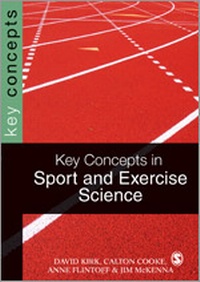
Key Concepts in Sport and Exercise Sciences
1st Edition
Published on 3. November 2008
160 pages
978-0-85702-304-9 (ISBN)
Description

'A very useful introduction to the key concepts in five main areas of study in sport and exercise science. The multi-disciplinary nature of the book is particularly attractive as it means that it can be used to support students studying a range of sport and exercise courses and modules. Furthermore, the chapters are concise, informative, written in an accessible style, and provide a good balance between theory and application to practice, making it a very interesting and relevant read' - Dr Lorraine Cale, Loughborough University
This book provides students and scholars with a fail-safe guide to the key concepts in the field of Sport & Exercise Science. Intelligently cross-referenced entries provide a sound map of the multi-disciplinary demands of sport related courses including physical and biological sciences, social science and education. The entries use clear definitions, examples and suggestions for further reading to explore each discipline and are:
" Comprehensive
" Lucid
" Pertinent to study needs
" Practically relevant
David Kirk is Professor in Physical Education and Youth Sport
Carlton Cooke is Professor in Physical Education
Anne Flintoff is Reader in Physical Education
Jim McKenna is Professor in Physical Activity and Health
All at the Carnegie Faculty of Sport and Education, Leeds Metropolitan University.
This book provides students and scholars with a fail-safe guide to the key concepts in the field of Sport & Exercise Science. Intelligently cross-referenced entries provide a sound map of the multi-disciplinary demands of sport related courses including physical and biological sciences, social science and education. The entries use clear definitions, examples and suggestions for further reading to explore each discipline and are:
" Comprehensive
" Lucid
" Pertinent to study needs
" Practically relevant
David Kirk is Professor in Physical Education and Youth Sport
Carlton Cooke is Professor in Physical Education
Anne Flintoff is Reader in Physical Education
Jim McKenna is Professor in Physical Activity and Health
All at the Carnegie Faculty of Sport and Education, Leeds Metropolitan University.
More details
Series
Edition
First Edition
Language
English
Place of publication
London
United Kingdom
Target group
College/higher education
ISBN-13
978-0-85702-304-9 (9780857023049)
Copyright in bibliographic data and cover images is held by Nielsen Book Services Limited or by the publishers or by their respective licensors: all rights reserved.
Schweitzer Classification
Other editions
Additional editions
David Kirk | Carlton B. Cooke | Anne Flintoff
Key Concepts in Sport and Exercise Sciences
Book
11/2008
1st Edition
SAGE Publications Inc
€69.51
Shipment within 10-20 days
David Kirk | Carlton B. Cooke | Anne Flintoff
Key Concepts in Sport and Exercise Sciences
Book
11/2008
1st Edition
SAGE Publications Inc
€183.60
Shipment within 10-20 days
Persons
Professor Carlton Cooke joined Leeds Met in 1990, whilst working as a principal investigator on the pioneering Allied Dunbar National Fitness Survey.
He became a Reader in 1993 and Carnegie Professor of Sport and Exercise Science in 1998, followed by his appointment in 2004 as Associate Dean and Head of the School of Sport, Exercise & Physical Education. In 2005 he became the Associate Dean for Research in the Carnegie Faculty of Sport an Education, being seconded to the University Research Office to be the Director of Postgraduate Research Students for two years in 2006. Carlton was again seconded to the University Research office in 2009 to be the Director of University Research, until the appointment of the new DVC for Research and Enterprise in 2010. Carlton now leads research in the new Carnegie Faculty.
His research interests range from physiological and biomechanical aspects of high level sports performance to physical activity, exercise and health in adults and children.
He became a Reader in 1993 and Carnegie Professor of Sport and Exercise Science in 1998, followed by his appointment in 2004 as Associate Dean and Head of the School of Sport, Exercise & Physical Education. In 2005 he became the Associate Dean for Research in the Carnegie Faculty of Sport an Education, being seconded to the University Research Office to be the Director of Postgraduate Research Students for two years in 2006. Carlton was again seconded to the University Research office in 2009 to be the Director of University Research, until the appointment of the new DVC for Research and Enterprise in 2010. Carlton now leads research in the new Carnegie Faculty.
His research interests range from physiological and biomechanical aspects of high level sports performance to physical activity, exercise and health in adults and children.
Content
Psychology
1. Section introduction
2. Motivation
3. Adherence
4. Physical activity and mental health
5. Emotion and effect in acute exercise
6. Coping in sport
7. Expertise
8. Leaders and leadership
9. Communication
Biomechanics
10. Section introduction
11. Kinematics
12. Force
13. Impact
14. Work, energy and power
15. Angular kinetics
16. Projectiles
17. Fluid mechanics
Exercise Physiology
18. Section introduction
19. Nutrition and biochemistry
20. Homeostasis
21. Muscle, strength and power
22. Energy systems
23. Energy balance and body composition
24. Principles of training
25. Fitness for health and sport
26. Growth, maturation, motor development and learning
Pedagogy
27. Section introduction
28. Physical Education
29. Curriculum
30. Instruction
31. Learning
32. Assessment
Sociology
33. Section introduction
34. Class
35. Disability
36. Bodies
37. Gender
38. Globalization
39. Identity
40. 'Race' and ethnicity
1. Section introduction
2. Motivation
3. Adherence
4. Physical activity and mental health
5. Emotion and effect in acute exercise
6. Coping in sport
7. Expertise
8. Leaders and leadership
9. Communication
Biomechanics
10. Section introduction
11. Kinematics
12. Force
13. Impact
14. Work, energy and power
15. Angular kinetics
16. Projectiles
17. Fluid mechanics
Exercise Physiology
18. Section introduction
19. Nutrition and biochemistry
20. Homeostasis
21. Muscle, strength and power
22. Energy systems
23. Energy balance and body composition
24. Principles of training
25. Fitness for health and sport
26. Growth, maturation, motor development and learning
Pedagogy
27. Section introduction
28. Physical Education
29. Curriculum
30. Instruction
31. Learning
32. Assessment
Sociology
33. Section introduction
34. Class
35. Disability
36. Bodies
37. Gender
38. Globalization
39. Identity
40. 'Race' and ethnicity
