

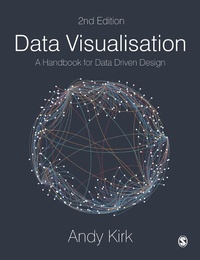
Data Visualisation
A Handbook for Data Driven Design
2nd Edition
Published on 8. July 2019
328 pages
978-1-5264-8288-4 (ISBN)
Description

One of the "six best books for data geeks" - Financial Times
With over 200 images and extensive how-to and how-not-to examples, this new edition has everything students and scholars need to understand and create effective data visualisations.
Combining 'how to think' instruction with a 'how to produce' mentality, this book takes readers step-by-step through analysing, designing, and curating information into useful, impactful tools of communication.
With this book and its extensive collection of online support, readers can:
Decide what visualisations work best for their data and their audience using the chart gallery
See data visualisation in action and learn the tools to try it themselves
Follow online checklists, tutorials, and exercises to build skills and confidence
Get advice from the UK's leading data visualisation trainer on everything from getting started to honing the craft.
With over 200 images and extensive how-to and how-not-to examples, this new edition has everything students and scholars need to understand and create effective data visualisations.
Combining 'how to think' instruction with a 'how to produce' mentality, this book takes readers step-by-step through analysing, designing, and curating information into useful, impactful tools of communication.
With this book and its extensive collection of online support, readers can:
Decide what visualisations work best for their data and their audience using the chart gallery
See data visualisation in action and learn the tools to try it themselves
Follow online checklists, tutorials, and exercises to build skills and confidence
Get advice from the UK's leading data visualisation trainer on everything from getting started to honing the craft.
Reviews / Votes
Many books focus on using software to visualise data but fewer consider good design. Data Visualisation addresses this in an inherently practical way. This is a much needed book which recognises and clarifies the process of designing excellent graphics. -- Chris Playford What do we actually mean when we talk about Data Visualisation? How do we 'do it'? How can we ensure our research using Data Visualisation is effective and ethical? The answers are all here in this inspirational and invaluable guide. -- Therese A.G. Lewis Everything I loved in the first edition of this valuable book has been incorporated into the second, including Kirk's typology of data visualisation and masses of visual examples, but with more precise written arguments. This volume continues to fill the gap between overwhelming data and the visualisations that can facilitate understanding. -- Pamela Woolner In this second edition, Andy adds relevant content to what was already a fantastic framework for learning the fundamentals of data visualization, all with acute and critical eyes. As an educator, I find it an invaluable resource to students and myself alike. -- Isabel MeirellesWhile most works in this space focus on data journalism, scientific visualisations or other specialist audiences, this book targets decision makers and helps with everything from initial concepts and data preparation to editorial layouts. A refreshing angle and a compelling read. -- Elena Simperl
More details
Edition
Second Edition (Revised Edition)
Language
English
Place of publication
London
United Kingdom
Target group
College/higher education
Edition type
Revised edition
Product notice
Reflowable
ISBN-13
978-1-5264-8288-4 (9781526482884)
Copyright in bibliographic data and cover images is held by Nielsen Book Services Limited or by the publishers or by their respective licensors: all rights reserved.
Schweitzer Classification
Other editions
Additional editions
Book
08/2019
2nd Edition
SAGE Publications Ltd
€91.79
Article exhausted; check for reprint
Person
Andy Kirk is an Independent Data Visualisation Expert delivering a range of professional services to clients around the world as a data visualisation design consultant and prolific trainer. He is a sought-after speaker, a four-times published author, the editor of visualisingdata.com, and host of the 'Explore Explain' video and podcast series. He's had over a decade experience as an adjunct lecturer positions teaching data visualisation modules on Masters programmes at a range of esteemed institutes and maintains academic activity through involvement as an external research consultant. Before finding his calling with data visualisation Andy studied at Lancaster University, graduating in 1999 with a BSc (hons) in Operational Research then commenced his working career with a series of business analysis/information management roles with organisations including CIS Insurance, West Yorkshire Police and the University of Leeds. It was whilst working at the University that he had the opportunity to undertake a Masters of Research degree (MRes) to study data visualisation, graduating with distinction in 2009 and changing the course of his career.
Content
INTRODUCTION
PART A FOUNDATIONS
Chapter 1 Defining Data Visualisation
Chapter 2 The Visualisation Design Process
PART B THE HIDDEN THINKING
Chapter 3 Formulating Your Brief
Chapter 4 Working With Data
Chapter 5 Establishing Your Editorial Thinking
PART C DESIGN THINKING
Chapter 6 Data Representation
Chapter 7 Interactivity
Chapter 8 Annotation
Chapter 9 Colour
Chapter 10 Composition
EPILOGUE
PART A FOUNDATIONS
Chapter 1 Defining Data Visualisation
Chapter 2 The Visualisation Design Process
PART B THE HIDDEN THINKING
Chapter 3 Formulating Your Brief
Chapter 4 Working With Data
Chapter 5 Establishing Your Editorial Thinking
PART C DESIGN THINKING
Chapter 6 Data Representation
Chapter 7 Interactivity
Chapter 8 Annotation
Chapter 9 Colour
Chapter 10 Composition
EPILOGUE
