

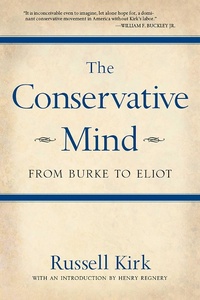
The Conservative Mind
From Burke to Eliot
Published on 1. September 2001
535 pages
978-1-59698-534-6 (ISBN)
Description

"It is inconceivable even to imagine, let alone hope for, a dominant conservative movement in America without Kirk's labor." - WILLIAM F BUCKLEY
"A profound critique of contemporary mass society, and a vivid and poetic image - not a program, an image - of how that society might better itself. [ The Conservative Mind ] is, in important respects, the twentieth century's own version of the Reflections on the Revolution in France... [Kirk] was an artist, a vsionary, almost a prophet." - DAVID FRUM, author of Dead Right
"I have been one of your fans since the time many years ago when I read The Conservative Mind." - RICHARD NIXON
"Dr. Russell Kirk's impact on conservative thought and policy in America has been decisive. It was his writings, and in particular his seminal work, The Conservative Mind, that laid the foundation for many of the ideas that continue to shape public discourse and debate to this day." - JOHN ENGLER, former Governer of Michigan
"Kirk is assured a place of prominence in the intellectual histories for helping to define the ethical basis of conservatism. He has tried to pull conservatism away from the utilitarian premises of libertarianism, toward which conservatism often veers, toward a philosophy rooted in ethics and culture." - THE WALL STREET JOURNAL
Russell Kirk's The Conservative Mind is one of the greatest contributions to twentieth-century American conservatism. Brilliant in every respect, from its conception to its choice of significant figures representing the history of intellectual conservatism, The Conservative Mind launched the modern American Conservative Movement when it was first published in 1953 and has become an enduring classic of political thought.
The seventh revised edition features the complete text and an introduction by publisher Henry Regnery.
A must-read.
"A profound critique of contemporary mass society, and a vivid and poetic image - not a program, an image - of how that society might better itself. [ The Conservative Mind ] is, in important respects, the twentieth century's own version of the Reflections on the Revolution in France... [Kirk] was an artist, a vsionary, almost a prophet." - DAVID FRUM, author of Dead Right
"I have been one of your fans since the time many years ago when I read The Conservative Mind." - RICHARD NIXON
"Dr. Russell Kirk's impact on conservative thought and policy in America has been decisive. It was his writings, and in particular his seminal work, The Conservative Mind, that laid the foundation for many of the ideas that continue to shape public discourse and debate to this day." - JOHN ENGLER, former Governer of Michigan
"Kirk is assured a place of prominence in the intellectual histories for helping to define the ethical basis of conservatism. He has tried to pull conservatism away from the utilitarian premises of libertarianism, toward which conservatism often veers, toward a philosophy rooted in ethics and culture." - THE WALL STREET JOURNAL
Russell Kirk's The Conservative Mind is one of the greatest contributions to twentieth-century American conservatism. Brilliant in every respect, from its conception to its choice of significant figures representing the history of intellectual conservatism, The Conservative Mind launched the modern American Conservative Movement when it was first published in 1953 and has become an enduring classic of political thought.
The seventh revised edition features the complete text and an introduction by publisher Henry Regnery.
A must-read.
More details
Other editions
Additional editions
Book
09/2001
7th Edition
Regnery Publishing Inc
€28.50
No shipping information available
Person
Russell Kirk
Content
- Intro
- Title Page
- Copyright
- Contents
- The Making of the Conservative Mind
- Foreword
- I: The Idea of Conservativism
- II: Burke and the Politics of Prescription
- 1. Burke's career
- 2. The radical systems
- 3. Providence and veneration
- 4. Prejudice and prescription
- 5. The rights of civil social man
- 6. Equality and aristocracy
- 7. The principle of order
- III: John Adams and Liberty Under Law
- 1. Federalists and Republicans
- 2. Alexander Hamilton
- 3. Fisher Ames' vaticinations
- 4. John Adams as psychologist
- 5. The aristocracy of nature
- 6. American constitutions
- 7. Marshall and the metamorphosis of federalism
- IV: Romantics and Utilitarians
- 1. Benthamism and Walter Scott
- 2. Canning and enlightened conservatism
- 3. Coleridge and conservative ideas
- 4. The triumph of abstraction
- V: Southern Conservatism: Randolph and Calhoun
- 1. Southern impulses
- 2. Randolph on the peril of positive legislation
- 3. The rights of minorities: Calhoun
- 4. The valor of the South
- VI: Liberal Conservatives: Macaulay, Cooper, Tocqueville
- 1. Burke's influence upon liberalism
- 2. Macaulay on democracy
- 3. Fenimore Cooper and a gentleman's America
- 4. Tocqueville on democratic despotism
- 5. Democratic prudence
- VII: Transitional Conservatism: New England Sketches
- 1. Industrialism as a leveller
- 2. John Quincy Adams and progress: his aspirations and his failure
- 3. The illusions of transcendentalism
- 4. Brownson on the conservative power of Catholicism
- 5. Nathaniel Hawthorne: society and sin
- VIII: Conservatism with Imagination: Disraeli and Newman
- 1. Marx's materialism
- and the fruits of liberalism
- 2. Disraeli and Tory loyalties
- 3. Newman: the sources of knowledge and the idea of education
- 4. The age of discussion: Bagehot
- IX: Legal and Historical Conservatism: A Time of Foreboding
- 1. Liberalism and collectivism: John Stuart Mill, Comte, and positivism
- 2. Stephen on the ends of life and politics
- 3. Maine: status and contract
- 4. Lecky: illiberal democracy
- X: Conservatism Frustrated: America, 1865-1918
- 1. The Gilded Age
- 2. James Russell Lowell's perplexities
- 3. Godkin on democratic opinion
- 4. Henry Adams on the degradation of the democratic dogma
- 5. Brooks Adams and a world of terrible energies
- XI: English Conservatism Adrift: The Twentieth Century
- 1. The end of aristocratic politics: 1906
- 2. George Gissing and the Nether World
- 3. Arthur Balfour: his spiritual conservatism
- and the tide of socialism
- 4. The books of W. H. Mallock: a conservative synthesis
- 5. A dreary conservatism between wars
- XII: Critical Conservatism: Babbitt, More, Santayana
- 1. Pragmatism: the fumbling of America
- 2. Irving Babbitt's humanism: the higher will in a democracy
- 3. Paul Elmer More on justice and faith
- 4. George Santayana buries liberalism
- 5. America in search of ideas
- XIII: Conservatives' Promise
- 1. Radicalism's sickness
- 2. The new elite
- 3. Scholar confronts intellectual
- 4. The conservative as poet
- Notes
- Bibliography
- Index
