

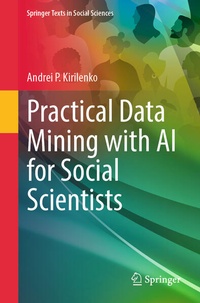
Practical Data Mining with AI for Social Scientists
Description

This book is designed as a foundational textbook for upper-level undergraduate and graduate students from non-technical fields who want to acquire a basic understanding of data science and learn practical skills in data analysis. It distinguishes itself by combining theoretical knowledge with practical applications, bridged through extensive Python programming exercises. To accommodate social scientists' needs, the book emphasizes the analysis of textual data, especially those acquired from surveys and social media. For those without prior programming experience, the book provides instruction on using an AI-assisted Python programming tool, following the learn-by-doing methodology of acquiring new skills through experience. The overall learning goal of the book is to develop a conceptual understanding of data mining as well as the technical skills necessary for real-world data analysis.
More details
Other editions
Additional editions
Person
Andrei Kirilenko has a degree in applied mathematics and a Ph.D. in computer science. He started his career developing computer models for evaluating climate change impacts on the natural environment and agriculture. Gradually, his teaching and research interests have shifted toward quantitative social science research. Since 2015, he has held the position of Associate Professor at the Department of Tourism, Hospitality, and Event Management at the University of Florida, USA, teaching courses on data mining for social sciences, Geographical Information Systems, statistics, and research methods. His research is centered on social media analysis, sustainability, and biodiversity. Dr. Kirilenko has served as an expert in the global assessments of the Intergovernmental Panel on Climate Change (IPCC) and the United Nations Environmental Program (UNEP) Global Environmental Assessments.
Content
Introduction to Data Mining. CRISP-DM Process.- Data Preprocessing.- Introduction to Data Mining Methods. Association Rules.- Decision Trees.- Clustering Techniques: K-means and DBSCAN.- Hierarchical Clustering.- Predictive Analytics and Supervised Learning. Classification.- Validation and Evaluation Methods.- Web Data Scraping.- Sentiment and Emotion Analysis.- Text Mining Essentials.- Topic Modeling: Latent Dirichlet Allocation.- Text Analysis with Large Language Models (LLMs).- Introduction to Social Network Analysis.- Understanding Data Storage and Databases.- Ethics and Explainable AI.
