

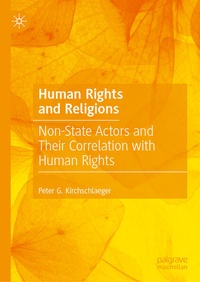
Human Rights and Religions
Description

Offering a critical, comprehensive, and holistic discussion of the validity of human rights inside and outside of religious communities, this book explores the relationship between religious communities, abstract "religion", and human rights from an ethical perspective. The work also provides a rounded discussion on human rights-obligations and-responsibilities of religions communities and worldview-based communities as well as of non-state actors. Prompting religions and worldview-based communities to redefine their relationship to the liberal state, this book allows for ethical conclusions to be drawn about other non-state actors, their relationship to human rights, and their means to peacefully coexistence in secular society. The book is therefore an attractive read for scholars interested in the social and religion dimensions of Human Rights and Religions.
More details
Other editions
Additional editions
Person
Peter G. Kirchschlaeger is Full Professor of Theological Ethics and Director of the Institute of Social Ethics ISE at the University of Lucerne (Switzerland) as well as Visiting Professor at the Chair for Neuronal Learning and Intelligent Systems at ETH Zurich and at the ETH AI Center (Switzerland). He is Visiting Fellow at the Global Ethic Institute at the University of Tuebingen (Germany) and Research Fellow at the University of the Free State, Bloemfontein (South Africa). Prior, he was Visiting Fellow at Yale University (USA).
Content
Chapter 1. The contributions of various religious and ideological communities for and against the development of a tradition of human rights.- Chapter 2. Do religious and ideological communities have to respect human rights, protect them and contribute to their realization?.- Chapter 3. Must the state enforce the application of human rights in religious and philosophical communities?.- Chapter 4. How should the corresponding arguments be evaluated from a social-ethical perspective?.- Chapter 5. Adaptation - thinking dialogically about the relationship between religious and ideological communities and human rights.- Chapter 6. Closing remarks.
