

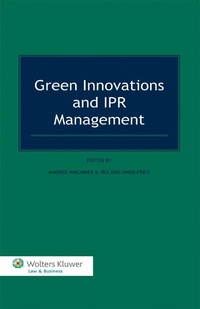
Green Innovations and IPR Management
Published on 1. March 2013
344 pages
978-90-411-4674-8 (ISBN)
Description

There can no longer be any doubt that promoting green innovations is essential if we are to meet the challenges of sustainable development, climate change, and intergenerational equity. With the maturity of this crucial awareness has come full recognition of the intellectual property rights of green innovators - an area of international law that has drawn a host of initiatives not only from lawyers and legal scholars but also from highly knowledgeable and well-placed authorities such as the World Intellectual Property Organization, the European Patent Office, the United Nations Environment Program, the International Tribunal for the Law of the Sea, the International Centre for Trade and Sustainable Development, the European Commission, and national environmental agencies. In this first-ever survey and analysis of the current and emerging state of the field, twenty-two outstanding practitioners, academics, policymakers, and officials describe the relevant work of all of these groups. Among the array of topics covered are the following: vast diversity of products, services, and processes; legacy IP measures from R&D in computers and semiconductors; role of green technology's moral underpinning; wide-open startup vs. exorbitant up-front cost; and licensing issues in technology transfer. Although primarily intended for professionals concerned with the legal aspects of green technology - lawyers, policymakers, agency officials, academics - this book will also be of great value to inventors and technology companies as a guide to mechanisms for managing and sharing intellectual property rights in the context of green innovations. It is sure to engage a wide audience for years to come.
More details
Other editions
Additional editions
Andree Kirchner | Iris Kirchner-Freis
Green Innovations and IPR Management
Book
03/2013
1st Edition
Kluwer Law International
€210.95
Shipment within 10-20 days
Content
- Intro
- Title
- Copyright
- List of Editors
- List of Contributors
- Perface
- Summary of Contents
- Table of Contents
- Part I: Green Intellectual Property Rights
- Chapter 1 Legal Aspects of Green Patents
- §1.01 Green Patents You Need to Know
- [A] U.S. Patent No. 5,083,039: The Life Story of a Seminal Wind Patent
- [1] The Patented Technology
- [2] '039 Patent Litigation: The First Wave
- [3] '039 Patent Litigation: The Second Wave
- [B] U.S. Patent No. 5,343,970: Targeting an Infringing Icon
- [1] Paice Patent History and Litigation
- [2] Injunction Denied
- Ongoing Royalty Ordered
- [C] U.S. Patent Nos. 4,904,618 and 5,252,499: Litigious LED Professor
- [1] LED Innovator
- [2] LED Litigator
- [D] U.S. Patent No. 7,601,858: Biofuels Battles
- §1.02 Issues and Challenges in Green Patent Prosecution
- [A] Solar Production: Known Manufacturing Processes, New Technology
- [1] The Law on New Uses of Known Processes
- [B] Patent Drafting and Prosecution Strategies to Avoid and Overcome Inherent Anticipation Rejections
- [1] Use of Process Claims
- [2] New and Different Purpose
- [C] The Law of Obviousness
- [D] Patent Drafting and Prosecution Strategies to Avoid and Overcome Obviousness Rejections after KSR
- [1] Unpredictable Use of a Combination of Elements
- [2] Teaching Away from the Inventive Combination
- [3] Surprising Results or Commercial Success
- [4] The USPTO's Burden of Establishing Obviousness
- [E] Non-obviousness Case Study: Swift Wind Turbine and the Sound of Silence
- [F] Patenting Green Polymers
- [1] The Challenge: Chasing Carbon, the Younger
- [2] Case Studies and Strategies for Patenting Green Polymers
- [a] Differentiate on Process
- [b] Differentiate on Structure and Bonding
- [c] Differentiate on Type of Polymer
- [d] Differentiate on Product Properties
- §1.03 Building a Green Patent Portfolio
- [A] Clipper's Liberty Wind Turbine
- [B] PlascoEnergy's Gasification System
- [C] Small, Narrowly Targeted Green Patent Portfolios
- §1.04 Fast Tracking Green Patent Applications
- [A] The UK
- [B] Korea
- [C] Japan
- [D] The US
- [E] Australia
- [F] Israel
- [G] Canada
- [H] Brazil
- §1.05 Conclusion
- Chapter 2 Legal Aspects of Green Trademarks
- §2.01 Introduction
- §2.02 Trademark Strategy
- §2.03 Harmonization of the National Trademark Law
- §2.04 Community Trademarks
- [A] Registration
- [B] Opposition Proceedings
- [C] Advantages and Disadvantages of the Community Trademark
- §2.05 Madrid System for the International Registration of Trademarks
- [A] Facts
- [B] Advantages and Disadvantages of the Madrid System of the International Registration of Trademarks
- §2.06 National Trademarks
- §2.07 Certification Trademarks
- §2.08 Conclusion
- Chapter 3 Eco-Label with Brand Character: Reliable Product Labelling of Type I According to ISO 14024
- §3.01 Introduction
- §3.02 Eco-Label with Brand Character: German Blue Angel and EU Eco-Label
- [A] Eco-Label Schemes
- [B] Process of Developing Criteria and Eco-Label Awards
- [C] Eco-Label: One Instrument of Environmental Product Policy
- §3.03 Brand Awareness: Increased Sales and Better Image
- §3.04 Best Practices
- [A] Success Story: Blue Angel-Recycled Paper
- [1] An Ecologically Sound Alternative
- [2] Environmental Benefits by using Recovered Paper
- [B] Success Story: EU Eco-Label for Cleaning Products
- Chapter 4 Nordic Eco-labelling: An Introduction
- §4.01 How It All Started
- §4.02 The Swan Today
- §4.03 The Swan's Vision, Purpose and Objectives
- [A] Vision and Business Idea of the Swan
- §4.04 Organization
- §4.05 How Eco-labelling Works
- [A] Selection of Product Groups
- [1] RPS
- [B] Criteria Development
- [1] Criteria Strategies
- [2] Work in Practice
- [C] Marketing the Criteria
- §4.06 Licensing
- §4.07 Spreading the Swan Message
- §4.08 Tightening of Requirements
- [A] Evaluation and Revision
- [1] Review of Licences
- §4.09 Fees
- §4.10 When Is an Environmental Gain Achieved?
- [A] How We Succeeded
- [B] General Demands
- §4.11 The Future
- Chapter 5 Legal Protection of Community Designs
- §5.01 Introduction
- §5.02 What Is a Community Design?
- §5.03 Unregistered and Registered Community Design
- §5.04 Registration at OHIM
- §5.05 How to Apply
- §5.06 Pre- and Post-registration Examination
- §5.07 International Registration
- §5.08 Selected Case Law
- [A] The General Court on Representations of Designs
- [B] The General Court on Prior Art
- [C] The General Court on Trademarks versus Designs
- [D] The General Court on Conflicts with Prior Design Rights
- [E] Opinion of the Advocate General
- [F] The Invalidity Division on Internet Disclosures of Prior Designs
- [G] The Invalidity Division on Copyright versus Design
- [H] The Boards of Appeal on Disclosure of a Prior Designs outside the EU
- [I] The Boards of Appeal on Designs Solely Dictated by Technical Function
- Chapter 6 Developing Environmentally Friendly Products: Potentials and Challenges of Eco-Design
- §6.01 The Basics of Eco-Design
- [A] Products and Their Environmental Impacts
- [B] The Designers' Influence on the Environmental Impacts of Products
- [C] Eco-Design: Developing Products in Line with Environment and Market
- [D] The Market Challenges of Environmentally Friendly Products
- §6.02 The Four Eco-Design Levels
- §6.03 Potentials and Challenges of Eco-Design Levels
- [A] Potentials and Challenges of Product Detail Improvement
- [1] Potentials
- [2] Challenges
- [B] Potentials and Challenges of Product Concept Improvement
- [1] Potentials
- [2] Challenges
- [C] Potentials and Challenges of Product Function Innovation
- [1] Potentials
- [2] Challenges
- [D] Potentials and Challenges of Product Utility Innovation
- [1] Potentials
- [2] Challenges
- §6.04 Conclusion
- Part II: Exploiting Green Innovations
- Chapter 7 Technology Transfer and Licensing
- §7.01 Introduction
- §7.02 Terminology
- §7.03 Terms of a License Agreement
- [A] Forms of License
- [B] Territory of Licenses
- [C] Field of Licenses
- [D] License Fee
- [E] Liability
- [F] Confidentiality
- [G] Term and Termination of Licenses
- [H] Limits on Exploitation
- §7.04 Technology Transfer and Assignment
- §7.05 Future Prospects
- Chapter 8 A New Approach of the European Union the IP-Charta-Initiative
- Chapter 9 Intellectual Property Rights Management at the European Commission: Challenges, Practices and the Way Forward
- §9.01 Introduction
- §9.02 European Commission: Legislation, Policy-Making and Regulation
- §9.03 European Commission: Institutional IPR Management Experiences
- [A] Relevance of IPR to the Work of the Commission
- [B] Risks and Challenges Surrounding IPR Management at the Commission
- [C] Ensuring Effective IPR Management at the Commission
- §9.04 Conclusion
- Chapter 10 Alternative Approaches to IPR Management
- §10.01 Donation of Intellectual Property Rights
- §10.02 Patent Pools
- §10.03 Collaboration
- §10.04 Defensive Publication
- §10.05 International Approaches
- Part III: Green Economy
- Chapter 11 Resource Regimes and Resource-Monitoring as New Instruments of a Sustainable Resource Management
- §11.01 Introduction
- §11.02 A Critical View on the Responsibility Approach
- §11.03 A Critical Evaluation of the Win-Win-Hypothesis
- §11.04 Sustainability as Economic Rationality
- §11.05 Management Studies on the Way towards a Resource-Oriented Business Perspective
- §11.06 New Instruments of a Strategic Resource Management
- [A] Management of Resource Regimes
- [1] Analytical Framework for Material Resource Regimes
- [2] Analytical Framework for Immaterial Resource Regimes
- [B] Resource-Oriented Sustainability Monitoring
- §11.07 Conclusions
- Chapter 12 International Climate Law & Technology Transfer: General Framework and Recent Developments
- §12.01 International Climate Law: An Overview
- §12.02 Technology Transfer in International Environmental Law and International Climate Law
- §12.03 Technology Transfer and Emission Reduction Projects
- §12.04 The Technology Mechanism, Other Recent Developments and General Outlook
- §12.05 Post Scriptum
- Chapter 13 Greenhouse Gas Emissions from Ships and Technology Transfer
- §13.01 The International Regulatory Framework on Air Pollution from Ships
- [A] Implementation of the Convention through IMO Rules and Standards
- [B] MARPOL Annex VI on Air Pollution
- §13.02 The IMO Rules for Reduction of Greenhouse Gases
- [A] The Energy Efficiency Design Index (EEDI)
- [B] Ship Energy Efficiency Management Plan (SEEMP)
- §13.03 Technology Transfer and Technical Cooperation on Energy Efficiency of Ships
- §13.04 Development and Transfer of Marine Technology in the Law of the Sea
- [A] Scope of Application
- [B] Legal Nature and Specific Provisions
- §13.05 Conclusions
- Chapter 14 Green IT: Enabler of Resource and Climate Protection
- §14.01 Definition and Framework
- §14.02 Effects and Examples of Green IT
- Part IV: Initiatives to Support Green Innovations
- Chapter 15 UNEP-EPO-ICTSD Patents and Clean Energy Project
- §15.01 Introduction
- §15.02 Technology-Mapping Study
- §15.03 Data Classification and Mining
- §15.04 Statistical Analysis
- §15.05 The Licensing Survey
- §15.06 Conclusions: Looking Forward
- Chapter 16 WIPO Green: The Sustainable Technology Marketplace
- §16.01 Rising to the Climate Change Challenge
- §16.02 Objectives
- §16.03 Context
- §16.04 Conceptual Framework
- §16.05 Main Characteristics of the Marketplace
- §16.06 Complementary Services
- §16.07 The Way Forward
- Appendix I Commission Recommendation on the management of intellectual property in knowledge transfer activities and Code of Practice for universities and other public research organisations
- Appendix II European Research Area Guidelines on Intellectual Property (IP) Management in International Research Collaboration Agreements between European and Non- European Partners
- Index
