

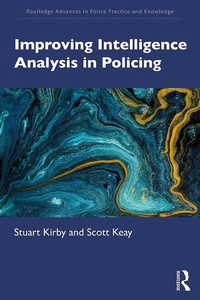
Improving Intelligence Analysis in Policing
1st Edition
Published on 8. June 2021
192 pages
978-1-000-39171-8 (ISBN)
Description

This book explains how improvements in intelligence analysis can bene!t policing. Written by experts with experience in police higher education and professional practice, this accessible text provides students with both practical knowledge and a critical understanding of the subject. The book is divided into three key parts:
Part One outlines how the concept of intelligence was initially embraced and implemented by the police and provides a critique of intelligence sources. It examines the strategic use of intelligence and its procedural framework. It provides a summary of the role of the intelligence analyst, establishing the characteristics of effective practitioners.
Part Two describes good practice and explains the practical tools and techniques that effective analysts use in the reduction and investigation of crime.
Part Three examines more recent developments in intelligence analysis and looks to the future. This includes the move to multi-agency working, the advent of big data and the role of AI and machine learning.
Filled with case studies and practical examples, this book is essential reading for all undergraduates and postgraduates taking courses in Professional Policing, and Criminal Justice more widely. It will also be of interest to existing practitioners in this field.
Part One outlines how the concept of intelligence was initially embraced and implemented by the police and provides a critique of intelligence sources. It examines the strategic use of intelligence and its procedural framework. It provides a summary of the role of the intelligence analyst, establishing the characteristics of effective practitioners.
Part Two describes good practice and explains the practical tools and techniques that effective analysts use in the reduction and investigation of crime.
Part Three examines more recent developments in intelligence analysis and looks to the future. This includes the move to multi-agency working, the advent of big data and the role of AI and machine learning.
Filled with case studies and practical examples, this book is essential reading for all undergraduates and postgraduates taking courses in Professional Policing, and Criminal Justice more widely. It will also be of interest to existing practitioners in this field.
Reviews / Votes
"I recommend wholeheartedly this book to anyone in law enforcement who is interested in the future of intelligence-led policing.... It presents a bold but realistic vision of the future of the analyst in modern law enforcement agencies."Shane Mac Giollabhui, University of Ulster, UK, Policing
More details
Series
Edition
1. Auflage
Language
English
Place of publication
London
United Kingdom
Publishing group
Taylor & Francis Ltd
Target group
Professional and scholarly
College/higher education
Product notice
Reflowable
Illustrations
6 Tables, black and white; 5 Line drawings, black and white; 5 Illustrations, black and white
ISBN-13
978-1-000-39171-8 (9781000391718)
Copyright in bibliographic data and cover images is held by Nielsen Book Services Limited or by the publishers or by their respective licensors: all rights reserved.
Schweitzer Classification
Other editions
Additional editions
Stuart Kirby | Scott Keay
Improving Intelligence Analysis in Policing
Book
06/2021
1st Edition
Routledge
€59.90
Shipment within 15-20 days
Stuart Kirby | Scott Keay
Improving Intelligence Analysis in Policing
Book
06/2021
1st Edition
Routledge
€206.00
Shipment within 15-20 days
Persons
Stuart Kirby previously served as a Lancashire Police Officer (UK). As a Detective Chief Superintendent (Specialist Crime and Operations Division), he had responsibility for Intelligence, Forensic, Major Crime, Organised Crime and Counter Terrorism. On retirement he started a second career in academia, becoming a Professor of Policing. As current Director of Crimeinsights Ltd. he acts as a policing consultant to national and international public sector agencies.
Scott Keay is a senior lecturer in Policing at Edge Hill University (UK). He worked for the Lancashire Constabulary for almost 20 years, in various analytical roles from criminal intelligence through to community safety and partnership intelligence. He is currently conducting a PhD, exploring how the police define, identify and respond to vulnerability.
Scott Keay is a senior lecturer in Policing at Edge Hill University (UK). He worked for the Lancashire Constabulary for almost 20 years, in various analytical roles from criminal intelligence through to community safety and partnership intelligence. He is currently conducting a PhD, exploring how the police define, identify and respond to vulnerability.
Content
1.Defining Intelligence Analysis and Understanding Its Role in Policing- Past, Present and Future 2.Understanding the Value and Danger of Intelligence Sources 3.Improving the Intelligence Process: A Managerial Perspective 4.Improving Intelligence Process: An Analyst Perspective 5.Intelligence Sources and Techniques for Crime Reduction 6.Intelligence Sources and Techniques for the Investigation of Crime 7.The Multi-Agency Partnership Environment 8.The Increasing Influence of Data in Intelligence Analysis 9.Improving Intelligence Analysis- Meeting Future Challenges
