

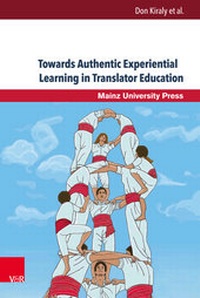
Towards Authentic Experiential Learning in Translator Education
Description

This volume deals with the theory and practice of incorporating authentic experiential work into curricula for the education of professional translators and interpreters. The contributions deal with a wide variety of topics in this domain, extending from the foundations of experiential learning in pedagogical epistemology to discussions of exemplary experiments with the use of authentic project work at leading translator and interpreter education institutions in Germany, Spain and Switzerland. Matters of educational philosophy, curriculum design as well as instructional design are dealt with, and the wide range of focal points and perspectives of the various authors provides a multi-facetted view of authentic project work that has so far been lacking in translation pedagogy literature.
More details
Other editions
Additional editions
Persons
Content
- Intro
- Title Page
- Copyright
- Table of Contents
- Body
- Acknowledgements
- Preface
- Raquel Pacheco Aguilar (University of Mainz/Germersheim): Chapter 1: The Question of Authenticity in Translator Education from the Perspective of Educational Philosophy
- Introduction
- Learning in Translator Education
- Authentic Translator Education
- The Ecology of Translator Education
- The Teleology of Translator Education
- A Matter of Qualification? Curriculum Development
- A Matter of Socialization? Transmitting Traditions
- A Matter of Cultivation? Authentic Translator Education
- Conclusion
- Works Cited
- Susanne Hagemann (University of Mainz/Germersheim): Chapter 2: (Non-)?Professional, Authentic Projects? Why Terminology Matters
- Works Cited
- Don Kiraly (University of Mainz/Germersheim): Chapter 3: Authentic Project Work and Pedagogical Epistemologies: A Question of Competing or Complementary Worldviews?
- 1. Empirico-Rationalism: A Cornerstone of Folk Pedagogy (which in turn is a cornerstone of contemporary translator education)
- 2. Social Constructivism: Beyond Instructionism and Radical Constructivism
- 3. From Teaching and Acquisition to an Emergent Learning Perspective in the Post-positivist Era
- Works Cited
- Don Kiraly and Sascha Hofmann (University of Mainz/Germersheim): Chapter 4: Towards a Postpositivist Curriculum Development Model for Translator Education
- 1. Introduction
- 2. Shifting attitudes towards workplace practice within translator education
- 3. Translator competence and competencies revisited
- 4. A Case for (Further) Pragmatic Abduction in the Study of Translator Competence
- 5. A fresh look at the Dreyfus model of skill acquisition
- The novice stage
- The competent stage
- The proficient stage
- The expert stage
- 6. Chesterman's Application of the Dreyfus Model
- 7. Towards the Dynamic Modelling of Translator Competence Development
- 8. Competence and the Work Placement
- Works Cited
- Don Kiraly, Lisa Rüth, Marcus Wiedmann (University of Mainz/Germersheim): Chapter 5: Enhancing Translation Course Design and Didactic Interventions with E-Learning
- 1. The genesis of a Moodle project in a Translation Studies degree programme
- 2. Three Moodle course facilitators with disparate educational backgrounds
- 3. The three project courses: from simple to complicated to complex
- 3.1 An introduction to CAT tools for translators (BA)
- 3.2 Moodle in a specialized translation practice class (advanced BA level)
- 3.3 An authentic translation project (advanced MA)
- Students' reflective comments: the Moodle blog in Don's authentic project course
- 4. Moodle: A Way Forward for Translator Education?
- Works Cited
- Maren Dingfelder Stone (University of Mainz/Germersheim): Chapter 6: Authenticity, Autonomy, and Automation: Training Conference Interpreters
- 1. Authenticity and Autonomy: Creating Pre-Professional Authentic Learning Experiences
- 1.1 The Friday Conference as a Lifelike Training Option: Premises
- 1.2 Learning Benefits: Autonomy and Authenticity
- 2. Automation and Autonomy: Creating Autonomous Learning Options for Self-Study
- 2.1. MOPSI as an Online Self-Study Tool: Premises
- 2.2 Learning Benefits: Autonomy and Automation
- 3. Final Thoughts
- Works Cited
- Andrea Cnyrim (Karlsruhe University of Applied Sciences): Chapter 7: Developing Intercultural Competence through Authentic Projects in the Classroom
- 1. The Concept of the Translator's Intercultural Competence
- 2. Which Approach to Intercultural Competence is Most Useful for Translators?
- 3. What Are the Specific Characteristics of the Translator's Intercultural Competence?
- 4. A Developmental Model of the Specific Intercultural Competence of Translators and Interpreters
- 5. Classroom Projects and the Development of Necessary Competences
- 5.1 Intercultural Teams
- 5.2 Culture and Expectations towards Children
- 5.3 Focused Research Methods for the Specific Needs of the Task
- 5.4 (Corporate) Social Responsibility
- 6. Conclusion
- Works Cited
- Catherine Way (University of Granada): Chapter 8: Intra-University Projects as a Solution to the Simulated/Authentic Dilemma
- 1. Introduction
- 2. Translator Competence
- 3. Designing an Intra-University Project: Translation and International Private Law
- 3.1 Putting the Pilot Project into Practice
- 3.2 Pilot Project Evaluation and Results
- 4. The Translation and Comparative Law Project
- 5. Conclusions
- Works Cited
- Carmen Canfora (University of Mainz/Germersheim): Chapter 9: Assessing Learning in Heterogeneous Learning Groups in Translator Training - A Role for Portfolios
- 1. Introduction
- 2. Implementation of the portfolio concept in translation didactics
- 3. Assessment of the portfolio concept
- 3.1 Analysis of learning curves
- 3.2 Questionnaire analysis
- 4. Discussion of findings
- Works Cited
- Gary Massey and Barbara Brändli (Zurich University of Applied Sciences/Winterthur): Chapter 10: Collaborative feedback flows and how we can learn from them: investigating a synergetic learning experience in translator education
- 1. Introduction
- 2. Background: the emergence of expertise in the situated event of translation
- 3. Study design
- 3.1. Context and infrastructure
- 3.2. Participants
- 3.3. Translation assignment and client
- 3.4. Structure and roles
- 3.5. Interactional spaces
- 3.6. Data collection for the research study
- 3.6.1. Peer and self-assessment questionnaires
- 3.6.2. Learning journals
- 3.6.3. Concluding plenary discussion and questionnaire
- 3.6.4. Client and teacher statements
- 4. Results
- 4.1. Client, teacher and student comments
- 4.2. Student peer assessment
- 4.3. Student self-assessment
- 4.4. Student learning journals
- 5. Discussion
- 6. Conclusion
- Works Cited
- Epilogue
- Contributors
