

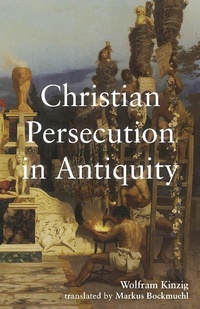
Christian Persecution in Antiquity
Description

For centuries into the Common Era, Christians faced social ostracism and suspicion from neighbors and authorities alike. At times, this antipathy erupted into violence. Following Christ was a risky allegiance: to be a Christian in the Roman Empire carried with it the implicit risk of being branded a traitor to cultural and imperial sensibilities. The prolonged experience of distrust, oppression, and outright persecution helped shape the ethos of the Christian faith and produced a wealth of literature commemorating those who gave their lives in witness to the gospel.
Wolfram Kinzig, in Christian Persecution in Antiquity, examines the motivations and legal mechanisms behind the various outbursts of violence against Christians, and chronologically tracks the course of Roman oppression of this new religion to the time of Constantine. Brief consideration is also given to persecutions of Christians outside the borders of the Roman Empire. Kinzig analyzes martyrdom accounts of the early church, cautiously drawing on these ancient voices alongside contemporary non-Christian evidence to reconstruct the church's experience as a minority sect. In doing so, Kinzig challenges recent reductionist attempts to dismantle the idea that Christians were ever serious targets of intentional violence. While martyrdom accounts and their glorification of self-sacrifice seem strange to modern eyes, they should still be given credence as historical artifacts indicative of actual events, despite them being embellished by sanctified memory.
Newly translated from the German original by Markus Bockmuehl and featuring an additional chapter and concise notes, Christian Persecution in Antiquity fills a gap in English scholarship on early Christianity and offers a helpful introduction to this era for nonspecialists. Kinzig makes clear the critical role played by the experience of persecution in the development of the church's identity and sense of belonging in the ancient world.
More details
Other editions
Additional editions
Persons
Content
Introduction: The Cruelty and Fascination of Ancient Persecutions of Christians1 The Marginalization of Christianity within Judaism2 Christianity's Offensiveness: Ideological Parameters of the Ancient Conflicts3 Legal Procedures and Punishments4 Persecutions in Rome under Nero and Domitian5 Christians as Victims of Local Police Actions (111-249)6 A Decade of Persecution: From Decius to Valerian (249-260)7 The Fiercest Attack on Ancient Christianity: The 'Great Persecution' under Diocletian and Its Aftermath8 Later Repressions of Christians in the Roman Empire9 Late Antique Persecutions outside the Roman Empire10 The Dispute about Repentance after ApostasyConcluding Observations
