

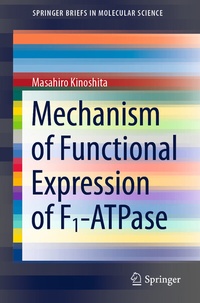
Mechanism of Functional Expression of F1-ATPase
Description

This book presents a new view of the mechanism of functional expression of ATP-driven motors (proteins or protein complexes). It is substantially different from the prevailing idea that the motor converts chemical energy to mechanical work. To facilitate understanding, the differences between the new and prevailing views are explained using many illustrations. The book is of interest to those who are not convinced of the notion of chemo-mechanical coupling. The claims presented are the following: The system, which comprises not only the motor but also water, does no mechanical work during the ATP hydrolysis cycle; a protein is moved or a protein in the complex is rotated by the entropic force generated by water. The highlight of the explanation in the book is that the mechanism of unidirectional rotation of the central shaft in F 1 -ATPase is discussed in detail on the basis of this new view. The hydration entropy of each ß subunit to which a specific chemical compound (ATP, ADP and Pi, Pi, or nothing) is bound, the hydration entropy of the a 3 ß 3 complex, and the dependence of the hydration entropy of F 1 -ATPase on the orientation of the ? subunit play essential roles.
More details
Other editions
Additional editions

Person
Masahiro Kinoshita received his Doctor of Engineering degree from Kyoto University in 1984. His research interests include statistical-mechanical theories of fluids (integral equation theories), hydrophobic hydration, unified elucidation of a variety of biological self-assembly processes, protein folding and unfolding, molecular recognition, mechanism of functional expression of ATP-driven motors, and thermostabilization of membrane proteins. He is currently a professor emeritus at Kyoto University and an invited researcher at Chiba University.
He has published 211 articles in internationally renowned journals such as Nature Chemical Biology, Journal of the American Chemical Society, and Physical Review Letters, to mention just a few. In addition, he has authored or made valuable contributions to several books in his field.
