

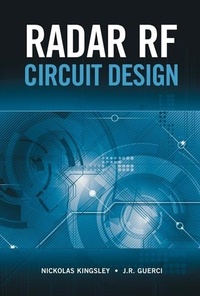
Radar RF Circuit Design
1st Edition
Published on 31. March 2016
316 pages
978-1-60807-971-1 (ISBN)
Description

This authoritative new resource presents practical techniques for optimizing RF and microwave circuits for applications in radar systems design with an emphasis on current and emerging technologies. Professionals learn how to design RF components for radar systems and how to choose appropriate materials and packaging methods. This book explains how to integrate components while avoiding higher-level assembly issues and troubleshooting problems on the measurement bench. Theory and practical information are provided while addressing topics ranging from heat removal to digital circuit integration. This book is divided into three sections: the first section introduces the basics of microwave design, including transmission line theory and common materials used in RF circuits. The methods for creating accurate device models for both passive and active circuits are presented. The second part details the design of power amplifiers, low noise amplifiers, and passive elements. Both conventional and state-of-the-art design techniques are included with ample 'tips and tricks.' The last section concludes with a focus on component integration providing details on design methods for military operations, high manufacturing yield, and preventing measurement issues.
More details
Other editions
Additional editions
Nickolas Kingsley | Joseph Guerci
Radar RF Circuit Design
Book
02/2016
Artech House Publishers
Unfortunately, price unknown
Available (delivery time upon request)
Content
- Radar RF Circuit Design
- Contents
- Acknowledgments
- Part I Microwave Background
- 1 Crossing the Chasm from System to Component Level
- 1.1 Basic Radar Systems Overview
- 1.1.1 Radar Transmitters
- 1.1.2 Radar Receivers
- 1.1.3 Fundamental Equations
- 1.1.4 Requirements on Components
- 1.2 Introduction to Microwave Components
- 1.2.1 Fundamental Equations
- 1.2.2 Essential Components
- 1.3 Traveling Wave Tubes Versus Solid State
- 1.4 "How" Components are Connected Matters
- Exercises
- References
- Selected Bibliography
- 2 Introduction to Microwave Design
- 2.1 Scattering Matrix
- 2.2 Matching Networks
- 2.2.1 Quantifying Mismatch
- 2.2.2 Graphically Based Circuits
- 2.2.3 Distributed Matching Networks
- 2.3 Methods of Propagation
- 2.3.1 Wave Modes
- 2.3.2 Coaxial Cables (Coax)
- 2.3.3 Microstrip
- 2.3.4 Stripline
- 2.3.5 Coplanar Waveguide (CPW)
- 2.3.6 Waveguide
- 2.3.7 Discontinuities
- 2.4 Material Selection
- 2.4.1 Semiconductors
- 2.4.2 Metals
- 2.4.3 Ceramics
- 2.4.4 Polymers
- 2.4.5 New and Emerging Technologies
- Exercises
- References
- Selected Bibliography
- 3 Component Modeling
- 3.1 Passive Modeling
- 3.1.1 Capacitor
- 3.1.2 Inductor
- 3.1.3 Resistor
- 3.1.4 Resonators
- 3.2 Footprint Modeling
- 3.3 Transistor Modeling
- 3.3.1 Semiconductor Background
- 3.3.2 Basic Transistor Theory Review
- 3.3.3 Transistor Imperfections
- 3.4 Custom Models
- 3.5 Measurement Techniques
- Exercises
- References
- Selected Biblography
- Part II Component Design
- 4 Power Amplifier
- 4.1 Amplifier Basics
- 4.1.1 Class A
- 4.1.2 Class B
- 4.1.3 Class AB
- 4.1.4 Class C
- 4.1.5 Harmonically Matched Classes
- 4.1.6 Do Classes Really Matter?
- 4.2 Design Strategies and Practices
- 4.2.1 Stability
- 4.2.2 Power and Gain
- 4.2.3 Efficiency
- 4.2.4 Gain Flattening
- 4.2.5 VSWR
- 4.2.6 Conjugate Matching
- 4.2.7 DC Bias Filtering
- 4.2.8 Multistage Amplifiers
- 4.3 Broadband Amplifiers
- 4.3.1 Multisection Matching
- 4.3.2 Balanced Amplifier
- 4.3.3 Push-Pull Amplifier
- 4.3.4 Distributed Amplifiers
- 4.4 Balancing Linearity and Efficiency
- 4.4.1 Explanation of Linearity
- 4.4.2 Doherty
- 4.4.3 Other Linearization Techniques
- 4.5 Multiphysics Concerns
- 4.5.1 Thermal Considerations
- 4.5.2 Mechanical Considerations
- 4.6 LOs
- 4.7 Tubes, Solid-State, and Where They Overlap
- Exercises
- References
- Selected Bibliography
- 5 LNAs
- 5.1 Explanation of Noise
- 5.1.1 Thermal Noise
- 5.1.2 Shot Noise
- 5.1.3 Flicker Noise
- 5.1.4 Noise Terminology
- 5.2 Transistor Noise Modeling
- 5.3 Design Strategies and Practices
- 5.3.1 Understanding Noise Circles
- 5.3.2 LNA Design
- 5.3.3 Self-Bias Scheme
- 5.3.4 Gain Equalizers
- 5.3.5 Resistor Component Selection
- 5.4 High Dynamic Range
- 5.5 Cryogenic Operation
- 5.6 Limiter Elimination
- Exercises
- References
- Selected Bibiligraphy
- 6 Passive Circuitry
- 6.1 Limiting Factors and Ways to Mitigate
- 6.1.1 Lumped Elements
- 6.1.2 Bode-Fano Limit
- 6.1.3 Discontinuities
- 6.2 Couplers
- 6.3 Isolators and Circulators
- 6.4 Switches
- 6.5 Phase Shifters
- 6.6 Attenuators
- 6.7 Filters/Diplexers
- 6.8 Splitters/Combiners
- 6.9 Baluns
- 6.10 Mixers
- 6.11 Antennas
- 6.12 Current Density Analysis
- Exercises
- References
- Selected Bibliography
- Part III Higher-Level Integration
- 7 Microwave Integrated Circuits
- 7.1 Component Integration
- 7.1.1 MMIC
- 7.1.2 Hybrid
- 7.1.3 Multichip Modules (MCMs)
- 7.1.4 Packaging Options
- 7.2 Packaging Model
- 7.3 Designing for U.S. Military Standards
- 7.3.1 Robustness
- 7.3.2 Operating Stability
- 7.3.3 Environmental Considerations
- 7.3.4 Electrical Considerations
- 7.3.5 Mechanical Considerations
- 7.4 Designing for Pulsed Radar
- 7.4.1 Radar Terminology
- 7.4.2 Component Design
- 7.5 Taking Advantage of Simulators
- 7.5.1 Passives
- 7.5.2 Actives
- 7.5.3 Full-Electromagnetic (EM) Simulation
- 7.5.4 Manufacturing Assessment
- 7.6 Manufacturing Practices
- 7.6.1 Manufacturing Essentials
- 7.6.2 Engineering Practices for High Yield
- 7.6.3 Designing for MMIC-Level Cost Reduction
- 7.6.4 Designing for Module-Level Cost Reduction
- Exercises
- References
- 8 Transmit/Receive Module Integration
- 8.1 Integration Techniques
- 8.1.1 Physical Transitions
- 8.1.2 Wire and Ribbon Bonding
- 8.1.3 Proper Grounding
- 8.1.4 Achieving Compact Size
- 8.1.5 Component Placement
- 8.2 Preventing Oscillation
- 8.2.1 Even-Mode Oscillation
- 8.2.2 Odd-Mode Oscillation
- 8.2.3 Spurious Oscillation
- 8.2.4 Ground Loops
- 8.3 Preventing Crosstalk and Leakage
- 8.3.1 Electric Coupling
- 8.3.2 Magnetic Coupling
- 8.3.3 Shielding
- 8.4 Thermal Considerations
- 8.5 Mechanical Considerations
- 8.6 Module Simulation and Monte Carlo Analysis
- 8.7 Incorporating Digital into an RF Module
- 8.7.1 Common Digital Uses
- 8.7.2 Current Digital Infrastructure
- 8.7.3 Digital Radiation
- 8.7.4 Avoiding Mixed-Signal Issues
- Exercises
- References
- Selected Bibligraphy
- 9 On the Measurement Bench
- 9.1 Measurement Uncertainty
- 9.2 Test Fixture Design
- 9.2.1 De-Embedding Fixture Effects
- 9.2.2 Connectors, Adapters, and Cables
- 9.3 Tips for Making it All Work
- 9.3.1 Unstable Active Circuits
- 9.3.2 Incorrect Frequency Response
- 9.3.3 Radiation or Coupling
- 9.3.4 Low Gain or Output Power
- 9.3.5 High Loss
- 9.3.6 Catastrophic Damage at Initial Test
- 9.4 Transistor Stabilization
- Exercises
- References
- Selected Bibliography
- 10 Final Thoughts
- Appendix A
- A.1 Frequency Bands
- A.2 English-to-Metric Units Conversion
- A.3 Temperature Conversion
- A.4 Constants and Material Properties
- A.5 Math Functions
- About the Authors
- Index
