

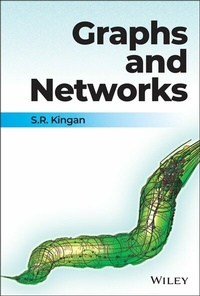
Graphs and Networks
Description

A unique blend of graph theory and network science for mathematicians and data science professionals alike.
Featuring topics such as minors, connectomes, trees, distance, spectral graph theory, similarity, centrality, small-world networks, scale-free networks, graph algorithms, Eulerian circuits, Hamiltonian cycles, coloring, higher connectivity, planar graphs, flows, matchings, and coverings, Graphs and Networks contains modern applications for graph theorists and a host of useful theorems for network scientists.
The book begins with applications to biology and the social and political sciences and gradually takes a more theoretical direction toward graph structure theory and combinatorial optimization. A background in linear algebra, probability, and statistics provides the proper frame of reference.
Graphs and Networks also features:
- Applications to neuroscience, climate science, and the social and political sciences
- A research outlook integrated directly into the narrative with ideas for students interested in pursuing research projects at all levels
- A large selection of primary and secondary sources for further reading
- Historical notes that hint at the passion and excitement behind the discoveries
- Practice problems that reinforce the concepts and encourage further investigation and independent work
More details
Other editions
Additional editions
Person
S. R. Kingan is an Associate Professor of Mathematics at Brooklyn College and the Graduate Center of The City University of New York. Dr. Kingan's research interests include graph theory, matroid theory, combinatorial algorithms, and their applications.
Content
List of Figures iv
Preface viii
Chapter 1. From Königsberg to Connectomes 1
1.1. Introduction 1
1.2. Isomorphism 18
1.3. Minors and Constructions 25
Chapter 2. Fundamental Topics 39
2.1. Trees 39
2.2. Distance 44
2.3. Degree Sequences 52
2.4. Matrices 56
Chapter 3. Similarity and Centrality 70
3.1. Similarity Measures 70
3.2. Centrality Measures 74
3.3. Eigenvector and Katz Centrality 78
3.4. PageRank 84
Chapter 4. Types of Networks 91
4.1. Small-World Networks 91
4.2. Scale-Free Networks 95
4.3. Assortative Mixing 97
4.4. Covert Networks 102
Chapter 5. Graph Algorithms 107
5.1. Traversal Algorithms 107
5.2. Greedy Algorithms 113
5.3. Shortest Path Algorithms 118
Chapter 6. Structure, Coloring, Higher Connectivity 126
6.1. Eulerian Circuits 126
6.2. Hamiltonian Cycles 131
6.3. Coloring 136
6.4. Higher Connectivity 142
6.5. Menger's Theorem 148
Chapter 7. Planar Graphs 159
7.1. Properties of Planar Graphs 159
7.2. Euclid's Theorem on Regular Polyhedra 167
7.3. The Five Color Theorem 172
7.4. Invariants for Non-Planar Graphs 174
Chapter 8. Flows and Matchings 182
8.1. Flows in Networks 182
8.2. Stable Sets, Matchings, Coverings 188
8.3. Min-Max Theorems 192
8.4. Maximum Matching Algorithm 196
Appendix A. Linear Algebra 211
Appendix B. Probability and Statistics 215
Appendix C. Complexity of Algorithms 218
Appendix D. Stacks and Queues 222
Appendix. Bibliography 226
