

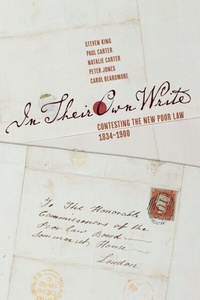
In Their Own Write
Contesting the New Poor Law, 1834-1900
1st Edition
Published on 15. December 2022
472 pages
978-0-2280-1536-9 (ISBN)
Description

Few subjects in European welfare history attract as much attention as the nineteenth-century English and Welsh New Poor Law. Its founding statute was considered the single most important piece of social legislation ever enacted, and at the same time, the coming of its institutions - from penny-pinching Boards of Guardians to the dreaded workhouse - has generally been viewed as a catastrophe for ordinary working people.
Until now it has been impossible to know how the poor themselves felt about the New Poor Law and its measures, how they negotiated its terms, and how their interactions with the local and national state shifted and changed across the nineteenth century. In Their Own Write exposes this hidden history. Based on an unparalleled collection of first-hand testimony - pauper letters and witness statements interwoven with letters to newspapers and correspondence from poor law officials and advocates - the book reveals lives marked by hardship, deprivation, bureaucratic intransigence, parsimonious officialdom, and sometimes institutional cruelty, while also challenging the dominant view that the poor were powerless and lacked agency in these interactions. The testimonies collected in these pages clearly demonstrate that both the poor and their advocates were adept at navigating the new bureaucracy, holding local and national officials to account, and influencing the outcomes of relief negotiations for themselves and their communities.
Fascinating and compelling, the stories presented in In Their Own Write amount to nothing less than a new history of welfare from below.
Until now it has been impossible to know how the poor themselves felt about the New Poor Law and its measures, how they negotiated its terms, and how their interactions with the local and national state shifted and changed across the nineteenth century. In Their Own Write exposes this hidden history. Based on an unparalleled collection of first-hand testimony - pauper letters and witness statements interwoven with letters to newspapers and correspondence from poor law officials and advocates - the book reveals lives marked by hardship, deprivation, bureaucratic intransigence, parsimonious officialdom, and sometimes institutional cruelty, while also challenging the dominant view that the poor were powerless and lacked agency in these interactions. The testimonies collected in these pages clearly demonstrate that both the poor and their advocates were adept at navigating the new bureaucracy, holding local and national officials to account, and influencing the outcomes of relief negotiations for themselves and their communities.
Fascinating and compelling, the stories presented in In Their Own Write amount to nothing less than a new history of welfare from below.
More details
Series
Language
English
Place of publication
Montreal
Canada
Target group
Professional and scholarly
Illustrations
16 photos, 4 maps
File size
5,17 MB
ISBN-13
978-0-2280-1536-9 (9780228015369)
Copyright in bibliographic data and cover images is held by Nielsen Book Services Limited or by the publishers or by their respective licensors: all rights reserved.
Schweitzer Classification
Other editions
Additional editions
Book
12/2022
McGill-Queen's University Press
€172.33
Shipment within 15-20 days
Book
12/2022
McGill-Queen's University Press
€45.00
Shipment within 15-20 days
Persons
Steven King is professor of economic and social history at Nottingham Trent University and the author of Writing the Lives of the English Poor, 1750s-1830s.
Paul Carter is principal records specialist (Modern Domestic), Collaborative Projects at The National Archives.
Natalie Carter is a visiting fellow at Nottingham Trent University.
Peter Jones is senior research associate at the University of Glasgow.
Carol Beardmore is lecturer in history at the Open University.
Paul Carter is principal records specialist (Modern Domestic), Collaborative Projects at The National Archives.
Natalie Carter is a visiting fellow at Nottingham Trent University.
Peter Jones is senior research associate at the University of Glasgow.
Carol Beardmore is lecturer in history at the Open University.
Content
- Cover
- In Their Own Write
- Title
- Copyright
- Contents
- Tables and Figures
- Preface
- Acknowledgements
- Conventions
- 1 Thinking about the New Poor Law
- PART ONE Finding and Hearing "Voices"
- 2 Navigating and Measuring
- 3 Advocating for the Poor
- 4 Responding to Paupers and Advocates: The Central Authority
- PART TWO Pauper Agency
- 5 Rhetoric and Strategy: A Corpus View
- 6 Knowing the Poor "Law"
- 7 The Female Voice
- 8 Becoming Old
- 9 The Able-Bodied Poor
- PART THREE Contestation
- 10 Punishing the Pauper Complainant
- 11 Limits to Agency? The Sick Poor
- 12 Experiencing the Poor Law
- Appendix: Sampling
- Notes
- Bibliography
- Index
