

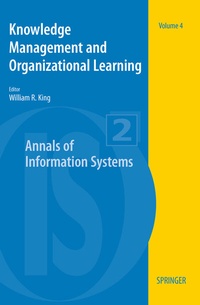
Knowledge Management and Organizational Learning
Description

Knowledge management (KM) is a set of relatively-new organizational activities that are aimed at improving knowledge, knowledge-related practices, organizational behaviors and decisions and organizational performance. KM focuses on knowledge processes-knowledge creation, acquisition, refinement, storage, transfer, sharing and utilization. These processes support organizational processes involving innovation, individual learning, collective learning and collaborative decision-making. The "intermediate outcomes" of KM are improved organizational behaviors, decisions, products, services, processes and relationships that enable the organization to improve its overall performance.
Knowledge Management and Organizational Learning presents some 20 papers organized into five sections covering basic concepts of knowledge management; knowledge management issues; knowledge management applications; measurement and evaluation of knowledge management and organizational learning; and organizational learning.
More details
Other editions
Additional editions
Person
Volume editor William R. King is the University Professor of Business Administration at the Joseph M. Katz Graduate School of Business and College of Business Administration, University of Pittsburgh. He was the founding president of the Association for Information Systems (AIS) and a past president of The Institute of Management Sciences (TIMS) (1989-90), an international professional society with 8,000 members, which he guided to merge with the Operations Research Society of America to form INFORMS. He has twice served as chair of ICIS-the annual International Conference on Information Systems (1988; 2005), has served as editor-in-chief of the Management Information Systems Quarterly, the primary journal in the field of information systems, and was the key figure in the founding of a new journal, Information Systems Research.
